Wednesday, November 16, 2005

Unreal America


Jimmy Carter hammered the Bush administration in an Op-ed piece picked up by the “Los Angeles Times.”

It was entitled, “This isn’t the real America” and, once again, we undertake one of our favorite practices here at highwayscribery: Mixing the words of an eminence gris (without their knowledge) with those of that rascally, unsavory, and poorly bred highway scribe.

If you think there's nuthin' to it, do a Google search with the names highway scribe and Jimmy Carter to see what happens. the scribe dares ya.

Here's the piece:

http://www.latimes.com/news/printedition/opinion/la-oe-carter14nov14,0,4858178,print.story

Further evidence the shield of (r)epublican dominance is cracking, Carter’s pile-on piece is, to his credit, a statement of ideas he has held forth on throughout the Bush years. Thoughts that garnered him a Nobel Peace Prize, thoughts he articulated before a national audience at the Democratic National Convention in 2004.

The difference is that now, finally, people are more willing to listen.

The former President, someone the scribe refers to “as the best mistake this country ever made” dressed the administration down from its spats to its top hat.

He opened with a direct hit using a sharp point: “In recent years, I have become increasingly concerned by a host of radical government policies that now threaten many basic principles espoused by all previous administrations, Democratic and [r]epublican.”

Which principles are those? You know the laundry list, but it’s fun to hear it shouted out into the bright light of day.

“[E]ndangered are our commitments to providing citizens with truthful information, treating dissenting voices and beliefs with respect, state and local autonomy and fiscal responsibility.”

(the scribe excerpting those passages that affect his life directly)

“Instead of cherishing our role as the great champion of human rights, we now find civil liberties and personal privacy grossly violated under some extreme provisions of the Patriot Act,” Carter wrote.

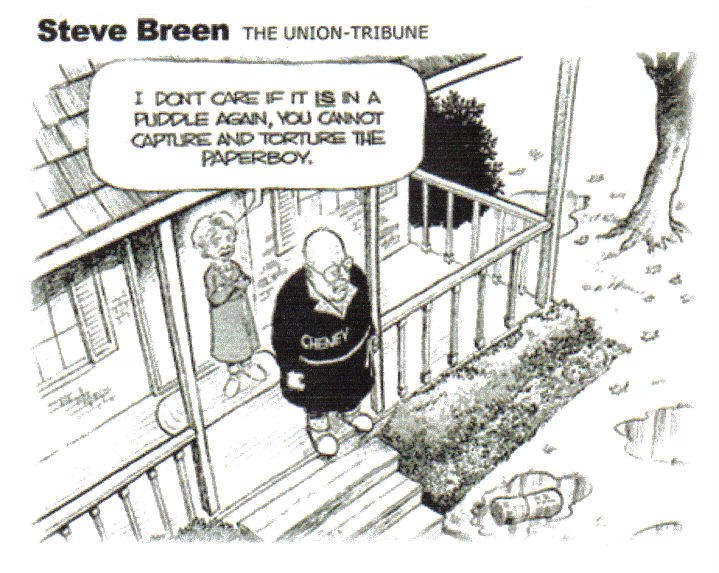
And who can forget the administration’s embrace of torture?

Not Jimmy Carter: “It is embarrassing to see the president and vice president insisting that the CIA should be free to perpetrate ‘cruel, inhumane or degrading treatment or punishment’ on the people in U.S. custody.”

The administration’s policies, he said, have left the U.S. as “a prime culprit in global nuclear proliferation.”

For those who insist that Democrats only criticize and lack their own vision, President Carter doesn’t strike with lightening, but humbles us with homily and basic requirements:

“As the world’s only superpower, America should be seen as the unswerving champion of peace, freedom and human rights. Our country should be the focal point around which other nations can gather to combat threats to international security and to enhance the quality of our common environment. We should be in the forefront of providing human assistance to the people in need.”

Now the scribe asks, What’s wrong with that for a platform and direction?

****

highwayscribery has been remiss in updating the situation of animal rights activist Nicole Fink, who has been in jail for 79 days, not for any crime she committed, but for refusing to testify before a federal grand jury about someone else’s crimes. U.S. District Court Judge Irma Gonzalez gave up for the third time, convinced holding the Compassion for Farm Animals activist was not going get a testimony from her. The judge had already released two young people being held under the same pretense (“As Much as You Can Stomach, redux” Oct 7).


*******

And don't forget. the scribe will read from "Vedette" http://www.angelfire.com/wa2/margin/nonficSellmanVedette.html with a lot of help from ultra-flash guitar wiz, Omar Torrez www.omartorrez.com/ at 33 1/3 Books and Gallery Collective, 1200 N. Alvarado St. (at Sunset), 8 p.m., Dec. 15.

Monday, November 14, 2005

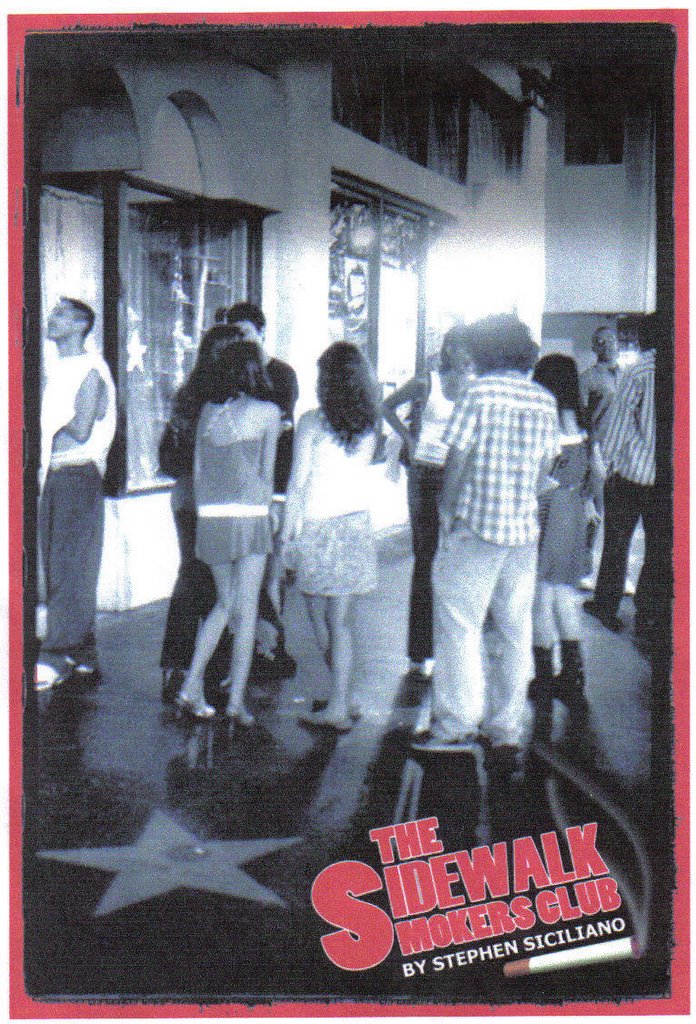
The Sidewalk Smokers Club - Chapters 51, 52, and 53


Chapter Fifty-one

Jordan had pulled out of the telephony system to get below the radar, skip out of the matrix, ditch the man, as it were. So Joya came by to roust him up. “Hon, Yvonne’s gettin’ cold feet and there’s gonna be a meeting about the next step for us!” She seemed quite exercised about the whole thing. Joya’s treatment at the hands of the BID was very unkind and she was not used to it, because she had never truly been pushed outside of things before.

Jordan had the problems of a suspected murderer to deal with and would rather have stayed in and avoided any more trouble. But this was Joya and she had been there for him and so he committed. “The Argentine place – 10 p.m.”

Rolling out at the appointed hour, Jordan noticed an obvious-looking man in suit and tie reading a paper behind the steering wheel of a car, which was parked across the street from his place. He tailed J. for a while before disappearing almost imperceptibly.

At the restaurant there was not a seat to be had. It was hard to breath with all the smoking. The waiters ran about emptying ashtrays and there was a grainy film to the air.

The Argentine, of course, was in deep. He’d been fined by now; the price of his own notoriety. Letting people smoke had been part of a different business model, the kind that was slowly cultivated and easily managed. But with his place becoming an unofficial sanctuary for the persecuted tobacco inhalant, he too was into something he could not get out of. Things had gone beyond his control. Strange and new customers stepped in and fired up without so much as a nod to the house rules. They sneered at his accent.

But business was booming. What would come would come, for the small entrepreneur cannot permit the luxury of long-term planning. The seats were full and that was his particular mission in life.

The all-stars occupied their assumed and official table. The people around them were proper enough not to stare, but noted how only the core group had been convened. No city attorney or Vindaloo Baxley or Hat Midone. No Trixie Marie, whom we know only through her work (and would never have been there).

It is hoped the fever-pitch at which each of The Smokers’ lives was being experienced at this point is clear. If not, please take our expository word for it: They’re a light-hearted bunch, but things were sure getting heavy.

“Things are sure getting heavy,” Yvonne kvetched. As the focal point of the campaign, she lived in a kind of perpetual embarrassment over her naked layout, which sold and sold, engendering further debate and more sales after that. She was on the front line and had already made her discontent known.

“They sure are, hon,” said Joya, who was profiting in measures equal to the Argentine restaurant owner, so that her plaintive utterance was more surprising, less expected than Yvonne’s.

“Yeah,” said Jordan, “I mean, I think somebody is following me.”

They stared at him (save for Joya), rightly mystified because Jordan was mixing up problems of his own making with those of The Smokers who were, as yet, unworthy of surveillance (or at least they thought).

“I kinda wish I’d never met alla you,” Joya said to crushing effect on her smoke-mates. Of course she didn’t really mean it that way. Yes, her business relationships were disintegrating like an acid tab on a hippy’s tongue, but the business itself was hale and hardy and they thought she didn’t have grounds to say something so deflating. Randall, always two or more steps ahead of everyone else, knew that she felt personally responsible for The Club’s plight merely because she’d served as a kind of sexual glue in the early formative period, which wasn’t very long ago, but certainly seemed so. “Why dare are peeple following you?” Clarisse returned to Jordan.

“I think we should try to answer Yvonne’s concerns,” was the best he could do to switch the focus of things.

“Yeah,” Corey unwittingly assisted, “Yvonne’s the one who’s taking the brunt of this thing.” And he was genuine in this observation because he was having, perhaps, the best run of anyone and knew it. And because he had the hots for Yvonne he was rather attuned to her diminishing capacity for absorbing whatever vitamins Klieg lights emit.

“Why Yvonne?” asked Clarisse. “Who ees followeeng hare?” which was a good question to which Yvonne, had she less seasoning, could have answered “Everyone.”

Randall saw where all of this was going and decided to redirect. “It doesn’t matter,” he told Clarisse, before puffing long and blowing byproduct around the table as he stopped to look each of his compatriots in the eye.

“An you don’ looks so good,” Clarisse responded, echoing the sentiments of everyone present.

Randall sighed because he knew it was true, and because democracy is both slow and messy. “Well yeah, you know we’re using sickness as a strategy here. Once I’m down, they’re going to lift me up.”

That people were willing to listen and be lead around by a guy who cooked up such schemes should not come as surprise to anyone actually seeking direction and purpose in life. Inspiration is harder and harder to find in a world where purchase is the final fruit of any labor.

“Though you did not know it,” Randall continued, “you all wanted this, except maybe Yvonne. Clarisse is making money like she never dreamed. Corey and I are creating an audience and platform for bum philosophy. Yvonne – whatever her difficulties – is giving as good as she got. Joya is Joya to a whole city of people once unaware of her existence and Jordan…”

Well Jordan, occupied with serious matters only one of them could fathom, had been identified with, but was not of, the group for some time. He was not a part of these ongoing campaigns and media blasts, that was certain, but he was most definitely a militant (S)idewalk (S)moker. Whatever he lacked in organization discipline he gave back in street-(smoking) -cred.

Randall didn’t get into all of that. Rather he interrupted himself in order to get to the point because, in reality, he felt as bad as he looked. “Anyway, you’re surprised there are difficulties and complications that come along with the perks of notoriety. So am I man. And although I’m not sure we aren’t already too far along the path we’ve taken to turn back, far be it from me to tell you we can’t fold up the tent and go back to the quiet lives we were once living.”

“Extremely quiet,” they thought in concert, alternating between nostalgia and nausea at their prior, anonymous existences. A verbose group, nobody said a word and Randall took their silence as a decision to forge ahead…for a while.

“If not,” he went on, “there’s work to be done on a number of fronts. Yvonne has
additional legal concerns to be addressed. Her infamy isn’t going to help her one wit, just the opposite. The powers-that-be want to skewer her.”

“Well we haf dat lawyer,” Clarisse pointed out.

“Not any more,” Randall clarified to a silence that said The Smokers understood just how unsavory association with them had become. “You know, we’re winning the public relations battle and we’re losing it at the same time.”

“How’s ’at possible hon?”

“There are a lot of people watching man.”

This made them glad and Randall observed small, self-satisfied smiles break across everyone’s face except Yvonne’s.

“So we need more money,” Corey tried to invite some conciseness into the roundtable, but really, everyone already knew that. “We need a better legal team and we need some other kind of strategy that’s proactive and keeps our enemies on the defensive.”

This reintroduced some glumness to the table because, again, everyone was kind of exhausted by the length of the saga. Randall moved to pep folks up, but Joya beat him to the punch.

“Well, maybe who we’re becoming will bring someone else to us that ken help?” she asked/asserted in that inimitable Smokers’ style. Of course, we know what she’s up to, but the rest of them don’t, so they all just shrugged and hoped she was right.

Chapter Fifty-two

So, with little more than the last part of Chapter Fifty-one for guidance, each of The Sidewalk Smokers went back to their respective corners to see what it was they could do for themselves and for one another; living proof the universal finds itself in the particular and the other way around, too.

Driving home from the meeting, Jordan saw a man in a suit and tie tailing him. There could be no doubt that he was, in a subtle way, very much in jail. When he parked and headed down the walkway to his place, the fellow drove off, smiling. It gave him the chills. (“Fold up the tent and go back to the quiet lives we were once leading.”)

Acting upon the bum philosophy strategy for proactive, offensive action, J. walked into his place and picked up the phone to call Eilin. He made up his own tenet: “The worse she can do is say ‘no’.”

She picked up and spoke. It surprised Jordan who’d expected a voice mail. What she said does not matter. Only that her voice grew out of a safe and sweeter world than his and that he wanted that world. So, on second thought, what she said did matter, or at least how it was said.

He found her willing and open. His plan for a date was revenue neutral and still she signed on. A walk along the beach. That’s all he had for her and the response suggested it was more than she might have hoped for. So there it was. Things had been dark, but he’d let a little light back in and now they were only gray.

Soon thereafter, he got a call from the prosecutor handling his criminal charges against Armenian Power. She said there had been a postponement in the case, at the defendant’s request.

“Being the defendant sounds great,” he said wryly.

“For now,” she assured him.

There had been earlier postponements and the delay was killing Jordan. She’d advised him he should not file a civil suit for damages ($) until he had a guilty verdict in the criminal proceeding. And that was too bad, because litigation seemed the only path still available to fiduciary salvation.

Across town (and a few days later) Randall was ruminating on this very thing. It seemed to him that The Sidewalk Smokers Club’s rigorous use of the legal system offered proof the courts were the only way left for redistributing wealth, progressive taxation being discredited as it was.

For his part, Randall felt distracted from the development of bum philosophy. “It keeps going on and on,” Corey had complained, but the truth was that Randall could not get into a good groove of late. There were phone calls to be returned cluttering his schedule. Hat Midone showed up one night with a pair of easy marks and Randall had been too weak to resist. This, he felt, was a sure sign of his success; he knew that one’s productivity usually went up when fortune receded, because there was nothing else to do but work. Those who attain this understanding are artists. Those who don’t, aren’t.

The news he would soon get from Joya’s corner would not cheer the heart. A friendlier member of the BID informed her that the executive board had taken things a step further in addressing the problem of sidewalk smokers along their retail strip. Convinced by Thorpe and Diaz that using private security would be more expensive and legally treacherous they decided to let local law enforcement handle the matter so that the general public picked up the tab.

The Chief was thrilled with the inspectors’ performance. He had been worried they might birth a disaster and not believed them quite so capable of dumping the problem back into the police department’s lap.

Elephantine, the force found a malleable suburban city councilman, cornered by his own claims of being a “law and order” candidate, to carry their ordinance for a blanket prohibition on sidewalk smoking. Without it they could do nothing, with it, the sky was the limit.

And so the stakes had been raised.

The Smokers had been deemed (gulp!) subversive. The only answer to this, in a free society, is to eliminate the cancer at its source by suffocating all freedom. The move was tantamount to making illegal The Sidewalk Smokers themselves.

Wow.

For the moment, the enemy was way ahead of The Club.

Chapter Fifty-three

Jordan saw a slice of blue in the blinds to the window over his bed. It was a sure sign that he was late for work. He slid some music in. The little machine on the floor began to put out a song he normally used to motivate himself for the onslaught of life at Java World, but failed to budge him. He could no longer tell if he was scared. The time of fluctuations was over. He permanently did not feel good and this made him reticent to move around. Jordan didn’t want to work at Java World. His recurring visions of the Armenian girl made him loathe to announce that he labored in the coffee service industry, for he suspected she would probably drop him like nobody’s business. The philosophy of romance holds that chemistry can indeed prevail; that when there is love, it doesn’t matter what you do for a living. But Jordan wasn’t buying. He was selling. Out. “Every man has his price, but the moral man keeps his affordable,” Randall had told him once. Jordan’s price was a calm, nice, anonymous life with a woman who had question marks over her eyes. That was good enough.So he turned over and went to sleep for another five minutes, which of course did not suffice, so he took a few more. The phone rang. He answered to the soothing sounds of his boss yelling a small employer’s mantra of threats, woes, and pleas. He knew the drill. He apologized, hung up, and pulled himself out of Terra Jordania and back into the world.

He chose not to look at the ocean. In it he would see Eilin and he didn’t want her around yet. The golden light of the little coffee bar burned warm. A sporty car was parked out front idling. As Jordan approached the door, the pretty blonde from the fitness club came out, both hands occupied with white clumps of packaging.

“Hey,” she said, “I missed you this morning!”

He found her lightheartedness enviable enough to kill him. “Sorry,” was all J. could muster. She smiled a little and waved goodbye. He reached for the door. “Hey,” her voice carried from a little farther away now. He turned. She got back out of her car and took a few steps closer. “Can I ask you a question?”

“Question?” Jordan widged. “Question? I’m great at answering questions. Go ahead.”
She sensed his edge, but with an angel’s mission pushed gently on. “What the hell are you doing working in this place?”

He sat there for a long time.

“I thought you were good at answering questions,” she prodded.

“I am.”

“Well what do you say?”

“Thank you.”

She nodded as if to signal he’d gotten it right, mounted her horsepower, and rode off into the blue morning gloom. The door to the barn screamed in its joints as he pulled it open. “Jesus!” he winced.

“Jesus,” the Boss mocked him. “Maybe if you oiled it once in a while…”

The place was empty and something of a tense standoff was going on between Carlos and The Big Man.

“I will ask you again: Did you close the register last Sunday?”

“I weel tell you agang, yes I close it.”

“What were the total receipts?” the Boss continued his persecution.

“I don know. Jou tink I remember tha? Maybe seben hundre, like every Sunday.”

“It was three-fifty Carlos, that is what you reported. There’s no way this place only made three hundred and fifty dollars on a Sunday.”

Jordan could see Carlos was not really in the mood, so he decided to further sabotage his own existence. “C’mon Chris,” he said, “this guy practically runs the fucking place.”

Carlos nodded in adamant agreement. Chris was speechless at the audacity.

“I’m serious,” Jordan said to fill in the silence which he guessed to be working against him. “This guy’s the coffee captain, the colonel of cappuccino. He picks up bagels on his way in, covers for incompetent college kids. You’re busting him for being Mexican. Anyone of these people working here, the ones that come and go, are more likely to clip you than Carlos.”

Implicit was the threat of some kind of nightmarish lawsuit based on race discrimination. Jordan’s affiliation to The Smokers and their apparent affinity for litigation left no doubt in The Boss’s mind that such a thing could be done. He reworked his attitude. “That’s a beautiful speech Jordan, but you’re fired anyway.”

Jordan heaved a great sigh of relief. Carlos beamed with appreciation. Chris said, “He’s the one that checks the cash register. There’s really no way around it.

If there was an imbalance between receipts and cash he should have reported it or found the source of the problem before signing off.”

“I guess that’s true,” Jordan said before extending his hand, “Thanks for the job,” he smiled graciously, “it was a pleasure and helped me out a lot, too. I wish you well.” They shook and he bounded out jaunty, free for a day.

“Well what are you waiting for?” Chris asked Carlos.

“What jou mean?”

“What are you standing there for? Get out of here.”

“Am I fire or no?”

“What do you think?"

“Say it.”

“You’re fired.”

Carlos, who might have been a lawyer had he been born under a different star, knew those two words were worth some hundreds of dollars a week in unemployment insurance for the next six months. He appreciated Jordan’s strengthening his hand in a crucial moment and he wasn’t going to forget it.

Sunday, November 13, 2005

Out of Time


The (p)resident cheated last Friday by taking advantage of the silence and respect reserved for veterans of foreign wars to grab some easy headlines.

Perhaps the White House thinks it pulled something off by getting the Friday on-liners and Saturday print editions to detail w.’s “forceful” defense of “his” war.

the scribe would suggest there was a time the [p]resident could accuse people who opposed him of aiding and abetting “the terrorists,” but that it has passed.

At one time he was isolating a “far left” of loonies and Dead Heads. Now he is barking at three-quarters of the country.

And nobody believes him anymore.

(and chalk one up for the far left)

You may or may not have heard that the (r)epublicans cannot come up with a majority of themselves to pass a budget with national priorities for our near future. Some moderates, it would seem have jumped ship, while the Democrats have held firm.

That’s something like an opposition.

“The Washington Post” reported that even after convincing the Jesus caucus to surrender for another year its cherished dream of pounding another hole in the virgin world (Arctic Natural Wildlife Reserve), some moderate republicans still wanted more.

They thought the plan went way too far in terms of cutting money for the tracking down of deadbeat dads, foods stamps, and other programs with humane ends that actually work.

All of this on the backs of Katrina, which CANNOT be paid for by a tax increase on, let’s say, windfall oil and gasoline profits.

“No can do,” said the moxy moderates (moximods) and so today, Monday, they’ll all get out their knifes and make further mush out what should be an easy peach pie to parcel.

In the Senate, Maine’s Olympia Snowe, Republican, joined Democrats in canning another of these attempts to extend who knows what set of tax cuts another year. She said the breaks were designed to mostly benefit the rich and that, “We’ve had three hurricanes for heaven’s sake,” (or something to that effect).

Here’s her number (202) 224-5344 just in case someone wants to call her and say, “That was extremely cool, Olympia.”

Here’s what the official geniuses had to say: “The twin setbacks added to growing signs that the [r]epublican party’s typically lock-step [goose-step] discipline is cracking under the weight of Bush’s plummeting approval ratings, Tuesday’s electoral defeats and the increasing discontent of the American electorate. After five years of remarkable unity under Bush’s gaze, divisions between [r]epublican moderates and conservatives are threatening to paralyze the party.”

Omar Torrez in “Hold On” does a rap with this riff:

“I say it’s self-evident
that our president
is not Superman in cape
he’s not a cowboy,
he’s an ape.”

(Dynamisto)

and the scribe says there is NOTHING like plummeting approval ratings.

Omar and the scribe will present some passages from the scribe's alter ego's novel, "Vedette or Conversations with the Flamenco Shadows," at 33 1/3 Books & Gallery Collective on Dec. 15 at 8 p.m. Sunset and Alvarado, Los Angeles.

Thursday, November 10, 2005

See Change

Read the papers and see that the country has changed.

From the “L.A. Times” a heartening piece about the demise of the “blow-up boxes” governator:

http://www.latimes.com/news/local/la-me-election10nov10,0,1938532.story?coll=la-home-headlines

James Goldsborough, who left the “San Diego Union-Tribune” over the contents of a column, declares the administration’s war policy a failure by evidence in, “Remember When Presidents Were Welcome?”

“We have,” he writes, “wrecked a nation and been trapped in its civil war,” which is what the scribe calls boiling things down to their essence.

http://www.voiceofsandiego.org/site/apps/nl/content2.asp?c=euLTJbMUKvH&b=312470&ct=1585693

Here’s an article about the Washington D.C.-based “Nation” and its refusal to endorse anymore candidates that don’t call for a clean and unremitting pullout of troops in Iraq:

http://www.washingtonpost.com/wp-dyn/content/linkset/2005/04/11/LI2005041100587.html

In his post-election e-mail, “Reality 2, Bush 0”, Sen. John Kerry claims to have gathered 200,000 signatures (20,000 a day) calling for the permanent withdrawal of 20,000 troops from Iraq by Christmas.

He’s looking for 200,000 more:

http://www.johnkerry.com/action/20000/index.php?source=8007

The “L.A. Times” treated liberals to a lovely pair of filets. The first parroting the general editorial line nationally that the (r)epublicans are sinking:

http://www.latimes.com/news/nationworld/nation/la-na-assess10nov10,0,461441.story?coll=la-home-nation

And a second regarding the House of Representatives, hot house and sending source for all the hoo-hah and freedom fries in American governance, quietly dumping their plan to drill in the Arctic Natural Wildlife Refuge (“Oil Drilling in Alaska,” Nov. 1):

http://www.latimes.com/news/nationworld/nation/la-na-unprotect10nov10,0,6261945.story?coll=la-home-nation

This is what we call retreating folks.

There is a cleansing and restorative effect to it all. Not in seeing running dogs run, but in a sense that however slowly, vox populi can redress its own mistakes. Mistakes like voting for Schwarzenegger or whooping it up over a war that was unprovoked and a textbook case of instant bad karma.

There is, also, satisfaction in being right; not by virtue of some ingenious foresight, but in abiding by old and tired chestnuts like war is hell, and stale but truthful maxims that you shouldn’t do to someone else (or another country), what you wouldn’t like done to you.

Even in such tremendous and trembling times, these simple guidelines can save us.

The question is how can we advance toward the land of milk and honey, where the earth is cherished and its riches enlighten the life of each living soul, when the thinking, power-wielding forces in our society refuse to accept them?

And the Beat Goes On

This from California's Governor, who probably had other things on his mind yesterday, marking the death of three slain California soldiers:

Governor Arnold Schwarzenegger today released the following statement regarding the deaths of Maj. Gerald M. Bloomfield II of Ypsilanti, MI and Capt. Michael D. Martino, of Fairfax VA.

"Maria and I are deeply saddened by the grave news of Maj. Bloomfield and Capt. Martino's deaths. These two valiant Marines went beyond the call of duty in protecting our freedoms and it is our responsibility to do our civic duty to pay tribute to their sacrifice. Our thoughts and prayers are with their families during this painful time."

Bloomfield, 38, and Martino, 32, died Nov. 2 when their AH-1W Cobra helicopter crashed while flying in support of security stabilization operations near Ar Ramadi, Iraq. Both Marines were with Marine Light-Attack Helicopter Squadron 369, Marine Aircraft Group 39, Marine Aircraft Wing, I Marine Expeditionary Force, Camp Pendleton, CA. During operation Iraqi Freedom, their unit was attached to 2nd Marine Aircraft Wing, II MEF. This crash is currently under investigation.

In honor of Bloomfield and Martino, Capitol flags will be flown at half-staff.

**********************
Governor Arnold Schwarzenegger today released the following statment regarding the death of Sgt. 1st Class James F. Hayes of Barstow:

"Sgt. Hayes bravely placed himself in jeopardy to serve our great nation and protect our freedoms. California has lost a heroic citizen and Maria and I send our heartfelt condolences to James' family during this painful time.

Hayes, 48, died Nov. 6 when an improvised explosive device detonated near his HMMWV during patrol operations in Tai, Iraq. He was assigned to the 1st Battalion, 320th Field Artillery Regiment, 101st Airborne Division, Fort Campbell, KY.

In honor of Hayes, Capitol flags will be flown at half-staff.

Peace.

Wednesday, November 09, 2005

Big Night

“Bicoastal Bad Night for Republicans” was the headline which immediately caught the scribe’s eye, blaring as it was from the Yahoo/SBC home page that pops up when he first logs on.

Oh but life can be sweet in its unpredictability.

The year 2003, when Arnold Schwarzenegger rode into office on a wave of particularly bad judgement on the part of Californians, who have an understandable weakness where movies are concerned, was a big (r)epublican year.

They could come in, pay people to gather petitions invalidating an election that had just happened, surround the big dolt with political deadwood like former Secretary of State George Schultz, and take over the top job in a Democratic state.

One year later, Schwarzenegger was joining (p)resident Bush in Ohio just before the campaign closed and, perhaps, helping him carry the decisive state. And that was a truly (r)epublican moment, too

The last.

W. and Arnold argued over the donors here in California when each really could have used a hand from the other, and now nobody wants to help either of them.

Two Democratic governors re-elected and four Schwarzenegger-drafted propositions bit the dust. That’s what you call a sweep and there’s more to come.

We stopped attacking Schwarzenegger on this Web log a long time ago. His boorish, egotistical demeanor made it quite clear to Californians that they’d purchased a white elephant, and the union movement (which has just racked up a major victory) recognized an amateur at the helm.

They proceeded to clean his political clock.

So we let him continue shooting himself in the foot; calling the legislators he needed to make law “girlie men,” and boasting to people that he was always kicking the nurse’s asses.

Which, by the way, ought to give all of you outliers an idea of how pleasant it is to work in the film game.

Now the (p)resident’s dead in the water, his team of crack fascists seemingly asleep at the wheel in crisis after political crisis. And he’s just in the first quarter of his second term. This can get pretty ugly and there’s lots of time for redress.

Delicious?

Yes, but more of a shame. And what an embarrassment for the whole country. What will Rush Limbaugh have to say tomorrow? the scribe can’t say, but he can predict with relative accuracy that less people will be taking him seriously.


Meanwhile, a silly lady who blogs for “The Washington Post” (a hybrid the scribe has yet to fully comprehend) spent her precious time in the spotlight attacking John Kerry over an e-mail he sent her. It’s the kind we often comment on here at highwayscribery (“Oil Drilling in Alaska,” Nov. 1).

She was bugged and offered us a black hole of insight by pointing out that “it’s over” and that Kerry should stop.

http://blogs.washingtonpost.com/thedebate/

We have held forth regarding this topic on numerous occasions and immediately fired off a comment post pointing out that the American habit of relegating good political stock to the compost pile because an election has been lost is most wasteful. Sometimes (we argued), the guys who have been to the summit and see how the big race is won, may be the best to lead the opposition.

It was the scribe’s hope, in pre-highwayscribery days that Kerry would be elected Senate minority leader, but we got Harry Reid.

Okay, that shutting down the Senate thing was pretty cagey.

Most of the people who posted seemed to agree, if on different grounds, that Kerry has the right to send out e-mails to former supporters informing them on the important issues of the day and that if little blogger lady didn’t like it, she could delete, the way we all do.

Monday, November 07, 2005

La Vedette Does La Danza


That’s Omar Torrez. Here’s his web site: http://www.omartorrez.com/ He and the scribe will be performing passages from “Vedette”. Here’s something about her: http://www.angelfire.com/wa2/margin/nonficSellmanVedette.html

Above him is the flyer for the event. You can print it out and put it under your pillow(s).

The Sidewalk Smokers Club - Chapters 48, 49, and 50

The first chapter was posted April 9 and new ones roughly every week after that.

Chapter Forty-eight

Across town in Vindaloo Baxley’s GTO, Clarisse had said she hated something or other.

“Don’t say hate,” Vindaloo scolded her. “Just the word makes negative energy. Isn’t that right Jordan?”

Jordan had to fight a tremendous urge to flatter the bona fide and certified example of ultra womanhood into whose clutches he had fallen.

“No,” he lamented saying.

“Oh really,” and she hid well the fact she was shocked by this.

“Yeah, I hate Armenians.”

He waited on the dismissive face that is privilege to ladies of Vindaloo’s range, but she just kind of looked sorry for him. “I would ask you why, but it doesn’t sound worth hearing,” she said with a sly grin.

Jordan thought Vindaloo was exactly right mostly because he did not like the role of victim to which the bloody tale invariably reduced him. There were many things he might want from the actress, her pity was not one of them.

Anyway it didn’t matter for as they bounced from bar to restaurant to poetry reading (Vindaloo’s India Balloo verse) J.’s weary shrugging off of any fantasy involving the actress had the predictable effect of increasing her desire to know him better.

At the restaurant Tuxedo Jordan went over budget because he knew Vindaloo Baxley was in an approving mood and not going to be seen not paying for a dinner with beings of lesser notoriety.

A grilled Pacific fish lightened by lime and dusty red paprika was adroitly helped into his midsection by the burgundy Vindaloo had ordered with a promise and guaranty of delight. “You were right,” Jordan said to her as he absconded with Clarisse’s second glass for the purpose of making it his third.

Vindaloo said she wanted to talk to Jordan alone in a voice that carried a distance far beyond what was necessary – to fill the restaurant, in fact. “I want to go out to the sidewalk for a smoke.”

That the girl had charms should not have been discounted by him, but it had been and this left J. vulnerable to them. Her pull was that much greater now that she had taken something of his life and turned it into a kitsch all her own.

“I can always use one,” he relented, slowly getting up, but resisting the temptation to pull Vindaloo’s chair out for her. She, however, joined him at the elbow and turned toward the door, careful to let Jordan lead the way and not the other way around.

That left Clarisse out, silent, regretting having quit puffing for the first time and having introduced Vindaloo to Jordan. Either you’re in the club or you’re out.
Either you smoke or you don’t smoke.

Outside, they were in, firing up. “Is this marijuana?” asked Vindaloo.

“Yeah, let me get you a regular,” said Jordan, who was running out of those.

“Never mind. This is great… I’m going to be frank,” Vindaloo said in the manner of people whose time is important. “And I don’t mean to hit you with all this beautiful actress and the best-things-in-life stuff, but that’s just how it is for me, so fuck it. You like me?”

“Can’t say that I don’t,” Jordan confused Vindaloo with Dumburton (yet again).
Vindaloo loved it. “Be a gentleman,” she demanded and no man cannot be chastened by this simple urging from a woman with champagne breath. “And don’t worry about being too easy. I’m in a hurry. You know what I mean?”

She had no idea just how well Jordan knew what she meant.

Vindaloo smiled and tilted her head toward the restaurant door. “I’m going to have another,” Jordan told her, not so much to savor the moment that had passed so pleasantly between them as to satisfy his addiction.

“Here’s your joint back,” she handed it over and he opened his palm to take it. “May it give you the magic I think you need.”

Jordan wondered whether everything seemed to be leaving sweeter impressions because he felt marked as a dead man. And still, there seemed to be a magic to Vindaloo Baxley (unless, of course, it was the joint she had returned and which he was now smoking).

Jordan did not get much further than this for as soon as one interesting woman went in another came out. Jordan looked at the sign above the door for the purpose of fixing future social commitments. He had seen this girl in the mirror on the wall in front of him, dining behind him, and thought he’d caught her watching his reflection, too. He was struck by her eyebrows, which where thick, but well attended so as to create a generous arch suggesting, for Jordan anyway, a vague innocence – an open query.

In the town where Jordan lives, a vague innocence is about all one can hope for with a face like that. She was an utter doll and somewhere beyond his marijuana-laced consciousness came a flash informing that he would now fight to the death before succumbing to jail time.

She pulled out a cigarette and raised those eyebrows in a pair of question marks that did not know the word “no.” He moved easily and lit her with a match.

“I feel guilty. Smoking killed my grandmother, but after a good meal...mmmmm.”

“A smoke out on the sidewalk says something about you, that is if you’ve been reading the papers lately,” Jordan suggested.

“I can’t read them,” she said sadly enough, “there’s something going on in my life right now.”

“Well you’re not going to die from a sidewalk smoke because there is too much out there for you.”

“Where?” and she tilted in a way that nearly brought him to his knees. He was puddy. There are no explanations for such reactions, but they happen. He was hers.

“I don’t know; out in the air?”

“The air is a very big place to look for love... Hey, are you smoking pot?”

Jordan confirmed her suspicion with more guilt than normal, rebounding quickly by asking if she wanted some.

“No thanks, not that I don’t, but I can’t. I’m here with my family,” and she blew out a thin formation that dipped low before chasing off gravity and climbing away.

“We’re very close,” she filled the blank space between them.
Some things can be overlooked, he reasoned convincingly to himself, and he nodded in understanding, despite the fact it was a lifestyle foreign to him.

“Armenian,” she said.

“How’s that?”

“We’re Armenian.”

“Oh.”

“You act like you have a problem with that.”

“Of course not,”

And he wasn’t even lying.

Chapter Forty-nine

“I’ve had enough,” Yvonne said blankly as they drove through the hazy chemical evening. “I want out of this now.”

Corey turned to Randall who didn’t really know how to say that he couldn’t deliver on that request. That it was out of his hands. That there was no escape from the thing that had become their lives and that he was suffocating, too.

Nor did he have the heart to tell her about DeConcini but she knew what was going on. “I feel reverberations for everything I do; backlashes and reflections and echoes. There’s too much resonance for the person who has done what I’ve done. I don’t deserve it.”

Nor did she want it, but Yvonne was woman enough to complain about something while still seeing it through to the bitter, or sweet, end depending. And so she dropped the matter.

“Randall’s hanging out with Hat Midone.”

“How come everybody else gets an actor out of this except me?” Yvonne whined.

“What’s wrong with us?” Corey drew a circle in the air around he and his partner.

She felt so sorry for herself and so many girls wanted to be her. Randall wanted to remind Yvonne of how she was the central player in a production that was using celebrities as minor stand-ins, but then fell prey to a suspicion she already knew this, and that it wasn’t enough to elevate her impression of the situation.

Randall thought it good a time as any to lift spirits and not having a whole hell of a lot to work with, the best he could come up with was a rallying cry to friendship.

“Tomorrow,” he commanded, “at the Argentine restaurant, a general meeting of all The Sidewalk Smokers Club, and that includes Jordan.”

Yvonne suggested they find a place that would not draw attention to them, but he rejected it decisively – decisiveness being a valued political virtue in the specific epoch in which all this unfolds. “No. We show them we are not cowed, not scared or anything else we really are. We show them that to keep fighting the good fight is the sole purpose of the fight...this is our purpose.”

His fellow bums nodded in agreement.

Chapter Fifty

Thorpe and Diaz were in over their heads once again. As firefighters, their fearlessness had served them well in a business that was more physical than chatty.

Their elevated profiles had now placed them in a world where chatty and evasive were important talents, where their prior rush-through-the-door enthusiasm served them poorly. They were scrutinized now. The Smokers were scrutinized now. Scrutiny was happening.

The fire chief was both upset and obliged to the officers. Conflicted, he decided upon sending them deeper into the very same forest they had yet to see through the trees.

The police had found out about Joya’s role in the Business Improvement District and informed the fire department. In doing so the PD had deftly volleyed the whole sticky matter away from themselves and back to the FD; pointing out that it fell under the Smoke-Free Workplace Act’s purview. The FD had, in turn, directed its two lone inspectors to organize the plan for the evacuation of smokers from the stores around Joya’s Joyas. They were familiar with the territory and its players, it was rationalized, and so were thrown to the (she) wolves.

Their specific charge was getting the BID to do their bidding, as it were, and get the job done with the security team it already had assembled. This was largely because the FD budget to did not provide the inspectors with the resources necessary to do it on their lonesome.

They said they were “privatizing” the action, and it played very well.

Like their boss, Thorpe and Diaz were ambivalent about the assignment. On the one hand, each had seen enough of The Sidewalk Smokers Club to last a good while. On the other hand, things in their lives had sure heated up since meeting that crew.
The two men convened the BID in a hushed meeting hall of some municipal building serving the area. The entity was comprised exclusively of women retailers ranging between the ages of 25 and 55; birds of a feather, well-dressed, of-the-moment, worked-out, and self-confident.

The hearing was structured procedurally, and beforehand, so that moving the sidewalk smokers out was a done deal and not subject to debate.

Thorpe, opening with a stale joke that only served to thicken the tension in the room, continued by thanking the bulky BID security team, sitting stage right, for all its efforts in the area. Not that they had ever done anything in the way of helping the inspectors enforce their pet law, but this is how such rituals are initiated.

Ms. Ashragi, a sultry middle-eastern woman with a deep and weary voice said, “Wod aboud fon turee?”

Thorpe said Inspector Diaz was in charge of that, nodded to his partner in an officious way, and sat back in his chair. It was news to Diaz. He didn’t even know what a phone tree was. And so, he was grateful to hear Joya’s plaintive voice pierce the plushness before being completely muffled by the floor-to-ceiling carpeting. “Why are we talkin’ about a phone tree when we haven’t decided if we’re really going to do this or not?”

City Attorney was right. Sometimes these Smokers were quite refreshing. The answer, of course, was that they had worked it out over the phone in a series of calls she was not privy to. And somebody would have to explain this, if not in those words exactly.

The appropriately named Mrs. Stern was chairwoman of the BID Board of Executives. She sat at the middle of the long dais on stage (as it were). There she enjoyed the advantage of a microphone hooked up to the public address system, which she used to great effect. So she leaned into the apparatus. “Let the record show that Joya’s Joyas was not represented in the preliminary discussions surrounding the no-sidewalk smoking campaign.”

“Preliminary discussions!” Joya verily cried out only to have the rich upholstery erase her yet again. “Preliminary discus-”

“Joya,” the chairwoman blew into the microphone, “most of us here are business people – full-time merchants.”

“Well what the hell’s ’at supposed ta mean?”

“Vot she mean dahlink,” said Magda Nagy, Hungarian-born proprietress of Madga Nagy Spa and Salon, “is daht you are too beezy making in de newspapers yourd peekchure and don vork enuf.”

Joya could now see that she’d had the rug pulled out from under her. The BID, an important ally, was done with her. She was the source of the problem at hand, and she had become something else in the weeks since that first fateful smoke out front of the Argentine restaurant. The ladies were mostly envious, she felt, admitting she’d not played them properly of late. She was, after all, an artist by trade and experience – not a ward heeler.

Joya looked up at Thorpe. He looked down at her; euphoric at the coup he did not even believe himself sly enough to pull off. And it was true that, by way of direction, his superior (hedging his bet) suggested the Coloradoan be neutralized.

It was not the strategy of a genius, but it was gold considering the mediocrity at the chief’s disposal. A good soldier, Thorpe followed through with the few steps his simplicity seemed well suited to. He knew the ladies, the ladies knew him, and together they had formed a coalition of numbers and resources that Joya was without means to combat – directly.

She sat down.

Mrs. Stern leaned in. “Inspector Diaz, what say you relative to the phone tree?”

“It’s a good idea. Go ahead with it.”

Mrs. Stern smiled, as did the mesdames around her. Their devolution from heroic safety workers to self-serving bureaucrats was almost complete. Leadership was easy. Thorpe smiled.

“Well,” said Mrs. Stern, “I’d be more than glad to make out the lists and the call-flow.”

“Oh puhleeze,” said Rita Cooley, an African-American woman with a Mondrian-inspired scarf around her head, and long finger nails that curled inward. “Do you hafta control EVerything?”

“Reeetah,” Ms. Ashragi purred into the fabric void, “don start wid all dat about rights and ev-erything.”

Joya got up and walked out, her body language revealing nothing but the usual loosey-goosey promise.

“No, sheee eees rright,” garbled Magda Nagy into the stifling textile, “why you haf to contorol evereetheeeng? Eh, Stern?”

“Ladies,” Thorpe tried interjecting.

“Listen Magda,” Stern gripped the microphone, “I do a lot of things for you ladies without the slightest compensation. I do it because we’re neighbors.”

Hiccup laughs, sighs, shaking heads.

“What are you insinuating?” Stern got a little defensive.

“That you mek munney, Meezus Stern,” said Ms. Nagy.

“Oh Magda, what are you all doing?” Stern stuttered.

Thorpe and Diaz looked at each other like two foxes who’d come to the wrong hen house. The din began to rise. The absorptive purpose of all the carpet, curtains, and upholstery became clear to the inspectors. There was, they still felt, wisdom in government.

Sunday, November 06, 2005

A Lecture for Nathan Zuckerman

Beating up on the(p)resident has become so mainstream that the scribe is stricken with a sense of inertia and purposelessness. Of course, this Web blog promises some poetry and prose mixed in with its politics so tonight highwayscribery mixes some politics with some prose. Whether it rises to the level of poetry depends on the estimation each individual reader has of Philip Roth.

the scribe likes him. And apparently Bret Easton Ellis likes him (“Rich Man, Regular Man,” August 28), which is not the same thing.

Tonight’s piece is pulled from the scribe’s notebooks, from the time when he worked as a reader at the Creative Artists Agency and enjoyed the honor of being screwed for his efforts in a really cool looking building.

It’s from Roth’s “I Married a Communist,” and involves a conversation between the sappling Nathan Zuckerman, (Roth’s alter-ego in a number of works) and a professor who has the hots for him and lets his frustrations out in a literary way about the relationship between politics and art:


“Who taught you art is in the service of THE PEOPLE? Art is in the service of Art – otherwise there is no art worthy of anyone’s attention. What is the reason for writing serious literature, Mr. Zuckerman? To disarm the enemies of price controls? The motive for writing serious literature is to write serious literature. You want to rebel against society? I’ll tell you how to do it – write well. You want to embrace a lost cause? Then don’t fight in behalf of the laboring class. They’re going to make out fine. They’re going to fill up on Plymouths to their hearts’ content. The workingman will conquer us all – out of his mindlessness will flow the slop that is this philistine country’s cultural destiny. We’ll soon have something in this country far worse than the government of the peasants and the workers – we will have CULTURE of the peasants and the workers. You want a lost cause to fight for? Then fight for the word. Not the high-flown word, not the pro-this and anti-that word, not the word that advertises to the respectable that you are wonderful, admirable, compassionate person on the side of the downtrodden and the oppressed. No, for the word that tells the literate few condemned to live in America that you are on the side of the word.”

Saturday, November 05, 2005

Armagideon Times

The Associated Press ran a piece Nov. 4 all about how the European Union would like to know a little about those secret CIA jails “The Washington Post” first wrote about two days earlier.

You see, running secret jails would amount to a gross violation of human rights.

We’re supposed to be the country that sets the standard on such things (for the good).

Here’s some pure text from the piece by Constant Brand: “Human Rights Watch said it has evidence, based on flight logs, to show that the CIA transported suspects captured in Afghanistan to Poland and Romania.”

You know, what with its well-publicized feud against Cheney and his neo-con national security geeks, Valerie Plame and all that, it’s easy falling prey to a sentiment that the CIA is somehow okay because it didn’t agree with the Bush posse.

It’s not okay.

Some more from the article: “The International Committee of the Red Cross expressed strong interest in the claims, first reported Wednesday by “The Washington Post”, that the CIA has been hiding and interrogating some of its most important al-Qaeda captives at Soviet-era compounds.”

Beating the Soviets had to be good for something.

It’s a frightening idea. That of being arrested, perhaps through extra-legal means, shipped off somewhere cold and distant and anonymous without a chance to talk with anyone or no clue as to when, if ever, you will be released. And it’s a frightening idea being manufactured right here in the U.S. of A, but in the true spirit of globalization, being sent off shore.

Why abide by wage and hour minimums in the U.S. when you can pay a slave’s wage overseas?

Why deal with a cumbersome bill of rights in the U.S. when other countries don’t bother with such niceties?

Meanwhile, Sen. John Kerry’s running an electronic petition calling for a withdrawal of 20,000 troops from Iraq for the holidays, for good.

If you agree with that strategy, click here and sign up:

http://www.johnkerry.com/action/20000/index.php?source=8006

Blogger Kerry writes: “This critical first step should be a part of a specific timetable for transfer of political and security responsibility to Iraqis and realignment of our troop deployment. That timetable must be real and strict. The goal should be to withdraw the bulk of American combat forces by the end of 2006.”

We don’t run this here at highwayscribery because we think it a new and fantastic idea, rather a response to the canard Democrats have “no plan.” Of course, it’s not much different (if at all) from what Kerry was talking about during the campaign a year ago. What options are there really? Stay and try to kill all insurgent Iraqis or admit 2,000 dead guys and gals was more than we had ever really expected to sacrifice and pack it in.

So let’s pack it in. The national conceit that all hell would break loose in Iraq if we left overlooks the fact all hell broke loose when we got there.

And anyway, we need the money.

Next, these announcements from the California Governor’s office.

Governor Arnold Schwarzenegger today released the following statement regarding the death of Sgt. Daniel A. Tsue of Honolulu, HI:

“Sgt. Tsue stood proudly beside his fellow Marines and served with fortitude and bravery. At this incredibly difficult time, Maria and I want to send our heartfelt condolences to Daniel’s family. We are forever indebted to him for his service.”

Tsue, 27, died Nov. 1 when an improvised explosive device detonated while he was conducting combat operations in Ar Ramadi, Iraq. He was assigned to the 7th Engineer Support Battalion, 1st Marine Logistics Group, I Marine Expeditionary Force, Camp Pendleton, CA. During Operation Iraqi Freedom, his unit was attached to 2nd Force Service Support Group, II MEF.

In honor of Tsue, Capital flags will be flown at half-staff.

****

Governor Schwarzenegger today released the following statement regarding the death of Sgt. 1st Class Jonathan Tessar of Simi Valley:

“Sgt. Tessar committed himself to protecting our great nation and we must never forget the sacrifices he made for his country. His example reminds us that the men and women of our armed forces will continue to triumph over any obstacles that threaten our liberty. Maria and I send our prayers to Jonathan’s family and friends who mourn his loss.”

Tessar, 36, died Oct. 31 when an improvised explosive device detonated near his HMMWV during patrol operations in Al Mahmudiyah, Iraq. He was assigned to the Army’s 2nd Battalion, 502nd Infantry Regiment, 2nd Brigade CombatTeam, 101st Airborne Division, Fort Campbell, KY.

In honor of Tessar, Capitol flags will be flow at half staff.

And finally...

...in what’s left of the land of the living, the scribe’s alter ego will read from “Vedette or Conversations with the Flamenco Shadows” http://www.angelfire.com/wa2/margin/nonficSellmanVedette.html to the accompaniment of flamenco guitarist Omar Torrez http://www.omartorrez.com/ on Dec. 19, 8 p.m., at 33 1/3 Books & Gallery Collective, at the junction of Sunset Blvd. and Alvarado St. Los Angeles, Califas.

Thursday, November 03, 2005

Rerun


This is a reprint from a June post on the anniversary of Robert Kennedy's death. It's one of the scribe's favorites and relevant to the extent we are witnessing the [r]epublican party's self-immolation and soon to be faced with questions about what exactly we want to replace it with.


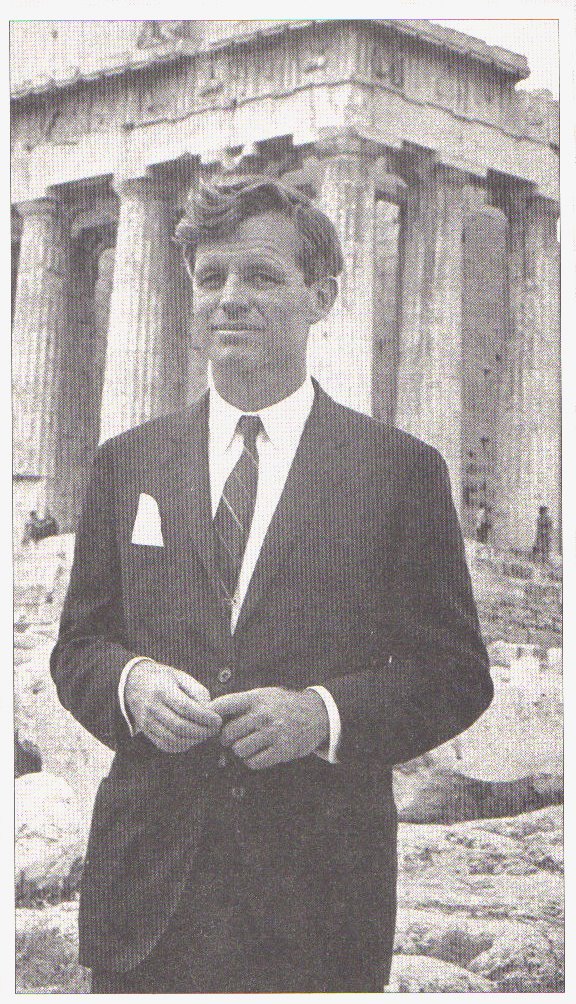
Tonight the scribe takes special pleasure in updating this Web log, for the subject is the memory of the late Bobby Kennedy. June 5th was the 37th anniversary of his assassination in Los Angeles.

the scribe thought it was today, and it is a reflection of our rightward drift and division that so little, if anything, was written on Sunday about this man whom, whatever his political inclinations, gave his life to the country.

In any case, we’ll do this a few days late; the sentiment is no less deep or profound.

Once a guy is dead and not around to defend his own name the enemy tends to do a dance all over their reputation. The Kennedys, Jack and Bobby, were by virtue of their murders raised to the level of saints. In reality they were politicians with all that implies and which left them open for some pretty vicious hits post mortem.

And furthermore, the scribe doesn’t go in much for family dynasties, which by their very nature are anti-democratic. You only need to look at what’s going on now to get an idea.

Nonetheless, the scribe lives his life in the belief that Senator Kennedy’s 1968 presidential campaign represented the high point of the American experience and that his murder marked the beginning of our decline as a special and enlightened nation which, through its ideas and not its armies, led a democratic revolution around the world.

To go back and listen to Bobby’s speeches from that terrible and tremendous time is to wonder what country they might have been delivered in, because it’s not the America any of us are experiencing. He and his brother the President were the closest thing to social democrats the post-war United States ever produced and both were shot like dogs for their efforts.

His own presidential candidacy featured a discussion about inequality and poverty never, ever repeated in American politics. He took the anti-war movement mainstream and gave it a head of steam and respectability it did not lose until they had killed him.

If you ever get frustrated at Democratic presidential candidates and wonder why it is so goddamn hard for them to just come out against a war they know is wrong, remember what happened to the last guy who tried it.

As they say in Spain, “Haz bien, trae mal” or “Do good, bring bad.”

That he was shot by Sirhan Sirhan is a certainty. That more bullets than the eight Sirhan’s gun could hold were found is also a certainty. That the doorway beam from which two bullets were pried was inexplicably burned by the Los Angeles Police Department is also a known fact. The rest can be left to those with the time to sort out conspiracies; for us it serves as a stark reminder of how the American right wing plays for keeps.

They talk a lot about the bankruptcy of American liberalism, the loss of direction and lack of ideas. They never wonder what the murders of the Kennedys and Martin Luther King Jr., meant in that regard. They were young men, standard-bearers of the left with many years of fight, maturity and leadership still ahead when they were struck down. And they could not be replaced.

We should remember that.

The recently departed Hunter S. Thompson wrote about Kennedy in his classic “Fear and Loathing on Campaign Trail ‘72”. He was addressing the McGovern campaign’s idea of using Bobby’s voice on commercial spots:

“In purely pragmatic terms, the Kennedy voice tapes will probably be effective in this dreary campaign; and in the end we might all agree that it was Right and Wise to use them...but in the meantime there will be a few bad losers here and there, like me, who feel a very powerful sense of loss and depression every time we hear that voice – that speedy, nasal Irish twang that mailed the ear like a shot of ‘Let It Bleed’ suddenly cutting through the doldrums of a dull Sunday morning on a plastic FM station.

There is a strange psychic connection between Bobby Kennedy’s voice and the sound of the Rolling Stones. They were part of the same trip, that wild sense of breakthrough in the late Sixties when almost anything seemed possible.

The whole era peaked on March 31, 1968 when LBJ went on national TV to announce that he wouldn’t run for re-election – that everything he stood for was fucked, and by quitting he made himself the symbolic ex-champ of the Old Order.

It was like driving an evil King off the throne. Nobody knew exactly what would come next, but we all understood that whatever happened would somehow be the product of the ‘New Consciousness.’ By May it was clear that the next President would be either Gene McCarthy or Bobby Kennedy and that the War would be over by Christmas...”


the scribe lived that connection before ever reading the passage. The Stones marked the boundaries of his lifestyle as a young rake, Bobby his political activism as a reformed one.

As a reporter with the “Los Angeles Business Journal” the scribe had to do a story about the Ambassador Hotel where Kennedy was slain. He asked to be taken into the infamous “pantry” where the nefarious act went down. He didn’t stay long.

In 1966, Kennedy gave perhaps his most famous speech to an arena filled with young people in Cape Town, South Africa.

We close tonight with an excerpt from the same:

“[T]he belief there is nothing one man or woman can do against the enormous array of the world’s ills – against misery and ignorance, injustice and violence...Few will have the greatness to bend history itself; but each of us can work to change a small portion of events, and in the total of all those acts will be written the history of this generation.

“It is from the numberless diverse acts of courage and belief that human history is shaped. Each time a man stands up for an ideal, or acts to improve the lot of others, or strikes out against injustice, he sends a tiny ripple of hope, and crossing each other from a million different centers of energy and daring those ripples build a current which can sweep down the mightiest walls of oppression and resistance.”

Let it bleed indeed.

Tuesday, November 01, 2005

Oil Drilling in Alaska


Sen. John Kerry has sent out an e-mail to his online community about the goings-on in Congress related to the Arctic National Wildlife Refuge up in Alaska.

(r)epublicans are obsessed with tapping the two or three years worth of oil up there and they don’t care what havoc they must visit upon a piece of pristine nature to do it.

Kerry says things are getting urgent:

“It’s now or never if we want to save the Arctic National Wildlife Refuge, and the White House and [r]epublican leaders in Congress are stacking the odds against us. They’re using underhanded procedural tactics to sneak through legislation to destroy the Arctic Refuge. The vote will occur this week in the Senate and next week in the House of Representatives.”

Kerry would like you all to write or call your representatives and tell them what’s up with the “refuge” part of the Arctic National Wildlife...Refuge.

http://www.johnkerry.com/action/call/congress/


“Refuge” according to Webster’s Dictionary is defined as, “shelter of protection from danger, trouble, etc.”

So in this case, we’re talking about wildlife and fauna mostly untouched by the poison of our civilization. Something that’s, lamentably, a museum piece for its rarity despite the planet’s size. There are few such places left and this one is worth preserving.

Kerry said he is working on this measure with Sen. Maria Cantwell (D-Wash) and Rep. Ed Markey (D-Mass) on stopping the latest effort.

Having been stymied the past few years by California’s Sen. Barbara Boxer (D) and her filibustering of the issue, now the (r)epublicans have shoe-horned their idea into a budget resolution, which cannot be filibustered.

Kerry added that the efforts of his online community (his e-mail list) were so effective last go-round that proponents of drilling complained about it on the Senate floor.

highwayscribery urges you to make it happen again.

Here’s a few more things the senator had to say about the refuge:

“The [reserve’s] 19 million acres comprise one of the last places on earth where an intact expanse of arctic and subarctic land remains protected.

“An irreplaceable treasure, the Arctic Refuge is home to caribou, polar bears, grizzly bears, wolves, golden eagles, snow geese and more. Millions of other birds use the Arctic Refuge to nest and as a critical stage area on their migratory journeys.

“The Arctic Refuge supports more than wildlife. For a thousand generations, the Gwich’in people of Northeast Alaska and Northwest Canada have depended on it and lived in harmony with it. To them, the Arctic Coastal Plain is sacred ground.”

There’s plenty of oil money being made right now with gas hovering at the $3-per-gallon mark, and too few solutions for a future without fossil fuels.

Let’s make sure our energy policy and plans take us down a path to sustainability instead of destruction.

The Sidewalk Smokers Club - Chapter 46 and 47


Chapter Forty-six

Jordan, of course, was missing from this tectonic occurrence in the goings-on of his cohorts, for when one has profound personal problems the ability for public interaction becomes limited.

And this was precisely Jordan’s predicament. Due to a redundant sense of worry, he’d been staying in, avoiding the white glare that seemingly followed The Smokers everywhere now, making preparations to meet the dark clouds gathering just off his horizon.

But to no avail really, for the morning after Chapter Forty-five had taken place, while Jordan enjoyed his first coffee and cigarette, Dumburton dropped by with a piece of paper requiring that Jordan follow him down to the police station for questioning.

J. was in pajamas, bathrobe and slippers and so he asked Dumburton for a minute to dress. The detective said sure and proceeded to step into Jordan’s space when the door was slammed in his face.

“What are ya doing?” the detective snarled through the cheap slab of wood separating them.

“Getting dressed man,” Jordan snarled back, “Your paper doesn’t say ya get to come into my bedroom, too.”

This was not spontaneous, but by design. J. had engaged in some research and preparation for what he now felt to be an inevitable confrontation with the gargoyles of public order. This prep consisted exclusively of delving through his local entertainment outlet’s collection of film noir classics and a similar raiding of the local bookstore for the works of Mickey Spillane, Dashiel Hammett, and Jordan’s favorite, Ray Chandler.

In this search for an edge he’d decided upon a technique, whereby he battled, parried, dodged, and slipped his tormentors; creating every step of the way, brick by brick, a case for whatever lawyer would be stuck with the job of defending Jordan from charges that were, in fact, true.

What he harvested were thirty or forty hours of delightful entertainment (and suspense) capped-off by a collection of wiseacre lines, some borrowed and some original, the latter coming to Jordan as he slowly became imbued with the spirit of the mid-century gumshoe.

And so, he met Dumburton outside his place in a tuxedo.

Those who are pulling for Jordan, and wondering how it was he chose what would appear to be a not-very-helpful strategy for breaking clear of the law’s claws, must admit that he’s taking things like a man and having a good time during what may be his last hours of freedom.

It was an attitude pumped from the bum philosophy’s bowels, a rebel-may-care stance that otherwise cooperative people are forced to affect when the fact they smoke pushes them out and away (which is somewhat the point of this story).
Dumburton, cold and worldly as he was, did a well-pronounced double-take to the pure satisfaction of the murderer.

It was in this moment the idea truly impressed itself upon Jordan. He was a murderer. Laws and lore held it to be so. The realization transformed him further than his black-and-white mug repertoire. He was no longer, and could never again be, a regular guy. He was something distinct, had done something of note.

“Asshole,” Dumburton responded in a way that was becoming customary to Jordan and therefore less intimidating than at first. “You don’t have any respect for the law or the system.”

“I’m dressed formally,” Jordan pointed out. “How much more respect you want?”

Dumburton drove a muscular car that was ostensibly unmarked save for the fact only non-uniform cops drove gas-guzzling behemoths built prior to the first energy crisis.

The detective got in on the driver’s side while Jordan stationed himself, hands on hips, at the opposite rear door. “What are you doing?” Dumburton sounded frustrated.

“Ain’t you gonna ‘cuff me?”

“No, I’m not gonna ‘cuff you. What are you gonna do to me?”

“You’re accusing me of murder, ain’t ya?”

“An old lady.”

“If I were you I’d put the ‘cuffs on.”

“You’re not me, but if it makes you happy…” Dumburton spit, slammed the door and stomped around the rear end of the car and gruffly ‘cuffed J.

He then stuck his hand on the top of Jordan’s head in the way people of his ilk do and pushed the suspect down into the back seat.

“Christ!” He shook his paw and made the facial expression of some frivolous girl who’s just seen a spider. “What the hell’s in your hair?”

“I don’t share beauty secrets,” Jordan told the buzz-cut detective.

“You have enough in there to last an eternity,” Dumburton barked while making his way back around to the driver’s side so that Jordan might hear him.

“Ya never know when a little grease might come in handy down at the big house,” Jordan nonchalanted him.

Dumburton looked in the rearview mirror. His eyes locked onto J.’s whose own locked onto the detective’s, just like he’d seen in the movies. “You’re drivin’ me fucking nuts!” the lawman acceded before getting back out of the car, walking back around the trunk end, opening Jordan’s door, grabbing his hair, losing grip from the grease as he tried to pull him back out of the vehicle. “Aggh.” And he looked for a place to rub his hand dry. “Get outta the car!”

Jordan casually obeyed, fully understanding the ebb and flow of his relationship with this man who’d crashed into his life some weeks before with neither invitation nor departure date.

Dumburton took the handcuffs off. “Get in the front, the games are over.”

Jordan got in understanding full well that the games were over when he decided they were.

Early in their little road trip, Dumburton’s car was passed on the right by an eye-catching woman in the passenger seat of a racy convertible handled by a gentleman neither he or Jordan bothered to look at.

“In this world,” Dumburton turned to a surprised Jordan, “there are a lot of whores.”

It was a crude observation and certainly not novel, but underneath it Jordan detected a strain of humanity, something which he had suspected of Dumburton from the first.

They rolled through neighborhoods of decreasing realty value for a few minutes more when Dumburton turned again to Jordan and said, “I just want you to know that I don’t think what you did was morally wrong. I am, you know, enforcing the laws, not makin’ ‘em.”

“Nice try. Mind if I smoke?”

“Yes.”

“Tough shit.”

We are placed on this earth to deal with one another. Argue to the contrary all you want, we are forging ahead. Those who accept this fact have a much better time of it and are able to penetrate situations otherwise impermeable. Jordan accepted it and therefore understood that Dumburton’s job – in its basest incarnation – was to round up murderers. But he also knew it to be a means toward many ends: earn money; make a wife happy; climb the career ladder, and garner positive press for a perpetually beleaguered police department. So, to a reasonable degree, Dumburton actually needed Jordan. “Doctor needs sick people, cop needs criminals,” he thought and promised to pass this along to Randall when the opportunity presented itself.

And to the extent the democracy rattles along with a few rights and guarantees still hanging to its twisted chassis, the situation required a modicum of cooperation on the suspect’s part or the whole thing would get nasty and defeat the purpose of neatly bringing to justice the murderer of an old woman.

The cigarette was sprinkled lightly with marijuana. Almost all of Jordan’s cigarettes had been pre-rolled in this way of late. He had a lot on his mind and it helped him relax. Pure and simple. That Dumburton was coming to take him away had not crossed Jordan’s mind two nights earlier when he had rolled ten or twelve to help navigate the next few days.

The detective, whose job provided ample exposure to all the worldly vices, only needed a whiff to determine something wasn’t right. “You smokin’ weed?”

“What’re you gonna do? Arrest me?”

Dumburton looked at his captive for the first time with something that approximated grudging admiration. He asked Jordan if he had a smoke without the weed and, in a moment of softness towards the hard bastard, J. provided him a pre-rolled. Dumburton smoked a little, coughed, and put it out.

“Real tough guy,” Jordan mumbled.

They arrived at the station and Dumburton told his prize to sit for a second while he went to do something or other, which he then proceeded to do.

Jordan looked like, and was, a fish out of water. For the enterprise that is American criminal justice runs on the fuel of minorities and hard-luck losers bitter at buying into a dream not their own. His status as killer notwithstanding, Jordan looked too white, too polished, too coherent, and too harmless to have much of anything to do with the miserable souls present and waiting for their legal skewering.

It was, really, very much like his night in the emergency room in county hospital, which when he thought it twice over, was how he became associated with this whole other class of countrymen in the first place. For if Jordan had not gotten sick without health insurance he would never have been forced to take treatment with people other than his own. And he certainly would not have been wandering around a hellhole of the misbegotten at three a.m. or whatever time it was he got it into his head to do a mercy killing.

Anyhow it didn’t matter because there he was sitting in a tuxedo. Once again J. monitored the poor speaking skills of the suspects, the faux bravado that only served to dig their holes a little deeper, the inability to connect at any level with their keepers, and the complete lack of development that stood at the root of their present trouble.

Dumburton came back seemingly glad to see Jordan who was a class act where criminals were concerned; a less bumpy ride yet more challenging. And the public nature of the case in which J. was about to be named suspect meant grand things for the detective.
Suffice it to say Jordan’s sentiments were not made of the same stuff.

“Alright, I’m gonna put you in a room for questioning, just like on television.

We’re waiting for somebody from the city attorney’s office to get here and then we’ll do the interrogation.”

“You tryin’ to get me excited?”

“No, I’m trying to scare you.”

Jordan contemplated spitting to mark his disdain, but his sense of cleanliness got the better of him, which is why he was a cop like Dumburton’s favorite kind of suspect.

The detective locked him in a new room, which was, as promised, just like the kind seen on television cop dramas. In front of him there was a long glass panel that Jordan pegged for one of those one-way viewing things whereby enforcers of the law could see him, but through which he could not return the favor. Then he waited and waited, which is a part of the game. He’d have smoked another cigarette/joint, but a cute lady in uniform with a giant gun and her hair in a bun had divested Jordan of his particulars.

He waited and waited some more. An hour went by. Another half an hour went by; at least so it seemed. Jordan had to avoid his favorite pastime, sexual fantasy, for lack of a place to let off steam should his imagination prove particularly fertile.

Finally Dumburton returned, crestfallen. Jordan could see it and this was because he was becoming familiar with the professional part of the officer’s personality; beyond which he did not suspect there to be much else.

“Okay, you’re free,” he practically whimpered and threw a folded newspaper at him. Jordan unfolded it. He saw pictures of his friends in a scuffle with what looked like the guys who’d shown up to make such a mess of the benefit/press conference.

And then another with City Attorney in very proximate environs to where all of this happened, which, if he wasn’t mistaken, was the Argentine restaurant.

“The city attorney’s been photographed at a restaurant with The Sidewalk Smokers Club. The whole office is in a war room mentality. Can’t get a deputy city attorney down here to help me with you.”

“And so who, I ask, is there to defend the sanctity of our system?”

“Alright, get outta here,” Dumburton recuperated form and growled, “but don’t think this is the last of it because it’s not.”

And that was probably true. Jordan thought about a come-backer, but survival instincts took hold and he chose to depart the station house lest somebody change their mind. As things were going, he did not find it at all odd that the lady with gun and bun would return his pre-rolleds with his wallet and keys and a comely wink.

It was not every day the station played host to a tuxedo guest.

Bereft of mobile communications capacity on principle, Jordan now found himself paying the price for that principle as he stood stuck in a neighborhood that left a little to be desired. He reflected upon how it is the nature of police stations to be in lousy neighborhoods, “more customers, in a manner of speaking.”

He pulled out a plastic calling card that had been in his wallet since the New Deal. J. never used it and, given the transforming bias of telecommunications, was not even sure the company that had issued it existed anymore. He had wisely attached a little clipping of paper explaining just how the device was to be employed. He went to punch the numbers in on the payphone and it was then Jordan noticed that it had been torched and smashed into uselessness. So he moved on, approaching broken payphones in his tuxedo until on a fourth try, next to a liquor store fortified with more bars than the jailhouse itself, he found an operable one.

Slowly the odd ritual performed between himself, the recorded voice of a woman who seemed to be in the employ of telephony companies the world over, and an interminable number of digits, yielded a dial-tone.

He thought it better not to importune poor Joya yet again. So he dialed Corey’s number, which landed him Clarisse’s voice.

It wasn’t the clearest connection in the world. “Who eet is?” she chirped and he answered that eet was Jordan and then explained how he was actually trying to reach Corey. “Oh. Well he doesn’t stay so much at dee apartment anymore and I have all de mess-ahge come to my phone.” There was a pause since J. could not really understand what it was she had said. “So what jou are doing?”

“I’m down at the police station. I’ve had a little trouble, but they let me out. I need somebody to come and get me.” There was another pause followed by some gurgling voices. Clarisse, he was sure, had covered the phone with her hand in order to explain his situation to whom he was not quite sure. Surprisingly, a squeal of delight wove its way through her knuckles and bounced off a satellite into his ear.

“Okay,” she said, “ we are coming down to get you.” And with that she hung up not having permitted Jordan to tell her exactly which station he was at.

No matter, a few panhandlers and violent threats later, a red convertible GTO roared down the street to the delight of street punks, drunks, and law enforcement types alike. As the car pulled up, it became clear the driver was that starlet from the benefit/press conference. He did not recognize her from the show for which she was known, but her glasses and floppy hat and other accessories that Clarisse had taken to mimicking gave the thing away.

It made quite the picture and the ladies’ incongruity to the surrounding neighborhood affected them not at all. And why should it have? All available gods were obviously keeping an eye out for the do-ette. And why shouldn’t they? Everybody else within eyeshot was, too.

Jordan, whose recent circumstances had sharpened his capacity for reflection, began reflecting anew as he sat his tuxedo-self in the back seat behind the two beauties, lit a tobacco/marijuana smoke, and settled in. He thought that, when the strings of control that keep a normal life normal are cut, for whatever reason, a person’s range of experience, ie; the depths to which they can sink and the heights to which they might soar, is given to greater oscillations. At least that was how his day, which had started with captivity and had morphed straight into any blade’s definition of fun, had run.

The actress looked back at him and smiled widely and whitely. Clarisse introduced her formally as Vindaloo Baxley whom he’d heard of. Clarisse introduced him as Jordan and he gave thanks Baxley had not yet heard of him given Dumburton’s efforts to make his name a household brand.

Although he could not quite connect Baxley’s face to her work, the name was one of those attached of late to must-know things and people. She was cute, no check that, she was really hotly scrumptious and the fact Jordan had too much on his mind to really concentrate very well on her lit Baxley’s fire of attraction for him: proof positive there is nothing more enticing to a woman than a man with large enough a life to inoculate himself from the universal effects of beauty. He carelessly asked her if Vindaloo Baxley was truly her name and she said, “Of course not!” while mistaking his distraction for the lack of respect she inwardly felt deserving of, but could not have thanks to her rank, station, and upturned nose.

J. had learned of late not to ask where things were leading. There was no longer any scheme or order to his life and, by egocentric extension, the universe in general.

The exercise of worrying about immediate details had dropped from his repertoire. He was suspected of murder no matter where he was and as long as that had not been confirmed in a court of law, every day was Christmas Day, every night New Year’s Eve.

When the GTO stopped at a light Vindaloo got a whiff of what Jordan was working in the back. “Are you getting high?” she trilled with a joy-element in her voice that was contagious as malaria in the Spanish-American War.

“Yeah,” Jordan answered in a way he might have were she Officer Dumburton. His demeanor had changed. The tough-guy, gumshoe rehearsals had only served to varnish a nature already deformed by the rock of Sisyphus he’d been pushing these many pages.

His gruffness caused Vindaloo to cast a sidelong glance at Clarisse who read it as, “God he’s cute.”

It would be helpful, at this point, to remember that when Clarisse hit her now dissipated crisis, it was Jordan, rather than her fading husband, whom she had turned to for solace. With the approval of her patron stamped all over his dour countenance, Clarisse’s tepid interest in Jordan was rekindled.

“So,” the actress looked over her shoulder with complete disregard for the unfolding traffic situation ahead, “do you mind if I ask what you got picked up for?”

“Yes,” Jordan yelled into the wind, “I do.”
“Great,” said Vindaloo, “so what were you picked up for?”

This made Jordan smile and he was tempted, as he had not been for quite some time, to regale her with the truth. “Smoking,” he uttered, keeping on message and demonstrating a discipline that would increasingly serve him in trials to come.

“Oh, you Sidewalk Smokers are the most!” she cheered. “It’s a veritable revolution.

Like you were everywhere pressing the advantage. I have to ask: Was it all planned?”

Jordan would have liked to answer that, yes, it was, but he wanted to know what had happened the prior night at the Argentine restaurant. And so, with the heightened ability to shift perspectives, compose alibis, avoid answers, and respond to questions with questions he’d developed in his dealings with Dumburton, J. directed things in a direction more pleasing.

“No, it’s more a spontaneous uprising of oppressed habitues citywide.”

She squealed with the childlike delight of those lucky enough to spend their life bathing beneath the golden sun of good fortune. It was all so much fun for her, so much spectacle.

“So Clarisse,” he probed, “what happened last night at the Argentine place?”

“Well, de things got out of hand from all de smoke.”

“Yeah, the newspaper told me as much. Got anything else? Like, say, how the city attorney ended up embroiled in the affair?”

“Shee’s hafing an affair with that city man.”

“Who?”

“Joya. Who else?”

“I thought Joya was a lesbian,” he labored through the interrogation.

“Yeah,” said Clarisse in so useless a manner for the purposes of information gathering that Jordan threw his hands up, resigned to waiting for a more specific accounting from Randall himself.

Whatever had happened, it was clearly to his benefit and Jordan leaned back in the hope this was a sign his fortunes had finally taken a turn for the better.

Stopped at another light, Vindaloo Baxley turned to Clarisse and said in a barely audible voice, “Should we share him?”

And Jordan smiled as a feeling of warmth that began somewhere in his solar plexus, moved convincingly through his chest, up his neck, and into his head where it exploded in a starburst the likes of which he had never known before.

He shivered, but not from the cold.


Chapter Forty-seven

Randall and Corey drove the latter’s SUV toward a different police station where Yvonne was waiting to be bailed out after an evening in the cooler.

“You’ve been coughing a lot,” Corey said as Randall sucked and chewed on a treacle-gooey Sir Edward cigarillo without much gusto at all.

“I know... I hung out smoking with Hat Midone after the ruckus last night,” Randall confided.

“Hat Midone the actor?”

“No, Hat Midone the bus driver.”

Corey wondered aloud why it was that everyone but him was getting an actor out of all the hubbub. “Who else got an actor?” Randall wanted to know.

“Clarisse has hooked up, profitably I might add, with Vindaloo Baxley, the actress.”

Randall was secretly disappointed he didn’t get the actress and Clarisse the actor, but instead said, “We’ve got a better actress. An actress on the largest stage of all – reality.”

Corey nodded. “For my money she’s the true ‘it’ girl right now.”

This line of discussion resulted in a rare moment of quiet between them. Corey felt close to Yvonne and was worried about the drama she was presently enduring. Randall had a vested interest in her well being, too, and was mindful of the fact the poor girl had handled plenty, and with aplomb.

“You think we’re putting her through too much?” Corey broke the silence.

“Doesn’t matter now,” Randall replied. “If she thinks forging ahead is costly, she should see the price of falling back.”

They discussed the media at the restaurant and glumly realized that there would be more of the same as Yvonne left the station house. They discussed how much it would cost them to free her and also DeConcini’s dropping the case, leaving them up a creek.

“He told me his practice can’t stand the publicity,” Corey smirked, a true believer that all publicity was good. “He said Yvonne is not someone who can be looked up to.”

“Although looking down is always a pleasure,” Randall permitted himself, because fun is important, even when it comes at a friend’s expense.

“Can it,” Corey exercised his veto power over Randall, who enjoyed the same option, “and tell me about Hat Midone.” His partner said in no uncertain terms that the late hours spent with Hat Midone were so extraordinary – meaning not very ordinary – that he feared the effect of the pleasures on his long-term health and the guilt upon his fragile conscience.

“How’d you end up going out after everything that happened? I was spent.”

“That’s when he called. Those people don’t live like…never mind.”

“That crazy huh? Would you repeat?”

“Most definitely.”

They pulled up to the police station and sure enough, a flock of photographers and other parasites had gathered in the hunt for Yvonne’s hide, both figuratively and literally.

Randall went inside to take care of business. Corey stayed outdoors with the media. “How does this hurt your case?” (big city daily) “Is it true your legal representation backed out?” (celebrity justice show) “Aren’t you married?” (liberal tabloid girl with horn-rimmed glasses) “Did Yvonne have sex in jail?” (national daily). One-by-one he fielded the double-edged barbs, tried to sense which side of the question had been sharpened to do hurt. He had to fight a rancor in the chest stemming mostly from his own interest in the ingĂ©nu of this, what shall we call it? Trauma? Tragedy? Light opera? Dramedy?

Inside, Randall was tending to the more satisfying task of insulting the police from behind the facade being an officially interesting person afforded him. Not that the police respected him in any way, rather they feared things might blow up in their faces while a better part of the city’s image and sound-recording machinery was on the premises.

“Tied any butterflies to your wheel lately captain?” he said to a fellow named Devonshire who did not at all appreciate either the tone or content of Randall’s query.

“Your pretty little friend broke the law,” he said with a breezy ease attributable to his own status as an officially interesting person. He stood between criminals and their unfortunate loved ones and this power over human emotion was something quite exquisite in his life. “Now she’ll have to answer for it; just like all of us.”

Devonshire was making a point about the limits of celebrity, Randall’s type in particular.

Randall resorted to his favorite tactic, the track switch. “Do you guys have any confiscated cocaine I might be able to purchase?” He was making his own point about certain rumors surrounding the force. “Oh sheeeeit!” said a black cat in cornbraids awaiting processing. A roll of laughter swept the station house. Devonshire banged his fist on the counter to little disciplinary affect. The laugh would have to unspool itself. Gone was the easy breeze. “Who the hell do you think you are coming in here and talking to me like that?”

“You know very well who I am in relation to the defendant whose bail had more to do with the fact she is known than that she hit a fireman,” he countered.

“You think the whole world’s going to be smelling her ass and yours forever? They’ll move on and I’ll nail you if I see fit.”

It was a perfectly believable scenario for Randall who saw the entire world as a mosaic of such sordid and untold occurrences. “Shall I impart this information to the reporters on my way out?” he countered with the confidence of a man determined to sweep the world clean of such occurrences.

“Sure. And tell them that if they got Al Capone for tax evasion, we’ll get you and yours for worse things.”

Any points to be collected here had either been scooped up or lost and there was no reason for Randall or Devonshire to carry on in this vein.

“Who do I give the money to?” Randall asked and was passed by Devonshire onto a more calm female presence just doing what she was told.

Corey came in. “Wow, that was ugly.”

“Were you able to handle it?”

“Handle’s not the word I would use because it’s not possible, but some of them will at least be gone when she comes down.”

Which she did just then, hair flat against her head, terse lips, ringed eyes, shrunken inside an oversized police windbreaker. She hugged Corey listlessly and said, “Let’s get out of here.”