Tuesday, January 10, 2006

United Farm Workers in the "Los Angeles Times."


Much ado over the “L.A. Times” series on the United Farm Workers Union and its sainted leader Cesar Chavez, after whom the state has proclaimed a public holiday.

You can catch some of the debate and links to the four-part exposé here at L.A. Observed:
http://www.laobserved.com/index.html

Anyway, the scribe has read the first three bits. The upshot is that the union has abandoned its original commitment to farm workers’ whose plight.

Four decades after the great battles fought by Chavez and Co. to gain recognition for the union and passage of the Agricultural Labor Relations Act, things are worse than ever without the union representing 7,000 of some 450,000 total workers in the agricultural sector.

In its stead its leaders have developed a branded-name UFW that uses its historical value as a fixture in the early struggles for social justice in the immigrant community to raise money and finance a larger pan-Latino struggle.

It’s irrelevance to field workers living in shanty towns outside Carlsbad, Calif., are treated with authenticity in the piece. Which is to say the writer has visited there and talked to its inhabitants and attributed their remarks to a name.

(take not, Bob Woodward).

Members of the Chavez family are doing very well as directors and such of a number of charities related to the Farm Workers and their causes, under a strange relationship, paradoxical in the American labor movement, whereby the charities raise money and pass it to the union, instead of the other way around.

If you walk down Olvera Street in downtown Los Angeles – the city’s first street and now an updated shrine to the latest strains of hip, Chicalanga latino-ism – the Farm Workers black eagle (see image fished up by the scribe, for you) flag is as visible as an icon as Ché t-shirts, Frida Kahlo postcards, and An-to-ni-O Vi-YA-ry-GOsa.

The UFW polls high in esteem among Latinos and one union official is quoted as having observed, at some point early in the transition to professional fundraising operation, “This is pure gold!”

None of which is the end of the world. Few institutions maintain an almost revolutionary street presence forever and, alas, when it comes time to put things in their place, family members are often tapped in a mixture of necessary trust and nepotism.

Not that any of this is desirable, just not the end of the world. The foundations do work for charities and build low-income housing, they seem to have merely moved away from the farm worker cause. There is no suggestion they are moving away from Chavez’ vision, merely carrying it out.

Somebody made a business decision.

What’s very discouraging are the hits Chavez takes himself in the series which confirms sentiment that he had retreated like a monk to his mountain aerie in Tehachapi, proud of the fact he wasn’t merely a union guy.

But if the reports are correct, the “retreat” became a place where the best-and-brightest who had been drawn to the UFW ideal were purged in bizarre events occurring under the rubric of “The Game.”

Actually, it’s not quite bizarre at all. Too many times the kangaroo court and public humiliation for “crimes” against the original idea have meant the end, often literally, of well-meaning and progressive people.

Too many ideas have become used for churches of purges.

The account is one of a paranoid Chavez “crushing dissent” and chasing real talent out of the movement. Even then, he seemed more serious about boycotts, hunger fasts and other media-driven events, than the hardcore mechanics of the strike. The article shows how this was fatal, in the end, to efforts at improving the lives of the lowest paid field laborers.

Completing the transformation from a media-message apparatus to a union that takes on the job of other peoples’ political campaigns, for money, must have been a hop-skip-and-jump given the difficult business of wrangling with landowners, farmers, and police across the pesticide-laden fields of California that stood as the alternative.

Sunday, January 08, 2006

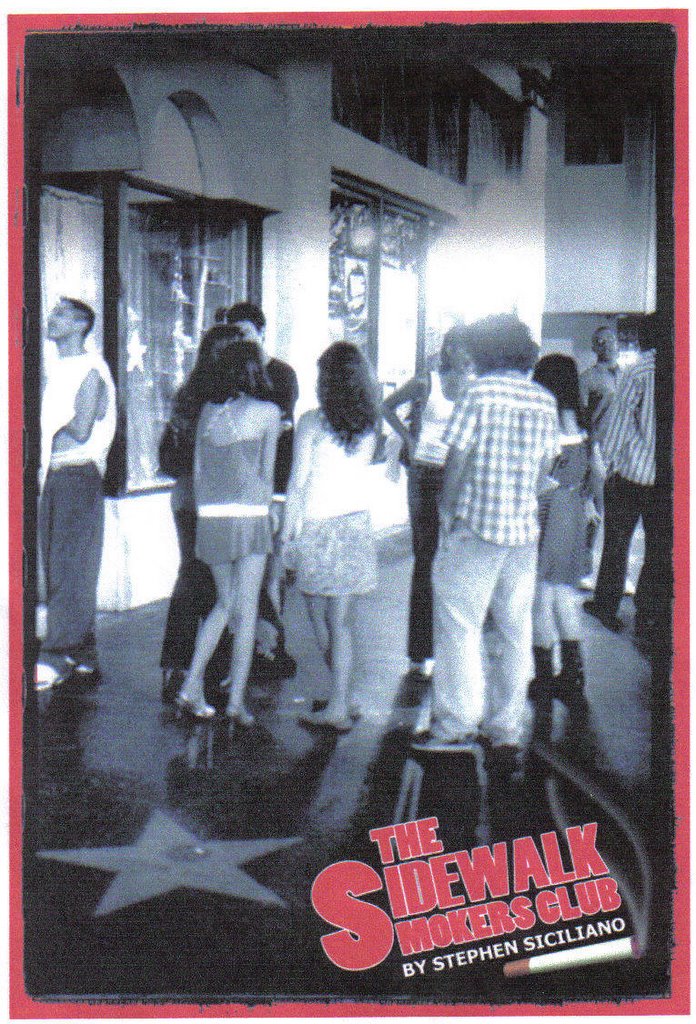
The Sidewalk Smokers Club - Chapter 65


Chapter Sixty-five

Yvonne’s learning about Joya’s remarkable transition to City Attorney’s fiancee did not shock her and there would be no jealousy for you cannot lose what you never had.

Each Smoker was bitter that something irretrievable had been lost to them. But that bitterness was tempered by the sweet fact it had been sacrificed at the altar of their own well-being. Joya loved them. They knew it now.

Corey, meanwhile, was still emboldened. His name and face were in print, his strategies commented on and the result, if not always desired, still resonated with him. It filled in some of the emptiness that haunts all of us. He called Yvonne, explained there was going to be a press conference at Joya’s two days hence. “Two days hence!” she laughed, delighting in the message’s packaging, while taking him down a notch.

Undeterred, Corey explained that, “folks want to hear from Randall.”

“Oh sweeeteey,” she condescended, “the people that live here aren’t folks.”

Corey grit his teeth in determination (and admiration). “Specifically, the question everyone wants answered is how he justifies his public posturing with his rotten health.”

“What’s he going to say?”

“He’s going to say that we’re coming out against the BID’s plan to move The Smokers to the bad part of town and that we can count on the support of the city attorney’s office.”

“That is an answer to a different question.”

“He will announce our plan to hire a high-powered attorney to take up your case,” Corey ploughed on in the same way he would direct Randall to do. “We’re going to hire someone who does breakfast-and-golf with the publishers. Are you with us?” he plied the menu once again.

She found the table sufficiently, if not elegantly, appointed and it was so agreed.

They would appear together in yet another inspiring rally for Sidewalksmokerism.
Clarisse had been contacted by Corey, too. It was her job to bring in some star power, if she could, from her list of lucky ones. Atop the pyramid of all this sat the A-list actress, but Randall said she was too big, that The Smokers did not want to end up in her own personal movie of herself.

After that came Vindaloo Baxley, still humiliated that Jordan had gone very solid with an insignificant Armenian-American bank clerk. What killed her was that she somehow understood the charm of it all and knew she could never offer any man the same thing.

Having a cool smoke-out with girls from the girly magazines is one thing; getting a show of support at an actual, politically inspired event was something else entirely. No, Vindaloo told Clarisse, she did not think so. City Attorney was definitely not where things were at and the occasional bit of street theater represented the extent of her commitment to such things, but she’d see if she could find the time to come down to Clarisse’s studio and check out what she had going on.

And for this last concession, the Belgian/French girl was eternally grateful, as were all The Smokers.

On the night before the press conference – Randall’s first since being home from the hospital – Hat Midone showed up with two companions for another destructive, seductive romp. Randall, despite his condition, could not pass it up. They were real beer commercial girls; girls who wouldn’t have given him a second look a few months ago. So he leapt.

“The best parties,” he scribbled in wobbly script the next morning, “are the ones you can’t remember.”

At one point in that long night Randall was turning over the bad news of Vindaloo Baxley’s bailing and considering anew the prospects of getting the A-lister back on board.

“It doesn’t look good,” Midone read his mind. The actor had then offered to make a showing on behalf of the coalition. Randall politely declined. “It’s okay,” Hat joshed, pouring something very dangerous down his throat, “I know I don’t project the wholesome profile you need to go for, but you have permission to use my name.”
Randall thought that Hat was right, that it was sad The Smokers were becoming what they were not, and what did it mean? Besotted, impressionable, subject to the actor’s formidable charms, Randall told Hat, never mind, he could come to the press conference, even speak if he so desired and Hat said he would. Randall did not remember this, but Hat did and called morning next to say he’d be making his entrance at 11 a.m.

After another round of calls, consultations, and calculations, the initial plan was finalized. Randall would announce tentative news that City Attorney planned to back The Sidewalk Smokers Club in its battle with the Fashion Business Improvement District and its paramilitary detail. City Attorney would then capitalize on the brief bit of momentum to (hopefully) be garnered from his appearance by confirming – from a different location – that he was staking the success of his campaign for mayor on the slogan of “Open City, Free Street.”

Hat showed up at Randall’s half an hour late (11:30 a.m.). Still, he looked great and dressed the part in his old-school jeans, black work boots, white and tight t-shirt, and a pack of Luckys (which he didn’t smoke) twisted into the short sleeve.

His ample head of hair was slathered in grease and slicked back, but the front bangs insisted. He was a very dashing young man.

“You’re half an hour late,” Randall scolded him.

“Fuck you,” said Hat Midone.

Randall thought how the day might be a difficult one. Together they left his disorderly apartment and split in the direction of their respective parked cars. “Where you goin’?” Hat asked.

“To my car,” Randall retorted, “we should take my car.”

Without the slightest degree of sensitivity toward Randall’s feelings Hat explained that his car was convertible and new and powerful and cool while the other entry in the which-car-should-we-ride-in sweepstakes possessed none of these features.

“I know, but I don’t want to create any resentment,” Randall responded rather correctly.

“It’s a little late for that,” Hat stated, also correctly, proving how two people can win the same argument.

As Hat’s ride rolled down the street past Joya’s Joyas in search of a parking spot, Randall could see the store had undergone a face-lift. This could be attributed to Clarisse’s sublime intervention. She had turned the fact she owed Joya a table into a tsunami of self-promotion in support of herself and The Smokers. The table had become a new set of area rugs, which had morphed into a graphic separation of walls by starkly different primary colors and then transmuted into a series of new display cases particularly suited to the new decor.

Joya wasn’t sure about this usurpation of identity, but kept quiet because Clarisse was Vindaloo’s designer du jour and that couldn’t be a bad thing if enough people could see it and they were, after all, just about to have a press conference.

After driving up and down the commercial strip a few times in search of a parking space, Hat said, “Fuck this. No way to make an entrance, man. Can you get somebody to park my car when we roll up?”

“No.”

“Perfect,” spat Hat as he veered the convertible at the line of waiting paparazzi mixed in with beat reporters burgeoning out from the curve in anticipation of their arrival. Hat came so close, so fast at the curb, that some felt compelled to dive to the cement and out of the way. The duo leaped from the car. Randall’s heel got caught in the hood mechanism and he stumbled a bit. People laughed. Hat puffed. Nobody was there to park it and traffic began slowing thanks to the slight bottleneck beginning to take shape.

“Hat!” they cried, “Randall!” even. A table was set up outside the window display for the press conference. The store was kept empty by a large security guard with a yellow jacket that had the words “Event Staff” blazoned across his wide back. Inside Joya, with the shadowy Sadina behind her, was beckoning to The Actor and The Smoker.

With a confidence born of experience, Midone led the way with his elbow stuck out, horizontally, toward the door. Joya unlocked and opened just enough for both men to slip in and closed it on a woman reporter’s foot. “Oh hon!” she said reopening enough for the limb to slither away.

“Shit,” Randall turned to the actor, “how did they know you were going to be here?”

“I had my publicist call them.”

“Why?” Joya and Randall queried in symphony.

“It’s in my contract. Any time I make a public appearance I have to at least let them know so they can be prepared for anything that might happen.”

“Happen?”

“I’m Hat Midone!”

There was no response from Joya or Randall who were, after all, the worker bees in this situation. He turned to her and said, “Why are you locking everybody out?”

“It’s a smokin’ crowd and we’ve already been through that hon. And the fine…well.”

“Okay,” Randall nodded, “but don’t worry about money.”

Money had ceased to be a problem for The Sidewalk Smokers Club as they had ceased, increasingly, to be The Sidewalk Smokers Club.

“And,” she went on, “Clarisse has redecorated the place for me and I’d like to keep it fresh and new for as long as possible.”

“Nothing can stay new for a long time,” Randall pointed out to no particular end. He looked around as did Hat who said, “This looks a lot like Vindaloo’s place.” Joya felt it best not to comment. Randall took a look into one of Clarisse’s sensual display cases and saw new things in there, too. “Your work is changing Joya,” he commented.

“Those aren’t mine,” she said, “they’re Sadina’s.”

“You’re back!” he turned happily to the Indian girl whose chocolate complexion cracked with cream for a smile.

“Yeah,” Joya said, “now that I don’t have any use for her as a girlfriend I have to exploit her artistic side.” Sadina, in her own unique style, said nothing in response.

“She never rises to the bait,” Joya smiled, “she keeps ya wonderin’.”

There was an increase in the ruckus going on outside. “Yvonne! Yvonne!”

“Jeezus,” Hat muttered, “that’s the end of my star turn,” correct as usual. The lovely, distressed Yvonne was being shielded as she came out of a car parked behind Hat’s, which was being ticketed by the city government’s most efficient outfit.

Corey had his arms around Yvonne and was unable to apply Hat’s strategy in getting to the door and things went pretty slow to the delight of everyone. Joya stationed herself at the portal, but stepped back when the wave-mass behind the pair hurled them into the store’s facade, causing a slight giving in the entirety of the glass frontispiece.

“Well, God!” Joya said, rather frightened before she opened up. Hat had joined her and punched at the hands and arms of the media elite grabbing at whatever part of Yvonne within reach. In they slipped. “Christ!” said Corey with no less vehemence than Randall. “What the hell, hey, your Hat Midone!” and he extended a hand of welcome to the actor. “Guess that explains the crowd.”

“My publicist. But I’m not sure Hat’s who everybody came to see,” said Hat pushing his chin up in Yvonne’s direction.

She looked as beautiful as ever. Ephemeral and light from the weakening that had occurred in her and which Randall and Corey had not foreseen, assuming, as they did, that the difficulties would increase her strength (which also happened, sort of).

Those black beans eyes had taken on a Perils of Pauline pallor first evidenced when the business of the magazine layout had become her life’s defining feature.

“Fortunately,” she said, “this isn’t about me anymore,” and she turned to Randall. “I think you’re the hot ticket.”

So everyone was hot and it was a great moment, which, if not for this novel, would never have been recorded. Without the novel, this subtle crest of triumph for The Smokers would be obscured in the ham-handed reporting of beginning, end, and official milestones in between, readily provided by your mainstream media types.

Swimming together in a sea of consecration as semi-important noteworthy players it was easy for Randall to invoke his own deep humility. “You they want to fuck. Me they want to kill.”

“There’s a lot of unserious media outlets here,” Corey complained. Hat did not take it personally. He owed his bread and butter to the fact a majority of the vultures assembled made-do with crumbs from his table. They could not be less interested in fulfilling the function of informing the public on matters of policy, economy, and process. The line between real news and fluff had been long erased, with the real world movers ceding larger parcels of territory to the likes of actors, bombers and, in this case, Sidewalk Smokers.

“You wanted people to know what you’re up to and we took care of it,” said Hat, matter-of-factly. As was quickly becoming his habit, Mr. Midone, which is how the newspapers on the East Coast referred to him, was correct.

“At least we’re offering a dose of politics with our sex,” said Randall winking at Yvonne who was, by now, impervious to this kind of remark and ready with an automatic smile that gave nothing whatsoever of herself.

“And they are waiting for that dose,” Joya pointed out.

“But we’re not all here,” Randall tried to put off the inevitable even if it was true that Clarisse and Jordan had yet to arrive.

“Yeah,” Corey took command, “but the moment is clearly now,” which it clearly was.

So he took a deep breath and, followed by Hat, went out the door and waded into the fray, arms akimbo after the actor’s fine example. The mass surged backwards and Corey was able to announce the press conference’s imminent launching, “If and when you step the hell back behind the table and give us a little room to breathe.”

The site of Clarisse standing in the opening he had parted with the power of his own voice brought a smile to Corey and she smiled to see him in that state of agitation, forehead creased, chest extended, legs set wide and firm upon the sidewalk. He was a man with an idea and the fact that idea was Yvonne was not enough to dampen her renewed interest.

She made her way in a tiny ballerina gait on flat shoes, head switching this way and that, cigarette brought once to lips, kindling monumental feelings Corey thought he’d buried for good.

Yvonne saw all of this and accepted it with the regret she felt entitled to. She really liked Corey even if their interest in one another had been somewhat staggered by the pace of events.

Historical actors make their love in closets, quickly.

Of course, he was but a married man with problems and she was a type of woman, a beautiful woman cursed with the prospect of never being able to settle for happiness, her future an endless offering. Upon the shelf or pedestal or wherever it was timid, fearful, but worthwhile men had placed her in their minds, Yvonne had long been out of reach to anyone with enough space in their lives and hearts for two people. She was an object and archetype to be admired from a distance, which is how she ended up in that silly magazine all that time ago. Her sexuality commanded the space, but her loneliness had left her in need of attention and boy did she ever get it.

Corey followed his wife into the store.

“Wow, eet looks greyt!” Clarisse said to Joya with a wave of her hand around the space. She’d left the details to a new and young assistant. Like Joya, she had decided that greater achievement was based upon an ability to delegate – leaving the details to others – while painting their ideas in broader strokes and moving on and into new territories. Randall thought this was his influence and all we can say is that he may have been right. “Thanks hon,” Joya said in her way, “and I do mean thanks for all you’ve done with it.”And, as usual, she sounded like she meant it so much, and that meant so much to the rest of them.

“Deed it improfe bizness?”

“Sadina’s watching the store now. The ladies around here hate my guts and I have other things going on,” and she waved her diamond ring in Clarisse’s face which lit up as if passed over by a magic joywand.

“I heerd! I’m happy for you!”

There was a knock on the window. Corey was calling Randall out. He’d been introduced.

“Randall-Hat-Hat-Randal-Hat-Corey,” issued forth from the many-headed hydra as he left the warmth of Joya’s Joyas behind. Corey stepped forward, arms raised outward in the universal gesture signifying a request for calm and quiet, which he got.

“We’re gettin’ better at all this,” said Joya from inside.

“Where’s Yvonne?” a reporter from a celebrity entertainment show yelled out.

“You can see her very clearly behind me, Jim,” answered Corey who now knew many – even those summoned through Hat Midone’s network – by their first names.

“Not as clearly as I can see her in the privacy of my own home,” chirped a British correspondent who pronounced “privacy” like “privy.” Everyone laughed at this while Randall whispered in Corey’s ear and the latter ceded center stage to the man everybody had assembled to hear.

“For those of you who take the business of your craft seriously, I’ve got a few announcements to make, but if there are any intelligent questions – and I stress the word intelligent – I’m open.”

It was a bold stroke straight from convalescence, self-assured and unguarded. He was open. They’d come for a piece of him and he would give it.

“How are you feeling?” asked one reporter kindly enough.

“It was something of a scare, but I’m much better now,” Randall confessed.

What passed for nicety done with, another reporter began the questioning in earnest: “Has this little brush with mortality changed your posture on the behavior of yourself and your friends?”

“You mean,” asked Randall in return, “my posture toward sidewalk smoking?” lest viewers think he was ashamed to call it what it was.

“Yeah,’ said another, trying to look busy for his managing editor watching on television from a paper-stuffed room somewhere else in the city.

“Hasn’t changed a bit. One should be able to put into and take out of their body what they please without the untoward interference from the forces of law, order, or capital.”

“What about those who have to breathe it to the detriment of their health?”

“We’re certain something could be worked out. It was done for a few centuries before this persecution began.”

“Would you be so lax toward corporate polluters?”

“Of course not,’ Randall snapped unpleasantly, “human bodies are not factories and ounces of dissipating smoke are not properly compared with tons of toxic emissions.”

“What about millions of smokers creating tons of toxic emissions?” asked the thin girl in the horn-rimmed glasses who never missed a Sidewalk Puffers Production.

“That’s a hypothetical.”

“Wow!” Joya emoted, “what did they give him in that hospital?”

“Health care,” said Clarisse.

Back out at the press conference a familiar anchorman blew hard on his windpipes in a fashion particular to those who have reached the apex in the television-reporting field. “How do you respond to rumors that you’re receiving funds from the tobacco industry to finance…whatever it is you are doing?”

Randall took the time to light up an Export-A, because in tense moments he preferred to go with an old friend. “You people are showing up,” he said after having taken a strong pull of smoke. “We’re just smoking on the sidewalks because we’re not allowed to do it inside. It’s where we were directed to go. But we’re here to say we will move no more. On the sidewalks we will, if necessary, make our stand.”

“What about the tobacco money?” the reporter/star blew hard.

“If you have to beg, a friend’s a good place to start,” said Randall; reaching into the unwieldy body of work he had been gleaning from his own mind, and those of his cohorts, all these strange and exciting months.

“So you don’t deny it?” said a very, very pretty blonde girl cut by the same machine most lady reporters are.

“We’ve never hid or denied anything,” said Randall, and it was true. With Yvonne, The Smokers brandished the very banner of transparency and it was largely responsible for what little moral respect they could muster from more serious sectors.

“But,” the girl in the horn-rimmed glassed chimed in, “don’t you feel taking that money taints both the objectivity of your message and your integrity?”

“Absolutely,” said Randall, “but we’re just smoking, not running for office.”

“So what you’re saying is that, despite the fact you were forced to stare death in the face, you plan to go on advocating this behavior?”

“The face,” Randall rejoined, “was not so ugly as I thought. In any case, if you think moving forward his hard, you should try going backward.”

“Yes,” the anchorman’s voice soared over the mice around him, “but to what purpose?”

“To keep fighting the good fight,” Randall explained, “is the sole purpose of fighting.” He was not completely comfortable speaking in bum-philosophic platitudes, but what else was he supposed to do? The Smokers wanted to make a point, sure, but they wanted to do a little business, too.

“So you’re fighting as an empty exercise?”

This brought a pause that depressed all present. “To keep fighting the good fight is the sole purpose of fighting,” was the perfect expression for a people desperate of not influencing things. It was deeply pessimistic. It was the fight of bums and nobody would admit to being that. Nobody but The Smokers was secure enough to admit it and that bothered the fuck out of all the spectators. The Smokers seemed fearless which, of course, could not have been farther from the truth. They were fearful, that is, full of fear, almost drunk on it and on the protection they found in one another.

The crowd had grown denser, tenser. “I can’t tell,” said a voice (Randall could no longer spot where every question was coming from), “if you’re attacking the right or the left.”

“Let me help you then,” R. was on a significant roll and the journalists (for lack of a more representative term) found themselves seduced by his rare preparedness to speak honestly five, six, seven times consecutively. “I’m attacking both.”

“How much money are you taking from the tobacco industry?” asked somebody from a fluff program who had no business doing so, since such was not the content of its nightly neon-splashed reports.

“Lots. More than we need,” which was true.

“How can there be more than you need?”

“We hold that every man has his price, but the moral one keeps his affordable.”

“So?”

“So our price was low and the gift high.”

“Where does that leave the women in your ranks?” asked the skinny girl with the horn-rimmed glasses (not unlike Randall’s) from the free alternative tabloid.

“All our members are men. The world requires it.”

She did not respond nor did anyone else pursue the line of questioning. Perhaps (and this we do not know) this masculine answer soothed some mysterious feminine longing in her, recalled a firm and gentle father, lit her desire.

The pause in questioning from the shuffling mass continued and so Randall, finally, filled it with his own news. “We had motives other than satisfying your curiosity about my near brush with death…”

Corey breathed easy now as Randall conducted the event as he would a symphony.

Having stymied the pack, the bum philosopher launched their campaign to prevent the Fashion Business Improvement District from, “moving out those sidewalk smokers whom have gathered since our last press conference at this location and made it a destination.”

“How do you plan to do that?” the anchorman’s foghorn spewed.

“By spending the money,” Randall said to the apparent satisfaction of everyone there and suddenly burst into a fit of coughing that set The Smokers’ case back a bit both with those on hand and with the growing numbers now watching or listening.

“It’s obvious that ruining your health didn’t affect your attitude toward this disgusting habit-”

“Foul!” yelled Randall like an annoyed schoolyard Johnny bouncing his basketball against the asphalt. His adversary would not be detained. “What if anything did you learn from the civil disorder that occurred the last time we were here?”

“We learned that, even at your own party, it’s hard to control everything.”

Inside Yvonne said, “We certainly did!”

“Is it all bum philosophy?” asked Joya.

“Yes,” said Yvonne, very relieved the focus had shifted to the boys for once and thinking that sometimes it wasn’t so bad being the woman behind the scenes.

“That’s all you got?” the reporter who’d asked the last question pushed for more copy to fill his column. And it really was all Randall had, but he knew the clock was still running and he had better make something up.

“No,” Randall was ready, “we also learned it is sometimes better not to control everything at your own party.”

Corey nodded, pleased. Randall had taken questions directed at him personally and turned the answers into answers from The Sidewalk Smokers, and that was something they finally decided not to fight; a fusion of the two sagas in peoples’ minds.

In his office, surrounded by loyal advisors, City Attorney was watching with an increased sense of concern. It was not that Randall’s performance, as it were, was not good. The press would turn out to be favorable and that was a start. However, if he was in-tuned to the media’s own smartypants sensibilities then he must also be talking over the head of your average household member.

“If there’s one thing worse than a prickly press,” CA said to the nodding heads surrounding him, “it’s a press that likes you for all the wrong reasons.”

It so happens that at the very moment City Attorney was sharing these thoughts with his inner circle Randall implicated him in the matter. “We have it from reliable sources asking to remain anonymous that the city attorney, whom you all know may very well be our next mayor, plans to join our campaign to push back the forces of repression unleashed by the BID.”

Corey smiled, the bit about “repression unleashed” being his lick.

City Attorney, meanwhile, took it in stride. His passion for the lanky Colorado lesbian was stronger than all the other forces at this moment in his life even if early press returns on their engagement hinted at his having sacrificed a life’s work to gain her.

The press, for its collective part, seemed duly impressed by Randall’s claim and unwilling to push given that time would soon attest to its veracity. They could have picked up CA’s scent and inquired as to whether the quiet dropping of charges against Yvonne had anything to do with this most recent, novel alliance, but that would have required background work and research.

Randall coughed violently again. Corey made a clenched fist of approval, like a player in a game. His partner pushed on, “Attacking on several social fronts, The Sidewalk Smokers Club will continue to press its lawsuit against the publishing industry coalition on Yvonne’s behalf and on behalf of the significant number of women who have accepted inclusion in her class for the purpose of litigation. With the help of fresh funding, we’ve assembled a legal team equal to the task of taking on your bosses.”

“Who?” came out from the pack in unison. Randall told them. They were impressed.

Inside, Yvonne’s smile had vanished as she again became again the topic of discussion.

“You don’t really expect to prevail?” sneered the anchorman, taking a little off his blowhard delivery for effect. “Millions of girls have appeared in those magazines over the years without expecting more than their fee and cab fare home.”

“You put things so delicately,” Randall said before coughing lightly yet again. “And you’re right. There have been millions, but you know sometimes it’s just a matter of the one pretty girl being luckier than all the rest.”

Inside, Joya couldn’t resist rubbing Yvonne’s bubbling ass and teasing her: “Ya see hon? You’re luckier than all the resta the pretty girls!” Yvonne found it in herself to laugh, with some release actually. She felt suddenly comfortable with her role now that Randall had stepped forward and fleshed out so much of what The Smokers had been trying to do, which mostly amounted to throwing lots of stuff at the wall in the hope that something stuck.

Back outside the girl in horn-rimmed glassed was at it again. “Does Yvonne really feel herself to be lucky to be caught up in all this?” Randall was getting tired.

The effort to keep the focus off Yvonne was beginning to sputter and so was he. Looking back over his shoulder into the store he saw her looking better than the night they first met. He looked back down at the reporter and asked himself what was so hard about having to address a comely girl from Vassar or Trinity or one of those places? That ain’t workin’.

“No, but even inside The Sidewalk Smokers Club, we find ourselves at cross purposes.

Admittedly, your obsession with her has been good for us,” he said hoping this was distasteful enough to force a change in their tack.

Inside, Clarisse could not contain herself. “Bravo Ran-dell, bravo Co-ree, bravo bum philosophes!

A tow truck positioned itself in front of Hat’s car, forcing the press to surge forward and knock over a few of its pushier members up front. Hat, glad to have been of help, took the cue, calmly pulled the pack of cigarettes from his short sleeve, fired one up, pointed at the driver with it and said, “Fuck that! Party at my house!” before jumping over the table, through the thickened crowd, and into the open convertible, which then blasted off in a fashion most becoming a fellow of such special formation. The tow truck driver followed suit. The pack scrambled after him.

Saturday, January 07, 2006

The Governor Remembers Ellen Stern Harris

I'm pretty sure Ellen Stern Harris never met Arnold Schwarzenegger, having spent most of her life in politics as opposed to popping in for a role challenge, but it was gracious of the governor to put out the following press release on Jan. 6:


Governor Schwarzenegger Issues Statement on the Passing of Ellen Stern Harris

Governor Arnold Schwarzenegger today released the following statement regarding the death of Ellen Stern Harris:

"I am deeply saddened by the recent death of Ellen Stern Harris, the 'godmother' of California's environmental movement," said Governor Schwarzenegger. "One of the main reasons I came to California as ann immigrant was the image of magnificent coastline and beaches. Future generations will be able to enjoy those natural resources forever thanks to her vision and tireless efforts."

Ms. Harris was best known for co-authoring Proposition 20, the citizen initiative that led to the formation of the California Coastal Commission and the California Coastal Act. But she also protected California consumers as a columnist for the Los Angeles Times. When Harris was named Times Woman of the Year in 1969, she was described as "a modern kind of earth mother who fights for land, sea, and air."

She was also a dedicated public official, serving on the Los Angeles Regional Water Quality Control Board and the California Coastal Commission. Ms. Harris was the only woman appointed to the first Coastal Commission in 1972 and served as it Vice Chair.


Fans and friends of Ellen will be meeting Jan. 8 at the Greystone Mansion, 905 Loma Vista Drive, Beverly Hills 90210 (in the formal garden).

Link to a map and directions on Ellen's web site www.BeverlyHillsCitizen.org.

Thursday, January 05, 2006

Feeling Any Safer?


Sidney Blumenthal has done what may be his best piece since joining Salon.com (the scribe hasn’t read them all) on the Bush administration’s circumvention of Congressional oversight and it’s calculated, systematic, and ultimately successful grab for power at the expense of our rights to be free of government harassment and prying, and to know what the hell our tax dollars are being spent on.

Remember, as Bush persistently (and incorrectly) asserts when talking about the nation’s tax base, “It’s your money!”

(It’s really ours.)

Blumenthal, you may or may not remember, was something of a minor player in the impeachment proceedings back in 1998. The “House Managers” prosecuting Clinton, and their backers, saw Sidney as kind of hired, intellectual pen, a left-wing gunslinger who did the President’s dirty work.

Like Clinton, he escaped the whole mess by the hair on his chinny-chin-chin and then wrote a book about it all called “The Clinton Wars,” the proceeds from which permit him the little hobby of writing off the top of his head for Salon.

Here’s the link to the piece which is entitled, “Bush’s war on professionals.” You’ll have to watch a brief advertisement for a movie called “Country Boys” before getting the site pass that will access the piece for you.

Click here and see what happens:

http://www.salon.com/opinion/blumenthal/2006/01/05/spying/print.html

Blumenthal uses the recent press divulgence of the fact the (p)resident authorized, for himself, the wiretapping/eavesdropping of American citizens without asking Congress, which he’s supposed to do.

The revelation, the writer states, shed light on a vast new national security apparatus, “a national security state of torture, ghost detainees, secret prisons, rendition and domestic eavesdropping.”

By the way (and this is the scribe talking) all of these things have been proven, and documented, are the subject of outrage in Europe and other continents, but barely warrant cocktail conversation here, where people don’t think they need rights, because they have credit cards instead.

“The arguments used to rationalize this system,” Blumenthal continues, “insist that the president as commander in chief is entitled to arbitrary and unaccountable rule.”

He says that Rep. Duncan Hunter (Calif.) and Sen. Pat Roberts (Kan.) have done yeomen’s work in both chambers on the administration’s behalf, fending off oversight and attacking representatives and senators who, in asking questions, are merely doing there job.

“This,” notes Blumenthal, “is the sort of congressional involvement, at White House direction, that the White House believes fulfills the congressional mandate.”

Which are naught but acute and accurate attacks, stuff you can get right here at highwayscribery most weekdays when we’re not running bulletins on dead soldiers or chapters in the upcoming, soon-to-be-released “The Sidewalk Smokers Club” novel.

What’s interesting and insightful about his piece is Blumenthal’s insidey, government wonky discussion of an obscurity called the “signing statement,” which, in shorthand, the author suggests Bush uses to essentially rewrite the law he’s just been sent by Congress to suit his own needs.

“During his first term, [p]resident Bush issued an unprecedented 108 statements upon signing bills of legislation that expressed his own version of their content. He has countermanded the legislative history, which legally establishes that he considered stepped on his power in national security matters. In effect, Bush engages in presidential nullification of any law he sees fit. He then acts as if his gesture supersedes whatever Congress has done.

“Political scientist Phillip Cooper, of Portland State University in Oregon, described this innovative grasp of power in a recent article in the ‘Presidential Studies Quarterly.’ Bush, he wrote, ‘has very effectively expanded the scope and character of the signing statement not only to address specific provisions of legislation that the White House wishes to nullify, but also in an effort to significantly reposition and strengthen the powers of the presidency relative to Congress.’ Moreover, these coups de main [anybody knows what that is, please inform the scribe by post] not only have overwhelmed the other institutions of government but have taken place almost without notice. This tour de force [this guy likes French] has been carried out in such a systemic and careful fashion that few in Congress, the media, or the scholarly community are aware that anything has happened at all.”

No argument, in principle, there although the scribe would observe that in his labors as a real journalist covering workplace issues and the environment, the administration’s tack has seemed to be breaking laws and daring anybody to sue, whereby the taxpayers’ money (It’s your money!) Is then used to finance a defense of the consciously illegal effort.

Sometimes that happens, which is good, but always expensive to public advocacy groups who must do the suing, sometimes it doesn’t, which is costly to all of us.

Remember the big, new amendment to the recently passed defense bill that prohibits the use of torture by U.S. personnel? Well Bush, who supposedly had to eat John McCain’s humble pie on this issue, changed it up with his signing statement so that, as Blumenthal writes, “the president, in the name of national security, claiming to protect the country from terrorism, under war powers granted to him by himself, would follow the law to the extent that he decided he could.”


Anyway, there’s lots more, especially how all of this new “equipment” is being used to silence people like Blumenthal (or even the scribe), or the “professionals” in executive agencies the title alludes to. There’s also inside gossip about how this parade of violent right-wing ghouls relates to one another (which isn’t very Christian), so go ahead and read it.

And tell ‘em the highway scribe sent ya.

(Or maybe not.)


***

On this date in 1932, Ghandi began his fast to win voting rights for untouchables in India. Thirty-three years later, the Berkeley Free Speech Movement held its first rally at, well, Berkeley.

Wednesday, January 04, 2006

Back to Business

Governor Arnold Schwarzenegger Issues Statement on Death of La Puente Soldier

Governor Arnold Schwarzenegger [Calif], today released the following statement regarding the death of Spc. Marcelino R. Corniel of La Puente:

"Spc. Corniel served his country with courage and made the ultimate sacrifice for this nation. It is a debt we will never be able to repay. Maria and I will keep Marcelino's loved ones in our prayers as they mourn this brave soldier."

Corniel, 23, died Dec. 31, when an enemy mortar attack occurred in the vicinity of his post in Baghdad, Iraq. He was assigned to the Army National Guard's 1st Battalion, 184th Infantry Regiment, Fullerton, CA.

In honor of Spc. Corniel, Capitol flags will be flown at half-staff.

Tuesday, January 03, 2006

Ellen Stern Harris


the scribe's good friend Ellen Stern Harris passed away Jan. 2 from a cancer that had begun hampering her indefatigable efforts on behalf of the environment almost 20 years ago.

the scribe met Ellen in 1987. He was writing an environmentally related article and she was a spokesperson for her own "Fund for the Environment." That part of the scribe that was not bohemian hit it off great with Ellen, a rare entree into a more elevated world.

She directed him towards a number of pressing local environmental issues and he reported them out. the scribe appeared as an "expert" on Ellen's cable access program, addressing the question, "Are Unions Relevant?"

Around 1990, the scribe showed up five minutes late to a ballot party. Ellen, always a stickler for promptness, took umbrage and the scribe took it in turn, being a mover-and-shaker doing his best to meet an avalanche of commitments.

Then we had it out in a debate over the state AFL-CIO's recommendations for that election card. Needless to say, labor and environmental activists were a long way from the "Teamsters and Turtles" alliance that finally surfaced in Seattle, 1999, as were Ellen and the scribe.

We went our own ways for about eight years until Ellen saw the scribe's byline in the "Los Angeles Business Journal" in 2000. Not long after, the scribe walked out of that particular hellhole and found himself in need of some help. Ellen was there, hiring him to organize her voluminous papers and writings which were to be archived at University of California, Los Angeles. The pay, the free lunch, and the engagement ring Ellen gave to the scribe to give to his future wife (since he was broke) all served to cement their friendship.

Ellen was the turn-of-century muckracker personified. The quintessential rabble rouser.

Back in 1991, the scribe sent her an article from "The Nation." The piece came in two parts. One about how an eastern university had made something of a mess by inviting author E.L. Doctorow to speak at its graduation commencement and then disinviting him. The second part was Doctorow's speech to a university that did take him, which was marvelous and the true reason for sending the article along to Ellen.

Needless to say, she was only interested in the first part whereby the fishing up of contradictory letters and documents had found a major institution with its pants down when it was preaching pants up.

This is who she was and what she loved.

Over the past year the scribe took Ellen to her chemotherapy sessions a few times at Cedar-Sinai. The pretense was that she needed the ride, but the true requirement was that he sit with her and hash over the current events of the day about which she maintained an 18-year old's passion.

highwayscribery did a report on the last of her famous ballot parties ("Beverly Hills Ballot Party," Oct. 3) http://highwayscribery.blogspot.com/2005_10_01_highwayscribery_archive.html the tone of which Ellen did not cotton to.

And so that was the last time the scribe ever saw or chatted with her. the scribe does not lament, that was how he and Ellen related to each other; she the activist mother, he the son and monster with a mouth she helped create, but was never completely comfortable owning up to.

If we could multiply Ellens, provide every community with just one, we'd have something like the democracy our foreparents dreamed about.

Ellen, neither of us was ever sure where you were going when your last, difficult chapter had concluded, but the scribe knows when you get there the streets will be cleaner, the air purer, and the leaf-blowers belching symphonic music.

Good luck old friend.

Below, her obituary in the "L.A. Times," which, back in the 1970s, named her its Woman of the Year.

From the Los Angeles Times, Jan. 3, 2006
Ellen Stern Harris, 76;
Activist Who Helped Establish
State's Coastal Conservation Act

By Myrna Oliver
Times Staff Writer

Ellen Stern Harris, the aggressive conservationist considered to be the mother of the California Coastal Conservation Act of 1972, who was an original member of the commission it established, died Monday. She was 76.

Harris died of cancer at her Beverly Hills home, her family said.

"The California coast would not look the way it does without her efforts," Susan Jordan, executive director of the California Coastal Protection Network, told The Times last month.

"We'd all be living in a very different place if it wasn't for her," Jordan said.

The indefatigable Harris was known for rallying supporters to her causes with such clever slogans as, "Come on in — the water's lousy!"

But clean water was only one item on her lengthy to-do list.

A Times editorial urging Harris' reappointment to the Los Angeles Regional Water Quality Control Board in 1970 described her experience as "an adult lifetime of battling to clean up air, water and earth; to preserve and enlarge our park systems; to expand our public beaches; to curtail noise pollution."

When Harris was named Times Woman of the Year in 1969, columnist Art Seidenbaum described her as "a modern kind of earth mother who fights for land, sea and air … a state official, a community organizer and a most uncommon scold."

A third-generation Californian born in Los Angeles on Nov. 2, 1929, Harris grew up in Beverly Hills and opted for marriage instead of college.

She veered into activism when, as a young mother with two children, she noticed that the palm trees along her street needed trimming. City officials put her off for 18 months.

Irked, she made one more phone call — threatening to serve a petition on City Hall if the trees were not trimmed immediately. The trees were trimmed.

Government performs, she decided, when confronted with embarrassment.

Later divorced, Harris was named to the mayor's and governor's conferences on beauty, and then lobbied the state Legislature on behalf of the Friends of the Santa Monica Mountains.

In 1966 she helped found the Council for Planning and Conservation and as executive secretary became its one-woman staff and chief agitator. She served on the water quality board from 1966 to 1970, when she was appointed to the Los Angeles County Environmental Control Committee.

Harris' concern with the long and winding California coast began in the '60s, when her family was driving up Highway 1 through mansion-clogged Malibu and her young son asked: "Where's the water?"

In 1968, as the gadfly member of the water board, she proposed the creation of an agency to curb rampant development along the coast. Later, she helped pass Proposition 20 in the 1972 election, co-writing what became the California Coastal Conservation Act.

As the acknowledged mother of the legislation, it was only natural that she be appointed — by then-Assembly Speaker Bob Moretti — as the only woman on the newly formed California Coastal Commission.

After four years as vice chairwoman, Harris left and became a vociferous critic of the commission. She contended that the agency, revamped by 1976 legislation, had failed to stem coastal overdevelopment or ensure adequate public access to the state's 1,100-mile coastline and beaches.

Disillusioned by what she believed was the commission's failure to carry out its mandate, Harris told CBS-TV News in 2002: "I've long thought with all the overdevelopment on our coast that we're going to have to wait for a tsunami to sweep it all fresh and clear and start again."

When supporters gathered at her home to pay tribute in December, Harris reiterated her concern about what she viewed as the Coastal Commission's mixed results. Among the black marks Harris lamented were the commission's permission for construction of the San Onofre nuclear reactors, the halving of the staff by then-Gov. George Deukmejian in the '80s and the revelation in the early '90s that a commission member had solicited $1 million from those seeking coastal building permits.

Assemblyman Pedro Nava (D-Santa Barbara), who met Harris in 1997 when he was a commission member, presented her with an Assembly plaque at that December gathering recognizing her activism.

"I was absolutely enchanted by her," he told The Times. "She's passionate, vibrant and intelligent."

In the '70s, Harris wrote a consumer advice column for The Times and was the host of several television programs.

She taught public policy at UCLA and ran unsuccessfully for the Beverly Hills City Council in 1988.

"You are a model of civic involvement," Supervisor Zev Yaroslavsky said as the county board honored Harris in 2004. "If we had 10 people like you in this county, or 10 more people like you in this county, it would be a different kind of place. You have really made a difference."

Harris is survived by her son, Tom; daughter, Jane; brother, Fred Stern; and one grandchild.

Services are pending. The family has asked that instead of flowers any memorial contributions be made to the Fund for the Environment, P.O. Box 228, Beverly Hills, CA 90213, to support the UCLA archiving of Harris' public service activities.

Sunday, January 01, 2006

The Sidewalk Smokers Club - Chapters 63 and 64


Chapter Sixty-three

Corey’s ongoing campaign for keeping the local press interested was a relative success. Indeed, certain outlets responsible for The Smokers’ story becoming what it was had assigned regular beat reporters to the ongoing affair. And still, the fanfare of the first event was entirely absent now. The Smokers were not gathered to celebrate, which is how people had come to know them. They had met to dispense with some business; the baggage of having become The Sidewalk Smokers Club. It was naught but a gray, emotionless affair during which they imparted the information required of public, semi-official figures, such as themselves.

Joya’s Joyas again served as the venue. It looked different than the time before. Colors had been emboldened, design elements had thickened. We cannot say that nobody cared. Quite the opposite. Sales were made, business relationships initiated, notes and pictures taken in all seriousness.

The press event opened promptly. Corey coolly explained Randall’s illness and a doctor’s order that he quit smoking as soon as possible.

“They say he tried to smoke himself sick,” said a misplaced member of the local business journal’s staff who’d convinced his editors The Smokers represented an evolution in marketing.

Corey responded that “they” probably owed The Smokers money and then invited the reporters to impugn the statement’s veracity with a little investigation, which he knew they would not. Yes. He would be flip and he would help make Randall a small monster.

“He’s pretty much the leader, right?” asked someone from a smaller chain of papers serving bedroom communities.

“You make those distinctions,” said Corey. “We consider ourselves friends.” This was both his partner’s cadence and brand of guerrilla reasoning. He held the floor, pressed his advantage, switched. “If it’s a free country we’re just looking for a free space, someplace, anywhere.”

It was a claim not completely true since The Smokers had very narrow tastes where desirable neighborhoods were concerned and wouldn’t be caught dead in most. But it was good, broad-stroke rhetoric that kept the message simple.

“And you don’t see any contradiction between your advocating sidewalk smoking while ‘your friend,’ as you refer to him, lays nears death as a result of the very same habit?” a blogger tried to burn him.

Of course Randall was nothing like “near death,” but the reporter needed that element so that his story had a little depth, sweep. Corey needed that too and remained mum on the point. Instead he said, “That is exactly the fact, but Randall is the guy you want to talk to about it,” which was both a very cynical and very professional dodge.

“I thought you said he wasn’t the leader?” said the bespectacled girl from the left tabloid, disjointing her attack with a little librarian’s smile.

“He’s the guy that got sick. I can only provide hearsay and I know none of you uses hearsay in your pieces.”

Randall read about it and thought Corey had acquitted himself admirably, setting the stage, leaving them wanting more, and handing off just at the proper moment.

Now, at least, they could focus on wrapping up Yvonne’s case and Joya’s battle against the BID to make them all extinct. Regarding each matter they had managed to furnish themselves with enough juice to put up a fight, to not just sit there, to not just be tumbleweed pulled through that junkyard by some invisible siren, unknowable, irresistible.

Chapter Sixty-four

Jordan called the hospital where Randall was preparing for his imminent departure. He was being discharged a little earlier than necessary because the hospital had a lot of people to treat and was less than subtle in letting him know it. He was able to pay the bill and when Jordan heard this he felt good and saw his debt owed the system somehow settled through his association with The Club.

The two men exchanged impressions, Randall agreeing fully with Jordan’s observation that choice of treatment was woefully lacking and that one largely accepts into one’s body (and out of one’s bank account) whatever the health experts ordain.

“They never really ask if they can do it do they?” Randall looked for a match.

“Nah,” and J. hung up.

Randall, of course, had been playing with fire by using sickness as a strategy. He did not count upon the black cloud that had gathered over him and begun to follow he and his image everywhere. The illness made Randall into something dark and sequestered.

Meanwhile, the beginnings of bum philosophy were being posted across the electronic republics, followed closely in small pockets of people in strange countries contacted by Corey who did not at all mind the extra work posed by Randall’s incapacitation.

The bum philosophy was an utterly irresponsible attack upon the work ethic – the measure by which we determine bad from good – and nobody with even a whiff of influence was interested in changing this. Call it what you want, Randall’s and, to a lesser extent, Corey’s invention was anything but status quo in that it gave the lazy new hope. Coupled with their arrogance on public smoking they might as well have launched an airborne plague in a major American city. Some asserted that they already had.

For the moment at least, Randall had become something he despised. His bad behavior was getting good life. It was a nasty switch because he’d imagined himself bouncing along the high road, apple pie progressivism filling his sails. It had however, been decided differently. And there wasn’t a thing he could do about it except answer the questions with the same answers he’d carried around during all those years when nobody was listening.

The phone next to Randall’s hospital bed went off and he picked up. It was City Attorney.

“Welcome back to the inferno buddy boy.”

“Thanks.”

“I’m ready to throw my weight behind your battle with the BID.”

“Wow,” Randall said, “this is almost big-time.”

City Attorney, who never had much of an appreciation for Randall’s humor, decided to forge ahead. “Whatever we can get out of this office we will,” he found himself selling. “First thing I do is advise the police department to stay out. They’ll be only too thrilled to dump a hot potato back on the fire guys. Next I go after the ordinance through legal means. We fight to keep the streets open for smokers. We present ourselves as defenders of free air and space against the hobgoblins of an over-regulated society.”

“How about we actually believe in it too?”

City Attorney understood he had to entertain such quaint notions with an apprentice outfit like The Sidewalk Smokers Club. “We put our bodies where we have to,” he promised.

This excited Randall who should have known it is easier for a city attorney to say such things than it is for a city attorney to deliver on them.

“I appreciate your poetic conception of politics,” he told him, “but are you looking to get your ass kicked?”

“What do you want from me?” City Attorney snapped, a little frustrated at not having gotten the gratitude he expected. But gratitude is a dog’s disease (Stalin) and only the fact this turn of words was concocted by a terrible man prevented its absorption by the bum philosophy. Randall heard in CA’s intemperance the voice of a kid, down the block from a big family of brothers and sisters, who wants to be friends.

“What do you expect? This is a little out of the blue you know,” he noted.

“I’m going to marry Joya,” City Attorney explained, tired of withholding.

“Does she know?” asked Randall.

“Yeah,” said CA, “it’s what she wanted.”

“What did she want?” Randall prodded.

“This.”

“This what?”

“This discussion, damn it. She wants me to make this commitment politically.”

“And then she’ll marry you?”

“Jeezus,” City Attorney said to camouflage his inner questioning of the decision’s virtue.

“Wow, okay,” Randall promptly composed himself. He had read about such machinations in the courts of old European aristocracies and the meeting halls of Democratic New York State circa 1910. Now here he was witnessing, and part of, a similar turn. He was confused, needed time, couldn’t sort out the good from bad. And this, by City Attorney’s design.

“Wouldn’t a diamond ring have been easier?”

“Hon, don’t give a jewel, be a jewel,” City Attorney recited his muse’s mantra.

Randall scrambled for a scrap of paper to scribble on.

The boys, of course, are at it in the backroom. Even an outsider like Randall gets invited once, maybe twice, to the backroom, if only because he’s a boy.

And what about the girls? Joya certainly played a decisive role behind the scenes, and the cost to her was higher than for (almost) anybody else because she had given herself up. Incredible stuff, and still she was not an actor on the actual stage.
Clarisse tried to buy some influence and had her contribution reduced to a lady-who-does-lunch-style trust fund for the cause.

Yvonne was fairly convinced – despite her fondness for all involved – that she’d set herself up for a using and she was not at all happy about it. Oddly enough, and contrary to her own public image, she was a good girl who wanted to go along with things and be liked.

And so we can see that The Sidewalk Smokers’ revolution is a limited thing; backward almost in the way Randall had come to view creative life (“Being and artist means being a beggar”). Yes, they were doing the best they could, reacting to the reactions of something they’d never mapped out and which they were not experienced enough to anticipate, but it was still a kind of scrambling.

“You’re going to take a pretty big hit here,” Randall pointed out, probing the depths of love.

“Maybe one that finishes me off. But we need a plan in any case, and ours is to cede
the field to the lesbian city councilwoman for a while,” City Attorney sketched. “She’ll be the frontrunner in the race for a job she doesn’t want and never thought she would be so close to getting. We get her in over her head. She’ll fumble it, subconsciously.”

Randall was impressed at the many simultaneous levels of thought CA could handle and he struggled to get a handle on his mental loco-motion. “And you?”

“I ride this horse for all she’s worth. I fight for the maintenance of a personal freedom, the openness of public space, the meeting places of democracy’s citizen legislators.”

It was all music to Randall’s ears. “You think you can do it? You could actually pull it off?”

“Like I said, it’s a plan,” was the best City Attorney, who was not in the habit of making guarantees, could do. He knew that a jump is a jump, a voluntary surrender of control in exchange for a lottery ticket. A victory of the weakling vertigo over ubiquitous gravity. A seduction by velocity.

“Alright let’s do it,” Randall said, agreeing to commit the resources of whatever-it-was he was the almost-leader of.

The Smokers, while being pulled apart were never more together, barreling toward another chapter, grown by the power of one influential politician, going in for their chances, upstream…muscular.

Wednesday, December 28, 2005

Still in New York

NEW YORK - These days, when you step up out of the subway in Manhattan, you need only look to see where there are no skyscrapers to tell which way is downtown.

Today, after briefly braving the massive crowds of tourists (the scribe must lamentably include his brood in the category) around mid-town, in an attempt to see the tree at Rockefeller Center, the temerous trio skooted over to Lexington Ave. and caught the 4 train down to Astor Street.

There the scribe and Mrs. Scribe, a little tingly with cold, slipped into The Central Bar for a martini (him) and a cosmopolitan (her) while Scribe Jr. slept in the stroller.

It turned out to be an English pub where a brilliant football derby (pronounced "Darby") between Liverpool and Everton was unfolding on a frigid pitch where the side in the red kit was handling well the efforts of the side in the blue kit.

And you'll have to find your own English pub if you want that translated.

The couple's best laid plans to finish the cocktails in peace were shattered when an African bloke playing for Liverpool scored a goal and brought a good number of lads to their feet, making a terrible row. Scribe Jr. awoke in his usual feisty manner and, a short time later, managed to overturn the table with the cocktails thereby putting an end to the revery.

Fortified nonetheless, the trio headed out to find the former home of famed anarchist Emma Goldman at 210 E. 13th Street just off of St. Marks Place. There was no 210 in evidence and so the UPS man was asked where it was and he responded "There's no such thing."

It was a little too cold to pursue the matter any further, and so, the troika headed toward Little Italy and Mott Street where the scribe's grandmother, Rosina, was born about 100 years ago in number 50.

Heartened by the half-finished cocktails the couple took delight in everything they saw. You will be glad to know there are still considerable swathes of Manhattan you don't have to be a zillionaire to live in, if roughing it in a downtrodden ethnic enclave is your cup of tea.

New York. There's no place like it and you have to revisit now and again to be reminded of this. In a single 100-yard strip just north of Houston Street, the intreprid ones saw five tiny restaurants with delicious and creative dishes never heard of or sampled. Invention and the cold seem to warm to each other.

There was a store called "The Paris Apartment Boudoir" which was designed like a small Paris apartment boudoir and we could only guess how such a niche business manages to turn over the $7000 necessary to pay rent and live the cool city life.


The Web site is www.theparisapartment.com and you can check it out for yourself.

Dinner was taken at "Il Fornaio" on Mulberry Street. It is one of the few places there not overdone in what we knew back in the day as "Brooklyn Baroque" and where you don't have to wait on line to get a table. It is a marvelous bowl of steaming pasta to combat the elements whipping in off the rivers, done al dente, that you will always remember and return to some many years later.

Fifty dollars (added to the credit card) later, the satiated adventurers headed for the F train station at 1st Avenue and Houston. There they ran into the headquarters for the Time's Up collective (environmental education & direct action in NYC) who seem to delight most in bicycling as a form of subversive behavior.

But here's their web page http://www.times-up.org/.

the scribe is just about finished with Jeanette Winterson's "The Passion," and here's a line he fell in love with on the subway glide home.

"The heart is so easily mocked, believing that the sun can rise twice or that roses bloom because we want them to."

Monday, December 26, 2005

Zoo Poem II

NEW YORK - Here's another poem "found" at the Central Park Zoo, this one in the rainforest section.

"Could it be true we live on Earth?
On Earth forever.

Just one brief instant here.

Even the finest stones begin to split
even gold is tarnished,
even precious bird-plumes
shrivel like a cough.

Just one brief instant here."

Nezahualcoyotll (Mexico 1403-1437)

Sunday, December 25, 2005

From New York

NEW YORK - the scribe swore off typing, computer screens and Internet surfing for a few days, but to no avail; this blogging thing is in the blood now.

Mrs. Scribe and Scribe Jr. made the trip here and New York is always a great place to spend Christmas.

On Christmas Eve the streets were packed with people finishing off their shopping, taking in the window displays at Bergdoff, Sacks, Bloomingdales and Macy*s. The rush of the sidewalks pushed the scribe's heart to crazy palpitations, much the same as it did when he was younger and slumming the anarchic byways of St. Mark's Place.

The Plaza Hotel is shut down for a residential conversion, its bright eyes on the city shut at sundown, its golden guady maws sealed and devoid of uniformed doormen. The perpetual swishing of its fabulous fountain is silenced and it seems that someone, and certainly something, has died.

While the family was airborne there was a transit strike in play and things weren't looking too good in terms of getting around town. By the time the plane's big wheels hit the ground the job action was over. the scribe's pro-union leanings aside, it was a good thing. There is no New York without the subway.

The family paid a visit to the zoo at Central Park South and saw Ozzie Osborne roaming about, looking fit as a free safety for the New England Pats. Maybe the drugged out, aging rocker schtick is just that, schtick.

They (the zoo people) post poems related to the animals on display or the habitat they occupy. Now there's an editing job! This one was engraved in glass at the pond of black-necked swans and is appropriately entitled "The Swan (An Exeter Riddle)" The author is anonymous and it was written in Olde England circa 975.

"Silent is my dress when Step across the earth,
reside in my house, or ruffle the waters.
Sometimes my adornments and this high windy air
lift me over the livings of men,
the power of the clouds carries me far
over all people. My white pinions
resound very loudly, ring with a melody,
sing out clearly, when I sleep not on
the soil or settle on grey waters - a traveling spirit"

Now the scribe would like to suggest that that is one sweet poem both high-minded as a pure god yet common, requiring no expert or worldly interpretation. It makes every man and woman a swan if only they can accept the mind-wings it profers.

Merry Christmas.

Wednesday, December 21, 2005

International News


The Spanish Political party, Izquierda Republicana, (Republican Left) ran pictures from the scribe's reading on their national Web site under the headline, "Republican Banner Waves in Hollywood." It's an honor. http://www.izquierdarepublicana.com/

Monday, December 19, 2005

"Vedette Does La Danza" at 33 1/3 Books & Gallery Collective


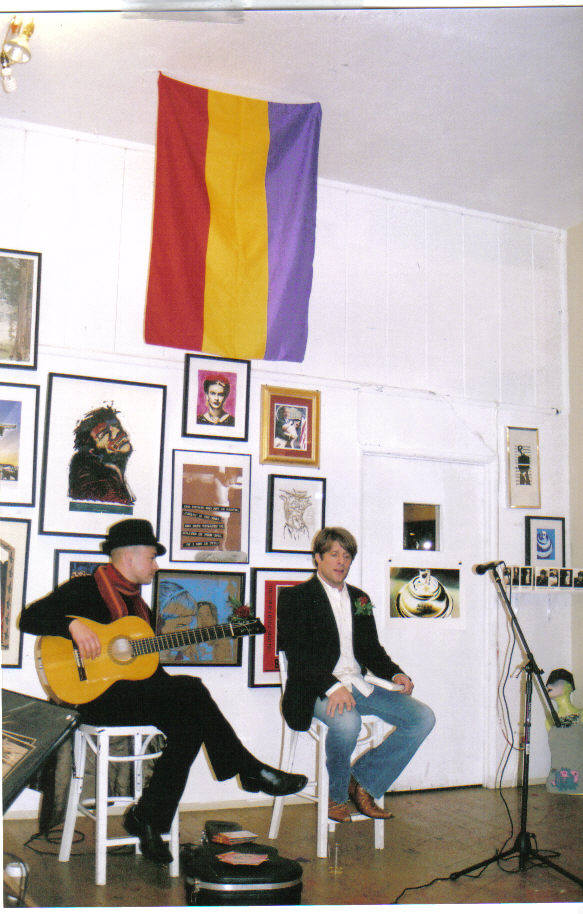
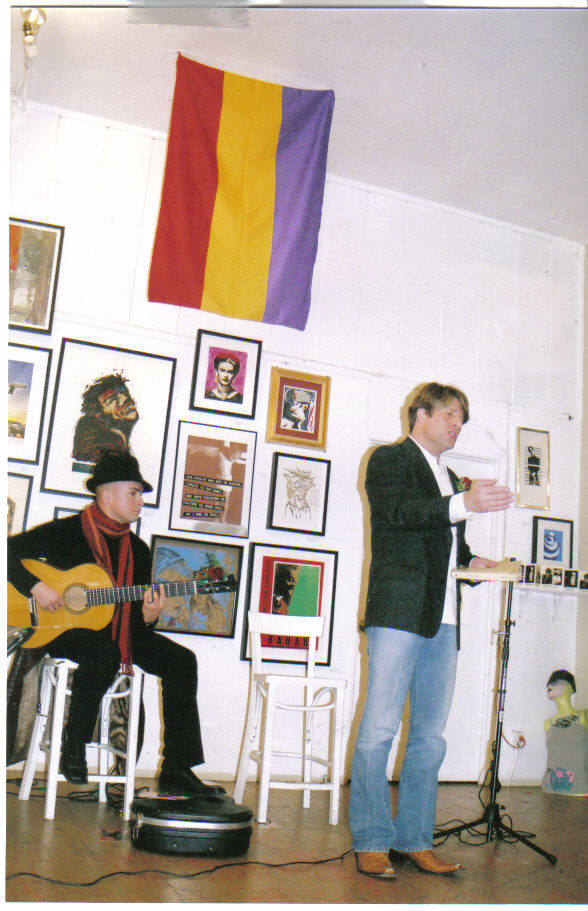
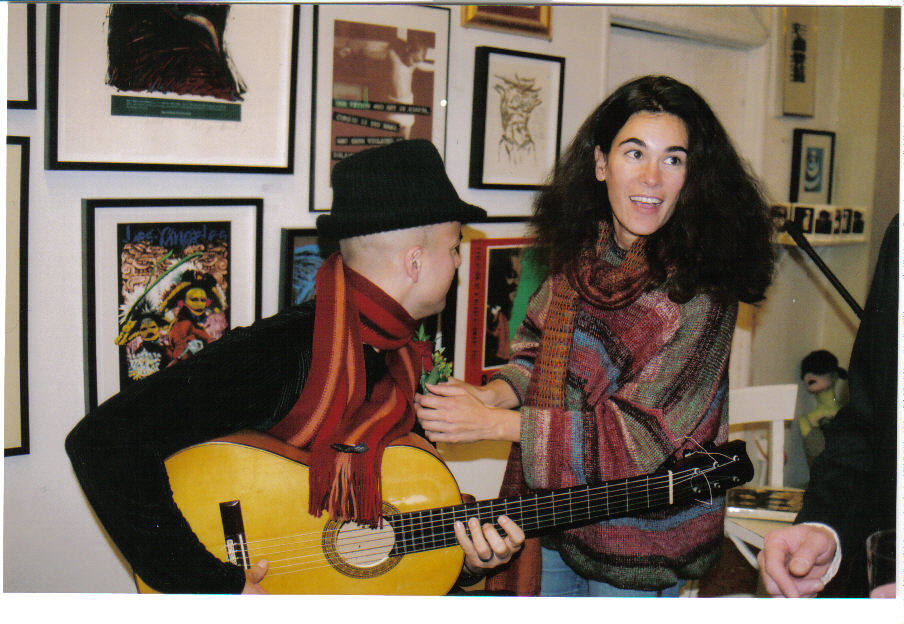
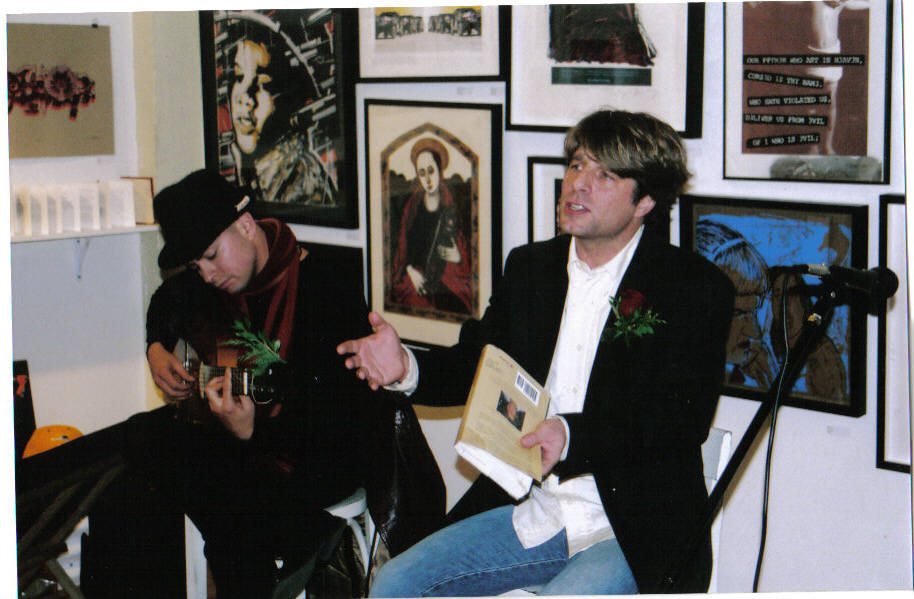
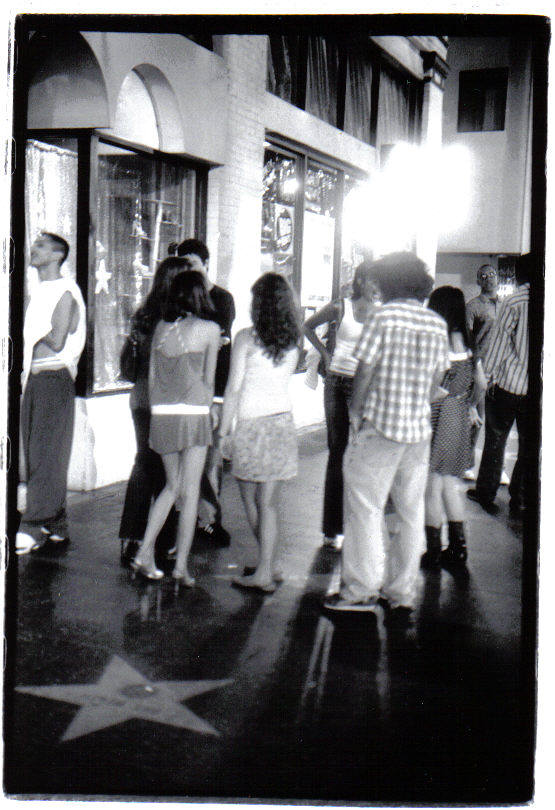
Above are some photos from the scribe's reading of "Vedette" at 33 1/3 Books & Gallery Collective on Dec. 15 in Silver Lake, Los Angeles. They are taken by Anna Siciliano, the scribe's wife, and Frank Bruynbroek http://www.fbsiteonline.com/fb_book/index.html .

At the top are two shots of the scribe and Omar Torrez, with the flag of the Spanish Republic overhead, provided by Izquierda Republicana (Republican Left), a political party dating back to the Spanish Civil War.

Next is an image of the riveted audience.

In the fourth from the top, and left to right are Omar's wife Masha, Omar, Llem (the bookstore owner), the scribe himself and Mrs. Scribe (Anna Siciliano).

After that are Masha and Omar.

Following are, well, you get the idea.

After six weeks of hanging posters, e-mailing, calling, reminding, and leaving fliers all over town, 15 people attended.

15.

John Tottenham, a local writer and the most English man the scribe knows told him 15 wasn't so bad. "Remember, Martin Amis said a game of Scrabble qualifies as a literary event in Los Angeles."

In any case, the whole thing worked and with the help of six bottles of flamenco sherry (do the math!) the event turned out downright jovial and the scribe felt great about it.

Thanks again to those who came; for those who didn't maybe we'll do it again.

The Real Vedette Revisited

Through the miracle of the Internet, highwayscribery was contacted by either a niece or nephew of the real Vedette, Gloriella. Our reportage was all wrong ("The Real Vedette," Dec. 16), but we were getting the information from sensationalist Mexican tabloids and in no position to dig up the real stuff (this is all free work here folks). Here is the "comment" from La Vedette Gloriella's family member:

"My aunt Gloria passed away on December 2, 2005. She left us too soon, she was so full of light and energy and was so much fun to be around. I miss her so much. She died at her Real Estate office in the city of Colima where she was born and resided. My Aunt even in her 50's was still a bombshell! Her beauty in these pictures is no comparison to the beauty that she was in person. Thank you for writing kind words about her. I know if she had the opportunity to see your site, you would have met her. "

The loss is the scribe's, too.

Saturday, December 17, 2005

The Sidewalk Smokers Club - Chapter 61


Chapter Sixty-one

Vindaloo Baxley was the gift that kept on giving. Clarisse was now more than just an artisan-for-hire. She’d become something of a confidant to Vindaloo who was, of course, a lonely famous rich girl.

The moment of their coalescing came just after Eilin had captivated Jordan’s attention for good. Clarisse had seen the boisterous and self-confident personality go pale upon looking back out to the sidewalk where the smallest advantage she’d ceded as a courtesy to Jordan had led her to lose him. Now Vindaloo, because another woman had bested her, decided that she really liked Jordan whom, despite his somewhat sloppy and clumsy life, has wracked up a pretty good record where admiration amongst the womanry is concerned.

Vindaloo was too busy creating an image of pure and hip happiness to spend any kind of time on her true emotional well-being, so that in the days immediately after she never put any particular plan into action for winning Jordan over. Clarisse could see that Vindaloo could see that Eilin had the game sewed up and that she was candy-striping her defeat in their little conversations about seduction and such. And Vindaloo could see everything Clarisse was seeing, which is how she came to be the luminary she was in the constellation of actresses. Which is to say that Vindaloo wasn’t stupid. And they were able to keep these truths to themselves and deal with each other affectionately. An important adjustment if you’re talking sorority.

Anyway, the point is that with Vindaloo busting her coffers with sick money Clarisse decided to chip-in and help solve some of The Smokers’ outstanding financial problems. Despite her spot-on assessment that these were the times in which she was to make hay and set up a better, more comfortable future, something in Clarisse’s Catholic upbringing left her with the nagging feeling that this had all been too much fun, that her gains were ill-gotten, that she was an egocentric and frivolous person and was being rewarded for it.

It did not help money matters much that those wanting to assist The Club could almost never locate its members. Each was operating on the fly, improvising in a game they made up as things went along; dodging capture by exactly whom they could never be sure (except Jordan).

With all the telecommunications advances in the world at her fingertips it took Clarisse the better part of a day to finally catch up with Corey, at night, in a hospital where Randall was under observation.

Her common law husband was wrestling with two matters: the first was how to square away Randall’s collapse with the fight for sidewalk smoking rights. What would he say when they pointed out the yawn between what The Sidewalk Smokers Club represented and what Randall’s health said about it? Corey thought it was pretty stupid that they had not seen this coming. They’d hitched bum philosophy’s cart to

The Sidewalk Smokers’ celebrity and now the two things were at odds.

Second was the matter of paying for Randall’s spin through the luxurious world of rolling gurneys, underpaid medical attendees, and whining patients.
The money from the tobacco lobby would pay for the costs of floating Yvonne’s case for as long as possible, but the enterprise was not up to providing health care.

Still they were The Sidewalk Smokers Club and couldn’t very well abandon Randall to his own devices without being noticed.

At least not while he was sitting there like a phantom, still weighing The Smokers’ prospects, worried the media would soon find out about that tobacco money, which they were going to be need along the low road, or even the high road.

“What they shouldn’t find out, they do,” Randall had said earlier, before surrendering to the high-tech chemistry coursing its way through his veins, heart, brain and secondary body organs. He gestured feebly for his notebook and pen on the night stand. Corey handed them over. Randall wrote. Corey marveled and envied his friend the energy and dedication. Randall knew this and kept to himself the fact that there wasn’t anything noble going on; there was simply nothing else to do.

Then Clarisse came in with the money necessary to hire Geffner. A quick sketching of the circumstances however, transformed her contribution from its intended purpose to that of health care. As has been said, The Smokers were adjusting on the fly.

“Sheet.”

By this she meant that paying Randall’s bills was not exactly what she’d had in mind. She’d wanted to help the whole group. Corey, reading his wife’s face as only a husband can, explained that Randall’s health was for the good of the group and Clarisse wanted to say that remained to be seen, but she didn’t. It was something of a breakthrough and Corey was present to witness it. Resorting to her usual grace Clarisse handed Corey a blank check and washed her hands of the matter.

Meanwhile The Smokers, despite their problems and complicated agendas, were still hot because Corey’s fax blast of the major and minor outlets reaped a number of calls beyond what he could disguise at work. They were just about done with Corey at that place, but afraid to fire him outright for the simple fact he seemed up to something – hatching – and if he was, they did not want to waste their investment in him. They owned what went on inside his head, and thought they wanted it; unaware of the bum philosophy or The Sidewalk Smokers Club, inhabiting a parallel universe as they did, with different games and different prizes and diversions.

He decided to force the issue and take what time he needed for his outside enterprise while providing the lamest of pretenses for springing himself from doing nothing around the office. He wanted to get fired and take advantage of the unemployment benefit – a matter of efficiency to him, recuperating money that had been paid out. There is something of the shark in Corey and reason has served him well up to now.

So he departed with a list of return phone numbers to call and set up a press conference on questions regarding Randall’s health and an overall update on the activities of The Smokers.

Chapter Sixty-two

Dumburton contacted Jordan and suggested a meeting between them. J. considered resorting to one of his many avoidance mantras, but something in the detective’s voice told him liberty might well be at hand.

They set a meeting at Java World so Jordan felt like he was on home ground, even if he no longer worked there. As Dumburton approached he tossed a nice tight-packed pouch of Drum Jordan’s way. J. read the cop’s language and understood that he’d gotten it all wrong. His time was up.

“How’d you-”

Dumburton couldn’t wait for him to finish the question before answering. “That day I took you in. I asked you for a smoke without marijuana and you gave it to me. It was the sample I needed.

“Here,” and he threw a manila folder on the table between them. “Have a look.”
Jordan was too busy marveling at how the tobacco had gotten his goat and not the marijuana he’d cavalierly smoked in Dumburton’s face.

“Open it!”

Jordan did. He could see it was an affidavit signed by a man named Henry Jones saying he’d seen the Angel Without Mercy and that the smoke from Drum was what he smelled the night of the old lady’s untimely and tragic death.

“I think they call that circumstantial evidence or hearsay or some such notion that translates into you having nothing,” Jordan returned the folder to the table.

“Not coupled with an ID. This guy remembers you. He’ll pick you out of a lineup.”

“What if he doesn’t want to?”

“You suggesting you’d tamper with the witness you little pussy?”

“We wouldn’t tamper. We’d just get out the cuerno de chivo.”
Dumburton’s face clouded. “Did you say what I think you just said?”

“No.”

There were a million ways to get you. Your average grandmother was probably guilty of breaking three or four important laws. In having to deal with it daily, Jordan’s humility before authority had grown. For it struck him that the detective could put some cuffs on the suspect, drive him out to a place of cliffs and cathedral-like launches of upward rock, shoot him in the head and toss him over on some particularly inky night without fearing any call, at all, to accountability.

“It could happen,” he told himself, fighting back some comment sure to upset Dumburton’s flimsy control of his darker selves. It was a decision rooted in J.’s firm intent to stay out of jail at all costs and thereby consort with his passion friend.

Simultaneously, the detective thought he saw something like fear finally wash over Jordan’s face. It may have been more like fatigue, but that was okay. Dumburton would have to settle for it given his quarry’s admirable talent for dissimulation.

“Anyway,” he said violently swiping the folder off the table, causing a flinch from Jordan’s quarter, “you’re off the hook. I could nail you, but you’re off the hook.”

Jordan hadn’t gotten it wrong after all. He was free. He could feel it.

“The orders from upstairs are to turn down the heat on this, bury it until things blow over,” he said dejectedly, disgustedly. “Politics are involved now, your smoking friends, a real mess. Nobody wants to touch it in an election season. So you walk.”

“Aren’t you giving up a little too easily?” Jordan said rather counter-intuitively.
“Look,” Dumburton said before wetting his nose in the double cappuccino, “No one knows better than you how I put plenty inta this thing.”

“Yeah. You did a bang-up job.”

“It was a good issue,” Dumburton went on. “It had promise and national implications.”

Jordan was unaware the detective harbored presidential ambitions.

“So you’re saying, it sounds like to me, uh, c’est la vie. That even though you’re certain I killed the old lady. It’s time to move on.”

Dumburton nodded “That’s right and that’s the difference between you and me. I feel obligated to do as I’m told, you feel obligated to do the opposite.”

“My world’s freer,” said Jordan.

“Mine’s safer and cleaner,” responded Dumburton, “which is a kind of freedom, too.”

“Except if you’re unsafe and dirty.”

Unsafe and dirty were the objects of Dumburton’s personal crusade and he could not understand how a nice boy with almost every advantage like Jordan would throw his lot in with the insecure and filth-ridden, the whiners, moochers, and marchers.

“Jeezus, Dumburton,” Jordan decided to make use of his face-time, “you hounded me like an obsession.”

Dumburton nodded benignly. It was merely part of a larger day’s work.

“No, what I’m saying,” Jordan put a forefinger in his former tormentor’s face, “is that you fuckin’ hounded me. You disrupted my existence. Tried to end my life.”
Jordan was trembling at first, but the steam was blown and next there was a relaxed air rising between these two representatives of distinctive demography.

“You forget a lot of the fear came from the guy tailing you and that had nothing to do with me. I was only half your troubles pal. And by the way, you need to settle down.”

Jordan was taken aback at the level of intimacy Dumburton employed, but even more amazed that he was wise to Carlos’s bodyguard.

“Anyway, I get a little edgier where old lady killers are concerned,” Dumburton appealed to Jordan’s reasonable side.

“That’s not police work. It’s thuggery.”

“Fill in the blanks of my response for me,” said Dumburton with an easy snarl.

“That’s what you’re paid to do?”

“Thaaaaat’s what I am, a thug,” and his tone jumped an octave in a burst of confessional rage. “I’m a third-degree black belt in karate. I can bust a man’s heart from fifty-feet away with a good pistol. I corner desperate men and subdue them.”

It was one hell of a job description thought Jordan who, despite his guilt, resented being grouped together with the kind of men Dumburton was going on about.

The case dispatched of, the rosy tinge of fading youth restored to Jordan’s cheeks for the first time in months, and now there was a dearth of things the two men might talk about. They had ceased to share something, anything, in common. Or had they?

“I guess it was time for the old coot to drop, huh?” Dumburton raised his eyebrows at J. who was sticking with the plan and refused to comment. The cop stuck out his hand. He wanted bygones to be bygones. Jordan wanted to punch him in the face for abandoning him to the mediocrity of life as a non-suspect.

Dumburton took the hand back, smiling naturally. “Ah, you’ll get over it with time,” which Jordan thought was very true and therefore very aggravating. Dumburton continued to sweeten up the dish. “This is life, things happen. Give me a call sometime.”

Give me a call? The detective dropped his card on the table in front of Jordan. “You’ve been a worthy opponent and you’ve got balls.” Jordan thought he could have done without the wrestling match and learned such things about himself some other way.

“Reason I say so is because my brother...he has a little marina up the coast. He’s tired of running it and he’s lookin’ for somebody to step in. If I weren’t committed to the force I’d take him up on it myself. It’s a creampuff job. Comes with a life on the water, great big boats, girls out the ass and a house big enough to fit you and a kid if you wanted. You just tie up the yachts, you just let out their rope.
Tie ‘em up, let out their rope. It’s a sweet life.”

The rhythm sounded simple enough and here was this dreadful man offering entree. He wanted to say yes, Jordan, but sagely opted for a little meditation first. This was, after all, Dumburton and the association would take some getting used to.

Noting Jordan’s numbness the detective gestured and went on his way, excited at the idea of his visit being of momentous event to the younger man.

Friday, December 16, 2005

The Real Vedette


In the bibliography of the scribe’s book “Vedette,” it is noted that, “Finally, it is worth pointing out that somewhere in Mexico there lives a real Vedette Gloriella. Apparently, she was something of a sexual bombshell whom appeared in a serialized pictorial magazine 'Rarotonga' in the 1960s and 70s. I read an account of her arrest following an attempted robbery of a gas station in the Mexican interior. I had never heard of a 'vedette' and began looking into the origins of the word. The rest, as they say, is history.

Well, as the scribe was doing a Google search for reviews of the novel, news out of the Mexican press turned up that she had been killed 9 days ago. Just 52 years old, Gloria Cárdenas Sandoval had retired from the stage and screen and lived by renting apartments in a building she owned somewhere around Mexico City.

There are few details, only that a man walked into her office, shot her once in the chest, driving her to the ground, and then stood over her to finish the job off with a second shot, before running away. He has not been detained.

the scribe fantasized that someday he would meet the real Gloriella and explain how her own story had inspired his signture work, but it was not to be. Instead her tragic death only serves to underline the terrible situation, circumstances, and violence women the world over remain exposed and vulnerable to.

Her feminine charms diminished, the second half of her life was not only sad and difficult, but too short. the scribe mourns Gloriella in an odd way, from afar, this woman he read about only twice in 15 years, but whose story opened a powerful and fateful chapter in his own life.

Monday, December 12, 2005

The Case of Tookie Williams


the scribe just received a press release from the Governor of California, Arnold Schwarzenegger’s office. He has denied clemency to Stanley “Tookie” Williams.

There is an accompanying, five-page “Statement of Decision.”

Forgive the scribe if, in all the death-laced sobriety, he still finds humor in the idea of somebody’s life being in the governator’s hand.

Or maybe you shouldn’t.

There is little in the document to suggest the matter was as soul-wrenching as Schwarzenegger would have us believe. There is a pretty nuts-and-bolts description of the original crimes (reproduced below), a fairly pat validation of all the court proceedings related to the Williams’ case, and a certain disdain for the convict’s conversion and redemption.

The document observes that Williams dedicated his 1998 book, “Life in Prison” to Nelson Mandela, Angela Davis, Malcolm X, Assata Shakur, Geronimo Ji Jaga Pratt, Ramona Africa, John Africa, Leonard Peltier, Dhoruba Al-Mujahid, George Jackson, and Mumia Abu-Jamal.

“The mix of individuals on this list is curious,” Schwarzenegger (or someone who writes for him), noted. “Most have violent pasts and some have been convicted of committing heinous murders, including the killing of law enforcement.”

That stinks very highly of culture war rhetoric, targets the rebel class in this country and others, while being more suggestive and general than true in its particulars. the scribe might point out that, like the Williams case, the “guilt” of some listed has always been laced with the hint of racism and injustice.

So be careful what you say, because of what they might accuse you of doing.

The document reads in part: “During the early morning hours of February 28, 1979, Williams and three others went on a robbery spree. Around 4 a.m. they entered a 7-Eleven store where Albert Owens was working by himself. Here, Williams armed with his pump-action shotgun, ordered Owens to a backroom and shot him twice in the back while he lay face down on the floor. Williams and his accomplices made off with about $120 from the store’s cash register. After leaving the 7-Eleven store, Williams told the other killers that he killed Albert Owens because he did not want any witnesses. Later that morning, Williams recounted shooting Albert Owens, saying, ‘You should have heard the way he sounded when I shot him.’ Williams then made a growling noise and laughed for five to six minutes.

On March 11, 1979, less than two weeks later, Williams, again armed with his shotgun, robbed a family-operated motel and shot and killed three members of the family: (1) the father, Yen-I Yang, who was shot once in the torso and once in the arm while he was laying on a sofa; (2) the mother, Tsai-Shai Lin, who was shot once in the abdomen and once in the back; and (3) the daughter, Yee-Chen Lin, who was shot once in her face. For these murders, Williams made away with approximately $100 in cash. Williams also told others about the details of these murders and referred to the victims as ‘Budda-heads'."

Williams might have gained as much economically by having a garage sale, but he didn’t and for choosing such a ghastly way of getting his money he should have his freedom and pursuit of happiness in the outside world revoked. It’s enough in Europe for the worst killers and crooks, why isn’t it here? Why do we have to taint the public enterprise by engaging in behavior (killing) that we supposedly abhor?

Is the message that injection is more humane and therefore validate’s the state execution as civil rather than savage?

the scribe should think not. By any anarcho-syndical analysis (our specialty here at highwayscribery), we must govern by example and understand that when we kill, we encourage killing. That when we govern by love, we may someday come to love one another.