Saturday, August 25, 2012

"Sammy Beneath the Freeway" by Stephen Siciliano


AND ON SUMMER EVENINGS, the kind where the sun beats on your head while you walk the streets all day and then - wham! - it’s gone and suddenly cold the way it always gets in the desert city-by-the-sea, Sammy would lock the whole world out of his room in the big house beneath the freeway to be alone with the maddest passion in the barrio - Elena Gutierrez - while cars whooshed by above their lonesome loving heads.

He helps her shed her clothes: classics. And I love you and I love you and I love you. And he feels here warm Summer breath against his chest of tattoos and gold chains. And the window is raised halfway, and sirens and endless moaning buses make noise all around them - as they embrace, skin dancing on skin, engendering gentle shudders and a parade of exquisite passions. And the clock stands still, breathless, and the city waits, breathless, outside his window for Elena to embrace them, too.

Abuelita

Abuelita once banged hard against his door with a heavy shoe - and him with Elena Gutierrez in there! She demanded that Sammy open the door in a way that said she meant what she said, and Sammy said, “Shhhhhhh.” He told Elena, “Be quiet and just act like you’re not here.” She told him, “I’m not and never have been. You’re such a dreamer Sammy.”

They just looked at each other for ten seconds, neither saying anything and neither really understanding what it meant except that it couldn’t be good. Downstairs in the kitchen, Abuelita - little grandmother - waited so that she might have a word with Sammy about women and lust and this being a good Catholic house. But she never had a chance to open her mouth because down came Sammy half hysterical at his unspent passion. Ranting and raving and finally growing sad, almost crying, looking out the kitchen window. “Goddamn it - what are we going to do about this arbol triste, this sad palm tree crying all over our front walk!” She snapped at him forgetting herself. “Sammy, don’t you dare take the Lord’s name in vain.”
She pleaded urgently: “Sammy, I don’t understand your modern world, your electric everything. I don’t understand your language. I don’t understand at all where you are coming from or rushing to. Good God, Sammy, isn’t there anything I can do to help you?”
Then she would get up slowly and place a dark veil over her face and leave to meet with gray ladies like herself at la misa where they would kneel and say prayers and sing sad psalms for el savior, the salvador.

He’d argue with Abuelita whenever he was around her. There was not one iota of respect for what the other generation thought or learned on either side, and she spit gray language at him and stared him down with gray eyes beneath gray brows. Just gray gray gray, that’s what he thought of when he thought of her, and it was too bad because she really loved him. She’d grow concerned and tell him of a time when the world was not so shamelessly mad and go on and on about education and jobs and how in the days of the Kennedys - and he would say, “To hell with the Kennedys. Nothing’s changed. Nothing.”

When Sammy finally got a job at the Davis Pleating Company for el minimo wage he almost immediately got involved with Jaime Torres and his rag-tag union of garment workers. Abuelita tried to warn him, to stay working, to stay away from that union - it was no good, Sara Martinez said it was ridden with Sandinistas and terrorists.

But when that son-of-a-bitch called the migra to clear out the organizers because they were all illegals anyway, they called a strike and they struck and struck and struck for months on end, sabotaging the factory and chanting UNION! UNION! UNION! at the lunch hour. Finally the company went broke and Abuelita said, “See now? What the hell good is a union without a plant in which to earn money?”

“If they start it, we can finish it,” was all he could say with his catkid kind of smile. “If they start it we can finish it.”

After Sammy shot the guy from Whittier dead because it’s an eye for an eye in this life, he said without blinking that he had not seen the face of the vato he had shot at the back of his poor stupid head. He just went with a feeling inside that told him it was the guy that shot his cholo long long before, and then he went to church to pray because Sammy believed in God when he was afraid or when he was sure he was gonna die.

Abuelita prayed for days when she heard, in church no less, that Sammy had killed another man, and she scolded him for days and stopped cooking caldo for days and decided that it was this goddamn barrio that had taught him to do these things, and he told her, “The barrio is just fine Abuelita. What about out there in Chino where they killed that whole entire family and chopped them up with axes and slit that little boy’s throat leaving him for dead? In Chino, Abuelita. In Chino.”

It had nothing to do with age, really. His street friends and cholos didn’t understand him any better, and he would be walking on the streets with them and the sun would be shining - but with the brightness filtered out by the filth in the air - and he would say, “What kind of fatal sunshine is this?” And shake his head, and they would spit on the ground and look at each other through squinty eyes, and nobody knew what the hell he was talking about.

It was orange and purple and beautiful, just like it had always been.

He looked at them poor stupid fools, all his beloved homeboys, and wondered, “How could it be that all these young cholos, the first Californians, be nothing but dirt in their own tierra of Aztlan, and what a bunch of losers we all are to never be the masters of our own destiny, to be condemned to eternal night-and-day passage of cars on the freeway above our heads and, after all, was this fair?”

Still, he was the happiest sad person that the wide streets of the town had ever seen, and before heading out on one of his endless boulevard nights, he would grab a handful of change from Abuelita’s silver cup for the gray-bearded bums and boys he would meet in doorways and alleyways of Streetworld, Eastside, L.A.

Puta

One chemical twilight along the Broadway, he fell head over for a perfect puta pushing herself on whomever. Sammy watched her sweet face and he wondered aloud, “My God, I would do you for love, poor puta. How can you do it with anyone and just for money?” And she told him straight away, without breaking stride or even stopping to look at him, “I can’t eat love, vato.”

He watched her roll past him down the street until she had gotten almost too far to hear him before shouting, “Go ahead, woman, and find your many sugar daddies and do what you must to survive in this terrible gringolandia. I’m sorry for bringing up love in this hopeless place. I’m sorry. I...am...sorry.”

Portia...

Late late at night, Sammy drank coffee and smoked mota and listened to the radio for this girl deejay on some forgotten fading-in-and-out station named Portia with a voice as smooth as streetsmack or midnight crack. He would listen for a while and then call in requesting this rap and that jam, and finally he began talking to her, holding full-blown conversations with her for extended periods of time, and everybody listening in. And, in doing so, he became a latenight legend - a sort of street prince. Really. Everyone knew this kid Sammy.

...And What He Told Her

He told Portia that all musical history, as far as he knew, was “nothing but white people and Rolling Stones ripping off what the blacks had thought up all on their own and turning it to money.” Now, there was no great love for the blacks, as between us we had what was left of the rest, but we were all niggers somehow, and the whole barrio nodded in solemn agreement in the earliest hours of the so cool cool California morning.

He told Portia about his fantasy girl, a white girl, the kind with taught face pulled down over high cheek bones. The kind in perfume commercials with sullen gray eyes and a cotton dress draped over a skinny skinny body.

He told Portia about his fantasy house. It only had to be a simple place where grayness could filter its somber way through a window of countless hanging green plants. It needed wooden floors and two pillows for each of their lonesome loving heads and maybe soft piano music that would echo up and down the wooden corridors of the simple city home of him and his gray girl in the cotton dress, and was that asking too much?
“It is from me,” Portia told him and giggled sexy, ruining the whole thing saying, “I’m a deejay and must avoid things gray at all costs. It’s a matter of professional necessity, Mr. Sammy Streetprince.”

He told Portia that he wanted to travel and see and meet and tell people that he was from a city where the poor begged the poor for money with little styrofoam cups. A city where deer walked in the gardens of castles in the hills and looked over an immense carpet of ribbons of white light that crisscrossed and endless valley, where dark silhouettes of Mexican palm trees popped up haphazardly like exploding fireworks of shadows and dark velvet.

A city where coyotes came down one cool evening and killed Abuelita’s rooster chained to a tree in the backyard.

“Some inner city,” he wondered over the airwaves. “Some inner city,” he said.

What She Told Him Then

“Quiet now, Sammy, my thunderbird prince so that I can play this cryin’ baby bluestime record for all those people who have forfeited the gift of sleep forever. Good night.” That’s what she told him.

The Cocoa Girl and Her East L.A. Blues...

One Sunday, after watching the Raiders and finishing up his carne de res, Sammy wore black gloves and rode his huffy bike up and down the street poppin’ wheelies for the rucas and firme baby dolls waiting on the corner - always on the corner.

“Que-vo-let Sammy!” they shouted at him, “You probably thinking you a kind of bad dude or sumthin’.” They were all there - Lil Payasa de Los Angeles, La Giggles (the one with the gun) and La Bambie de East Dallas - all watching and acting as if they thought Sammy was some kind of fool.

Sammy rode over to the teen angels like he was the baddest vato in the whole of Aztlan, checkin’ El Chivo’s chola and sizing up that new one, that sweet lil’ sad girl. “Oh!” under his breath, “La Bambie de E. Dallas! Soy tuya mi amor.”

She was a small girl with a kind of cocoa complexion and blue eyes by God knows who, and she left with Sammy, and the rucas began talking as soon as they were out of earshot. “Wait ’til La Crazy Loca hears about this,” Chata Galava did say. “Wait until she hears.”

Sammy walked and talked love with Bambie and he told her like he told them all that she was the most beautiful chola in all of Califas and that now he was la chola’s vato - her vato.

Then they drifted across town. Walking and taking the bus, walking and taking the bus, because nobody gets anywhere in this town without wheels. So much so, Sammy told the new girl, that the first thing he taught a new brother fresh from the rainforests of revolution to the south was how to say, “Five bucks gas please.”

“How else could they survive, Bambie? How else?”

Finally he made love to her gently, like with Elena, up on the two hundred steps of Micheltorena while the greasy smell of carne asada drifted up from Zamora Bros. carniceria way down below, and Sammy seductively securing her delicate heart, barrio blossom baby, for his growing garden of love. She flipped for him. Just flipped.

The next Saturday, when Sammy finished his carne de res, he wore black gloves and rode past all the firme baby dolls on the corner. They were always on the corner.

Bambie glowed in anticipation and licked tamarindo from her icy little fingers. She waited patiently. After all, he was her vato, and all that stuff with La Giggles was just Sammy playin’ - wasn’t it?

But Sammy did not come around to her and instead left with another ruca, telling her that she was the most beautiful baby in all of Califas, whispering the same steamy “soy tuya mi amor.”

...And What She Wrote Sammy

La Bambie de E. Dallas wrote a dedication beneath the crying palm tree on the sidewalk in front of the big house beneath the freeway named for another goddamned Spanish priest.

to Sammy from little ruca sadgirl
the one who really love you
lo mucho que te quiero/my room
is lonely without you...
...let’s get it on

But these words were wasted ones, and soon the heart was broken forever, and the girl from East Dallas joined the thousands of others like her - the suffering madonnas de nuestra señora la reina de los angeles: riding the bus, toting children, never shaving their legs (letting the hair grow long on them) and working in la fabrica o la tienda.

What the Operadoras Said

Feeling for La Bambie and the hurt she carried forever inside, Abuelita warned Sammy that things go around and around in the timeless barrio. Sammy laughed at her for hours on the front step, just laughed and laughed - because he didn’t really have much to do or anywhere else to go anyway.

And soon after...he had his heart broken, too. Poor Bambie had heard the operadoras and sweatshop seamstresses saying that it had been the doing of La Crazy Loca from the 18th Street Gang. She’d heard them laugh, satisfied. She’d heard them say, “So he’s finally stopped playing reggae.” That his silly revolution had finally faded away.

She’d heard them say that Sammy had joined all the men in the doorways of downtown. The men with the enormous stomachs and sad eyes who stood growing old nursing countless Coronas, bottomless-bottles-of-beer men who watched the broken hearts in the buses go by.

Thursday, August 09, 2012

The Day 'The Marc' Died


"If it be radicalism to believe that our natural resources should be used for the benefit of all of the American people and not for the purpose of enriching just a few...then, Ladies and Gentlemen of the House, I accept the charge. I plead guilty to the charge; I am a radical and I am willing to fight it out until hell freezes over."

On this day in 1953, Vito Marcantonio fell dead on the streets of New York. He was downtown at City Hall to file for a run at his old Congressional seat.

The "New York Daily News" rendered the scene these passages:

"Drenching torrents greeted him as he returned to his law office from a weekend in Connecticut on a summer Monday morning. He was hatless and raincoatless as he got off the train at City Hall Park, and he began to trot through the downpour, and he was just at Broadway and Warren St. when he quietly dropped dead.

"Rushing through the rain themselves, New Yorkers in their fashion ignored the fallen man on the curb for 10 minutes or so. Finally, a passerby alerted a cop. A priest from nearby St. Andrews was summoned to administer extreme unction. One of the dead man's law associates came down to identify the body. Someone eventually thought of retrieving the forlornly soaked gold-initialed briefcase from the gutter."

And such was the day The Marc died.

We can console ourselves in the fact that there are no happy endings when it comes to the final step, and instead focus on what the man was in life.

A titan of New York and national politics, at the height of his power, he could enter the Democratic, Republican and American Labor Party primaries and win them all so as to avoid a general election fight.

He had allies in culture. Dashiell Hammett worked on his mayoral campaign, writer Howard Fast drafted political literature. He was allied with Dorothy Parker and the patrician painter Rockwell Kent.

For all that bohemian glitter, his biographer Gerald Meyer insists, Marc mostly played cards with the Italians in his East Harlem neighborhood where he was born and which he never left.


His own loyal constituents declaimed him "The Bread of the Poor," for his vision of a Congressman as an all purpose helper and guide through the system. And this he did in ways too numerous to list here. Needless to say, it was practical, hands-on kind of stuff.

In return, their support allowed him to withstand the attacks of columnist Walter Winchell, a full bore assault waged by Tycoon William Randolph Hearst through his newspapers, and a blanketing surveillance launched by J. Edgar Hoover at the FBI to win some 12 noisy years in Congress for himself.

There, he was a phenom, a shock to the southern gentleman who ran the shop and expected deference from junior members. Blessed with a golden beak, The Marc was also a master of the substantive game. The House Parliamentarian said Marcantonio was the only one who knew more about procedure than him.

Controversial in the Italian-American community for his unabashedly left-wing life, Marcantonio is an unblemished saint in the Puerto Rican community.

They were part of his district with strong links and recent links to their Isle. He saw them impacted directly by the politics of Puerto Rico and made it a point to intervene in its affairs on behalf of its beleaguered residents and his own neighbors.

He was a friend to black people and worked with disparate elements in that community such as Philip Randolph of the Pullman Car Porters Union and famed singer and activist Robeson


He fought to successfully open the arms industry to the employment of African-Americans during World War II.

He was a constant thorn in the side of President Franklin Roosevelt for his nettlesome introduction of anti-lynching and civil rights measures. These ran against the wishes of powerful Southern Democrats who killed them in exchange for articulate, public dressings-down by The Marc.

He told one such congressional rival that he was ready to campaign in his district and affect his defeat. The southerner said that Marcantonio campaigning against him could only help his cause.

"Oh I don't plan to campaign against you," Marc responded. "I'm going to campaign FOR you."


Hopefully we've taken the sad date and turned it on its head. Made it more of a celebration through remembrance. Why? Because sometimes we owe it to those with lives exemplified by self-sacrifice and service to the weak among us.

Marc's was one such life.

Thursday, May 24, 2012

"Believe in Eve"


"The Intra-realist borrows from all the failed movements of time, flings its way through the 'isms' the way it would through the scarf section at a thrift shop."

The Intra-Realist Manifesto

highwayscribery viewed the feature film "Believe in Eve," a night or so ago, and hasn't stopped replaying it since.

"Believe in Eve," was well-accepted in some dark and dank corners of our culture. But generally speaking, those of us who created and brought it to the big screen were mostly subjected to insult and ostracizing in the immediate wake of its 1990 release.

The movie was produced by elegant Mob Films, an evolutionary step in the artists collective of the same name that thrived in late 1980s Los Angeles.

The spontaneous clustering occurred around "READ" magazine, a literary review circulated at a nightclub of the same name started by Larry Karaszewski, Jaime Glanz, and Nick Griffin.

The magazine was run by Antonio Mendoza, Jose Perez de Lama Halcón, and the highway scribe. There was a core of some 20 regular contributors and a total of around 75 rotating poets, graphic artists, photographers and performance types who added to both the review and public events thrown at Zatar's Bar on Wilcox Ave. in Hollywood, and at Gorky's downtown, to name only the regular happenings.

One of those contributors, Javier Gomez Serrano, asked the scribe to script the movie Javier had in his brain. Jaime Glanz loaned the scribe a photocopied book with a title like, "How to Write a Screenplay and Make a Million" and a few weeks later, there was a script for what would eventually become "Believe in Eve."

The various currents of which The elegant Mob was comprised coalesced around the effort. We had the numerical might to cast and fill out scenes and crew with our own crowd and enough cachet as an edgy, artistic outfit to convince producer Jose Vergara we were worth a shot.

The powerful negative reaction we experienced would lead all but the most mature of artists to recoil from their own creation.

But 22 years on, highwayscribery feels only pride. It boggles the mind that a group of dynamic young people gathering their own resources, and leaning upon one another to make the film, should have been so maltreated, rather than granted the careers they richly deserved.

We were the honest ones.

True, we had no notion of the film industry's workings or of its commercial demands. If we had, we would not have cared a damn. We were intra-realists, disdainers of Mammon. What we cared about was the film being what it needed to be, which was what we wanted it to be.

Quaint, yes, but genuine to the extent that was the energy which drove the project.

When the scribe would view "Believe in Eve" some years after it was made, he gnashed his teeth at the metered discussions and the ornate alliterations from the script, ashamed they were amateurish juvenalia compared with the crisp and charged dialogue that would mark his later screenplays.

But The elegant Mob was, after all, a group of poets. The films that jazzed us were "Un Chien Andalou" and "Sang d'un Poete," and we sat around most nights writing poetry or reciting it somewhere.

It was only natural that we create a lyric and theatrical work for film. It was an "Art" film and announced itself to be so in the very first scene, which entails a furtive and tense walk through a gallery replete with Sergio O'Cadiz's renderings of Eve, the mother of all human beings.

In retrospect, the actresses, Monique Salcido and Anna Nicholas (Ann Royal), appear pitch-perfect and absolutely gorgeous. Alex Sellar as the wayward Juan Roman is thoughtfully nuanced. The powerful Keith Coleman maintained a menacing presence as Dash, while Andrew Koch made a Franval out of whole cloth, ignoring the script, yet somehow remaining sensitive to its boundaries.

Gene Butler's rendering of The Reverend seems now like something of a life-saver, his interpretation wresting some of the highway scribe's youthful rage from the role, tainting it with a dark sarcasm and terrifying congeniality.

the scribe did not see this at the time, because he'd imagined a movie in his head and transcribed it to paper, and these were not exactly the characters he'd had in mind. But the thespians, in the end, knew the characters better than the person who created them. And this is the magic behind the collaborative film process.

"Believe in Eve" represented the Platonic ideal of collaboration.

We were influenced by the Surrealists and Situationists. There is a scene in which Dolmance robs a postman of his mailbag in broad daylight.

"If people have to wait all day for you, why don't they get a robot? I'm gonna blow your brains out!"

There was some mechanical plot necessity for this, but it escapes me now and, what's funny is, it doesn't matter. We drew it up as a gag the way Dali and Buñuel did and it works without figuring in the plot, because of the film's generally chaotic progression and because it's funny.

Juan Roman doesn't know what's going on, and you, the viewer, are right there with him.

After the film was shot and edited, there was a great striving to demarcate what was dream from present reality, what was flashback from dream, and so forth, by the use of voiceover.

It did not work, but it did little harm as the three states of mind flow seamlessly into one another in spite of the attempt to erect boundaries around each.

The scribe made a rare compromise for those days, drafting the voice-over during post-production, but only because he lacked an argument, had not moved to Spain, and had not read Calderon's "Life is a Dream."

What is life?
A frenetic race.
What is life?
An illusion, a shadow, a fiction
the largest good small
all life is dream and
dreams are what dreams are.

"Eve" is a radical and wide ranging work that addresses racism, the anomie of Los Angeles, Biblical heresy, and our passions as a group at the time: anarchism, intra-realism, sex, philosophy, pacifism, environmentalism, communism, drugs and dream states, hallucination and, did I mention drugs?

It was the height of all that Nancy Reagan "Just Say No" pap, and enough to make any self-respecting intra-realist gag.

The inner cupola worshipped de Sade, from whose work all the cult members' names are derived (Franval, Dash, Madame Mistival, Dolmance). The film lifted scenes straight out of George Bataille's "Story of the Eye," (pictured) and sampled Eric Satie's "First Gnossienne."

Poetess Yvonne de la Vega lent her adaptation of that work - "Many Loves" she called it - as well as an original slice, "Bad Boys," which was employed in a scene where Terése rapes Juan Roman.

Sultry Yvonne performed "Many Loves" during the party scene, which we made by throwing a bash and filming ourselves behaving badly, something we were all quite good at. This was the spirit behind the film. Your years of misspent youth were not wasted at all. Players were needed to portray a church of pleasure! Free beer!

The soundtrack was composed by Don Preston, an original member of Frank Zappa's Mothers of Invention, and his wife Tina thrilled us with her interpretation of Mrs. Camper. Their availability and enthusiasm for the project stood as tribute to the depth and width of L.A.'s artistic rank-and-file. Back then, at least.

More than anything, watching "Believe in Eve" now is a deeply personal gift. Not everyone gets to see their youth, what is to say, their friends, lovers, enemies, co-creators, ideas, fashion and, yes, fresh faces, frozen in time, theatrically treated, and presented in the most literary of lights.

For the scribe, the scene of Brenda Lee and Juan Roman walking through the Los Angeles barrio, as Alex Sellar reads a poem from the script to sprightly flamenco music, is a keepsake like no other. Many poems are published. Few are produced and mounted with the glue of music and image.

Brenda Lee Underwood
If I could only catch her
sheet of bright breeze
again.

If I could only manage a smile
for every mile of Loveworld
she lived in.

Oh, Cajun-spiced,
twice as nice,
something to count on
something taken for granted

Watch out!

Leave your wildflower in the wind
and see it be supplanted.

The scene is as lilting as the afternoon it was shot. Javier and DP Juan Carlos Ferro did naught but set a camera up at a street light west of McArthur Park and have Monique and Alex walk through the barrio, toward it. The day was devoid of the usual headaches associated with filming. It was lock, load and shoot. Ian McColl had come to watch the process and wound up playing, with all originality, the drug dealer who briefly accosts them.

The sun set on cue, an Indian woman walked into frame with a tropical plant on her head, and the city blossomed around the lovers as they crossed the urban landscape, establishing an intimacy no amount of dialogue could have duplicated.

Elegant Mob Films endures as a maker of a dozen beautiful documentaries of radical and social cast. It is run by the director of "Believe in Eve" the aforementioned Javier Gomez Serrano, who has put up a link to "Believe in Eve" for all to enjoy. "Believe in Eve"

Monday, April 23, 2012

"Hillbilly Bikini Bottom" by Stephen Siciliano

This here short story was inspired by a Lynyrd Skynyrd song, "Cheatin' Woman." the scribe misses Lynyrd Skynyrd and what they might have made and said over years of maturity. Neil Young's "Down by the River," had a hand in the inspirational department as did the scribe's own years of university study in Arkansas. And so, without further adieu, "Hillbilly Bikini Bottom."

Jefferson Davis was in a fix.

It was towards the end of the fourth quarter already and the natives were getting restless. Bugs swarmed in the high and bright lights and the players' pads were soaked in Indian summer sweat.

Jeff saw Brenda Lee Underwood over by the south end bleachers, just above where they liked to drink beers and nip at each other most nights when football wasn't on.

That bitch was there with the prick with the Camaro from up north of county line and didn't she just love anything with pants on?

"Should've listened to Danny Joe Dean, the Highsteppers' bass player," he told himself, "when we was up at the Collection House and he said she wasn't worth the cheap dress she was burstin' out of."

Darnell Hampton was loping back to the huddle. He saw his mother standing in the north end, hands clenched in prayer, old before her time. There were others from the family and neighborhood standing frozen around her. Aunts and uncles come to see Darnell the Wonder Boy. He didn't need to look to know they'd all be praying, too. Or passed out already from the delirium of the Jaguars' pending defeat.

The football religion was strong on both sides of the tracks and both sides of the tracks were simmering in disappointment.

This was no homecoming crosstown rivalry. It was a little 'ol Catholic school you couldn't even find in the Arkansas state high school football rankings. And here were the Jaguars sputtering toward the final gun, ready to blow a shot at the perfect season in the first warm-up game.

Whitman High took a last time out. Coach called Jeff Davis to the sideline so he could draw up a play. As Jeff jogged in he scanned the bleachers and saw Danny Joe Dean giving him the finger.

Damn he loved that 'ol boy!

Coach whipped up Xs and Os that had a shotgun, a pulling guard, and a wildcat something or other. He sent Jeff back out to hunt with those words, but Jefferson Davis didn't hear a any of it. He just nodded and jogged to the huddle.

His left guard, Ralph Mazzanti looked like something come out of the meat grinder and Henderson, the right-side tackle, was useless out of habit.

Jeff Davis looked at Darnell. "You hear that farm boy call you a nigger?"

Darnell looked out at the north bleachers again. The family was still praying for the Lawd to help Whitman High football win. They kept all the stories, the sad stories he had heard. Held them close and whispered them.

Uncle LeRoy was gone, because somebody had to get the chicken and ribs for after the game. That's when they would all rush back to the other side of the tracks to eat and sing and be apart from everything else happening in town.

Darnell was always invited across the track on football Friday nights, but before the clock clanged twelve he was back in the low shacks, a speedy Brougham turned brown pumpkin again.

"Ain't nobody called me a nigger all night 'cause they know I will kick a lot of serious ass if that was the case."

"Like Hayl," Jeff spit. "Number 77 called you a fast country nigger."

Darnell looked into the Maria Regina huddle for a Number 77. "He's black you fool."

"So he's cool?" Jeff asked. "He can say it?"

"Mostly," Darnell practically whispered.

"It's true anyway," Mazzanti said. "The bit about bein' a fast country nigger."

"D'jou just call me a country nigger Ralph?"

"Um, not direct-like. Not like, 'You, Darnell Hampton, are one very fast country nigger as per my words, Ralph Mazzanti.' No. I was paraphrasing."

Jeff knew Ralph picked up "paraphrasing" in Miss Keating's English class, because she wore patch pocket pants and he was focused.

Henderson knew none of those boys cared if one was green and the other blue as long as they could get a miracle touchdown, so he put it out there. "Hayl Darnell, Jeff's just a little hot-and-bothered about Brenda Lee Underwood and her being with that ol' boy from Paragould."

"Henderson you are a useless piece of shit," Jeff Davis shot back.

"Maybe, but it don't change the veracity of what I said none."

Jeff knew Henderson picked up that word, "veracity," from their "principles of dairying" teacher, Doc Hotstetler. He looked over at the south bleachers again and saw Brenda Lee kiss her new beaux.

He'd like to get a gun and kill her straightaway after the game. He thought he'd do it. Get a pistol, shoot all her friends, too. End her world, that fuckin' bitch.

He was drifted back to that night in July down by the river when Tiffany James come up and told Jeff all about how sweet Brenda Lee was on him, and how she was over by the swimming hole with the rope hung on a tree.

"You know the place," she tilted her head at him and pulled on a beer. He almost didn't want to leave.

Jeff Davis went up river and he saw Brenda Lee hanging down from the rope, swinging, her cut-off blue jeans getting pulled up her butt like a hillbilly bikini and this about drove him wild. He watched her swoop out over the water and let loose, landing in the black oily splash. He licked his lips.

Then, like a kinda swamp rat, some guy's head popped up laughing. Brenda Lee squealed and made like she was trying to get out of his arms and that's when she saw him, Jeff, standing there.

"Why Jefferson Davis!" and Brenda Lee looked at him with a kind of challenge in her face, before she turned and kissed that 'ol boy that was in the river with her.

The ref came over. "Break it up," and blew the whistle, waving his right arm around like a whirlybird.

This was the moment. Jeff Davis had never given his troops the play, because he never heard it, and because of Tiffany James and that night down by the river. Same kind of night. Summer night. Bugs and gnats in the air, in your lungs.

He looked over at the bleachers. Again. Brenda Lee pulled herself out of a kiss with the Camaro kid and stared straight at him. Her face had the same challenge in it as that July night by the river. Her button nose pointing skyward.

And he was sparked. Hard. Not by the challenge of a Camaro, but by the memory of that hillbilly bikini bottom.

Jefferson Davis turned to Darnell Hampton and looked at him across generations of black and whiteness and railroad track and said...

..."Go deep. I'll hit ya!"

Wednesday, April 04, 2012

"Vedette Does La Danza" (Reprise)

highwayscribery and his able collaborator, guitarist Omar Torrez will do a performance of "Vedette Does La Danza" at the monthly downtown Los Angeles Artwalk April 12. It's at night, probably around 8 p.m. Omar's band will also play.

For those who don't know, "Vedette or Conversations with the Flamenco Shadows," is this blogger's first novel, and signature work. Omar Torrez is a singer, composer and master guitarist. He and highway scribe cooked up this "literary flamenco" or musical/spoken word presentation in 2006. It has been performed in Los Angeles, New York City and San Diego.

We hope to see you there.

Saturday, December 31, 2011

War is Over


Troops in America have truly come home. The war is over.

Or one of them anyway.

Wars rarely end to the same kind of fanfare with which they are launched. It is one thing to rush off and get holes blown through you, it is another to lick your wounds and quietly carry your fallen comrades home.

Like all of them, but more so, the Iraq War was a horrible war.

It involved the deaths of countless innocents. No class, creed, gender or age group was spared. No one was spared.

Somebody casually mowed down a line of fish-frying stands along the river, killing all the merchants who had maintained them for years. Another madman blew up a United Nations building full of people bearing food and medicine. There were the burned U.S. contractors hanging from a bridge, macabre marionettes in Falloujah. The middle-aged female aid worker whose resume read like Mother Theresa's, kidnapped, videotaped in misery, and left to the side of the road with a few bullets in her.

the highway scribe could go on, but as a practical and mechanical exercise, it would take more than a lifetime to chronicle the million little horrors that unfolded in Iraq over the past ten years. It would go on and on through the decades: the highway scribe sitting behind a manual typewriter as Iraqis came and recounted the way a bomb went off in the market where they were shopping, shattering their psyches forever, or about the family who misread the soldiers' signs at a checkpoint and were killed with machine-gun spray through their windshield.

highwayscribery's allegiance has always been to the little girl playing with a kitten in the courtyard, and favors policies that ensure, at all costs, she is not the victim of violence cooked-up with special malice in some weapons laboratory.

Such policies were not in evidence in Iraq.

Opposition to the war was intense before it began. The country was split between those who saw an immature man in search of something easy to legitimize his shaky presidency, and those who thought the problems of the Arab world were just a few quick fighter-jet strikes away from being solved.

These latter generated no great passion and the administration resorted to some "mushroom cloud" nonsense. They had only marginal success with that. Bush went ahead with the plan anyway. Colin Powell was the administration's Kabuki artist at the U.N. where he lied to the world and truncated his promising political career.

The American left, lampooned and characterized as usual, hit the streets with dignity and impressive force. Large numbers came out to oppose the adventure and the president applauded our democratic state because they were "allowed to express their opinion," if not to necessarily have it acted on.

There were brawls, arrests, and beatings between protestors and police, and citizen against citizen. The policy further widened schisms in American life, confirming the progressive lesson learned in the 2000 presidential elections: your vote and voice matter less than you thought.

They bombed the crap out of the place. It was really something of a slaughter, even where the Iraqi army was concerned. Built up into "elite" cadres and "seasoned" outfits by a media constructing a narrative from embedded positions within the U.S. military, they turned out to be what would you might have expected prior to the PR blitz: A tinhorn operation with as much chance of resisting U.S. forces as the Washington Generals do of beating the Harlem Globetrotters.

But this was a Republican project, the Democrats lamblike acquiescence notwithstanding. Once the president made an idiot of himself around the world by strutting on an aircraft carrier in pilot's suit and declaring "Mission Accomplished," there was no plan.

The parallels between the government response to Hurricane Katrina in New Orleans and the post-invasion plan for Iraq are simple and direct. A party that disdains government, is actually quite poor at governing, administrating, and statecraft.

So, in the early heady weeks, when administration officials swooped in to done flak jackets and collect a war photo for their personal collection, they made some rather careless, poorly developed decisions that opened up an insurgency.

Especially in 2004 through 2006, Iraq became an inferno of massive civilian bombings that could kill hundreds, and ferocious battles like Fallujah that verged on extermination of the local peoples.

Some 4,500 Americans were killed. Another 38,000 flood the veterans hospitals now. It's the usual stuff, missing limbs, brain damage, wheel chairs, prosthetics, grim striving, vivid agony.

The numbers and suffering of Iraqis were far worse. It is not at all ironic that they had no say in whether their country should be invaded in a fashion that was designed to "shock and awe."

That is the logic of most wars. Some will play at it. Many more will suffer it. Little girl in the courtyard beware.

There are no ticker tape parades as the troops trickle home, another clean-up job left to President Obama. We don't know if the work and money left behind will uphold and sustain a true democracy. Iraq reminds us that distinct cultures make homes of varying quality for civic life.

Attempts to install the instruments of modernity run up the grain of very established practices and, unfortunately, may not be possible.

In Iraq we must wait and see what the balance of our efforts their be.

But maybe there is a quiet joy in the land, at least in the homes of those directly affected by the war, the people hired to fight it and the families left alone because of it.

Nobody escape unharmed, that is certain, but people did escape and for them it is going to be a happy new year.

The war's end should make it one for you, too.

Wednesday, November 02, 2011

Book Report: "I married you for happiness," Lily Tuck

I Married You for HappinessI Married You for Happiness by Lily Tuck

My rating: 4 of 5 stars


Early evening, a woman's husband comes home, greets her, goes up to their bedroom and dies. She spends the night by his side, looking back on their happy marriage.

That's the plot, such as it is, to author Lily Tuck's "I Married You for Happiness."

Philip and Nina are worldly, educated, and well-traveled so that the stuff of their otherwise anonymous lives does not weigh the reader down in boring, quotidian minutiae.

She is a painter. He is a mathematician specializing in the field of probability. The novel is peppered with lectures on this topic, some to his students, some to his wife. These can be interesting or opaque and difficult to understand.

Even in the latter case, Tuck manages to make it sound good and it's not beyond reason to suspect there was something in the language associated with probability that she found pleasing to the eye and ear.

As Philips examples and scenarios accumulate, it seems the author is trying to say this happy marriage, with its ebb and flow, glories and pratfalls, was something that might or might not have occurred given the laws governing chance and that, even though it panned out, it was not meant to be forever.

Ms. Tuck is a prior winner of the National Book Award and her command of craft is patent in "I married you for happiness."

The remembering takes place as the night winds on. The reader is kept abreast of the changing light outside, the passing of cars, and barking of dogs. You know Philip is dead and the recollections are more poignant because we know this woman will have no more of them.

There is no chronology. The memories are placed by the author in places she needs them most, the musings on probability the same, yet for all this temporal disorder, an overall impression of control and order seep from this thin tome.

Maybe it's the two lives detailed that imposed the order.

Those with happy marriages can mourn along with Nina, even apply the exercise to their won coupling. Those less fortunate can indulge in a kind of guilty pleasure, absolved, up to a point, by the underlying theme of chance and likelihoods.


View all my reviews

Tuesday, October 25, 2011

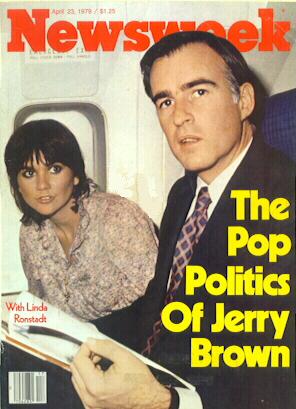
Jerry Brown: A Literary Appreciation


Let us not praise him for leaning left or right, rather for being an uncommon artifact in a world of windblown bluffers.

And let us not confuse this post as a political endorsement of California Governor Jerry Brown (D).

The purpose here is to focus on someone who meets our special highwayscribery threshold for the successful mixing of politics and literature.

Brown, as might be expected, and as this article in "Capitol Weekly" attests to, is comfortable with a book.

The article does a detailed review of the governor's library, which includes Melville's "Billy Budd," a tome on "Christian Monasticism," Kevin Starr's "California," "The Dancing Column: On Order in Architecture," Beat poet Gary Snyder's "The Old Ways," and much more: a well-detailed map of one Renaissance man's mind-stamp.

"Yes highway scribe," you shake your head, "that's very impressive, but how does his literary bent inform his work as governor? Is there a difference between a west Texas bumpkin, and a fellow who sets himself up as an intellectual, when it comes to horse-trading and dispatch of the National Guard?"

Glad you asked and hard to say.

It's not much, but by way of first-hand experience, highwayscribery can say the governor handled the 600 bills sent him by the California legislature, almost all of them at the end of September, differently than other's he's covered including Arnold Schwarzenegger (R), George Deukmeijian (R), or Gray Davis (D).

(We skipped the Wilson years)

Typically, the bills begin to trickle out as they are signed. Some are posted on a governor's web site or announced in press releases by his office, some on the web pages of legislators who sponsored the measures. Reporters also break the news before it's available from the public record.

It's willy-nilly and in tune with the frantic note set by the closing days of the legislature.

This fall, Brown disappeared while those of us waiting on the final disposition of bills we'd followed for months waited and wondered. What was Brown doing? There was a deadline and, with about five days to go, he had only acted on a handful of measures.

The signing and veto messages were finally released in a staggered fashion, smartly grouped by issue. These issues (environment, transportation, public safety, etc.), for the most part, jibed with those Brown campaigned on as priorities.

They were the stuff of PR: "Gov. Brown Signs Bills Protecting California's Lakes, Streams and Coastlines," but were presented in the form of an argument and as the expression of an overall policy. It-

"C'mon highway scribe," you interrupt, "that because Brown know the state machinery inside out. You can't attribute that to the fact he read some Beat poet."

Point taken.

Over time the record has shown art to be no great civilizer, nor artists benighted with special human graces.

In "My Last Sigh," filmmaker Luis Bunuel wrote of the Spanish Civil War:

"I tell myself that all the wealth and culture on the Falangist side ought to have limited the horror. Yet the worst excesses came from them; which is why, alone with my dry martini, I have my doubts about the benefits of money and culture."

This second article from "Capitol Weekly," suggests that Brown's reading has at least informed his veto and signing messages, which, unlike those who came before him, writes his own.

The reporter, Greg Lucas, notes that "Brown has been brusque, pithy, candid, acerbic, droll, trenchant, and even a tad persnickety - sometimes all in the same veto message. His penchant is brevity, simplicity, and precision in word choice."

The article quotes Brown's communications director, Gil Duran, as saying, "He's a writer. he pays very careful attention to what he's saying and how he says it. Why use a word with three syllables when you can use another with only one?"

There are good answers to that, but they'd take up another article and that's not happening.

Here we sought only to examine the literary and legislative habits of one character in current American political theater.

Friday, June 03, 2011

Chile: A Dead Poet's Society?


"I was alone like a tunnel. The birds fled from me,
and night swamped me with its crushing invasion."
Pablo Neruda


The past, they say, dies hard.

And so did poets, musicians, and other dreamers who, decades ago, tried to make Chile a more fair and just society.

You don't read about these things in the United States, which is why highwayscribery's sleepy editorial board has decided to apply the blog's efforts at informing the uninformed.

It was reported in the Spanish daily, "El Mundo," that a Chilean court has ordered an investigation into the death of Pablo Neruda, "The Poet of Love."

Neruda, (pictured at right) for those of you who did not see the Miramax production of "The Postman" (Il Postino), was a rock star poet whose work was known and beloved throughout the world in spite of the fact he was a dyed-in-the-wool communist.

Or because of it. Who knows?

The last of his kind, Neruda typified an early-to-mid-twentieth century intellectual who worked as hard generating beauty as he did justice.

We'll not engage a curricula vitae of his work in poetry and politics here. Suffice it to say, he served in the Chilean senate, ran for the presidency, and secured the Nobel Prize for Literature.

An important and worthwhile man who touched millions.

The poet died 12 days after a sanguinary general by the name of Augusto Pinochet led a Sept. 11, 1973, coup d'etat which overthrew Neruda's close friend, the left-wingy, but legally elected, Salvador Allende (at left).

The poet was ill with advanced prostate cancer at the time. He died, it was officially reported, after his condition was exacerbated by watching his friends being rounded up, tortured, and killed.

President Allende, for his part, was assumed to have shot himself before butchers in the Chilean military could lay their cold and grimy paws on him.

Enough of the dictator's acolytes are either dead or senile now to permit a thoroughgoing examination of these claims without Chile sliding back into the bloody horror of the 1970s and '80s.

To that end, Allende's body was recently exhumed for a forensic examination that will hopefully reveal the true nature of his death.

As for Neruda, his chauffeur, one Manuel Araya, recently told a story that conflicted with the official version peddled once the poet's voice was stilled.

Araya says that Neruda was fine, walking about, and ready to be flee the country in a plane Mexico's then-President Luis Echevarria had put at his disposal.

According to the driver, Neruda sent Araya and other helpers to get some personal belongings. When they returned, the poet was dead, with a big, red, bloody blotch, staining his stomach.

Araya insists the poet was injected with a lethal chemical cocktail by a doctor at the clinic in question.

Not surprisingly, nor out of character with the incoming regime's practices, Araya was then arrested and sent to the national stadium where so many unfortunate progressives met their terrible end.

Some Neruda "experts" have contradicted Araya's account, but it should be pointed out that he was present on the poet's last day, and the biographers and academics were not.

Similarly, it is worth noting that Neruda's death mirrored that of way too many others.

Long after the state was secured, Pinochet's thugs made a habit of showing up to the houses of journalists, writers, and opposition activists in white vans, 'round midnight, and pulling them from the frantic arms of loved ones.

These unfortunates invariably "disappeared," and their bodies are still being searched for to this day.

As for artists, the dictatorship reserved a special disdain and exquisite cruelty.

highwayscribery long ago drafted an intense post designed to memorialize the life and death of singer/songwriter/guitarist Victor Jara.

The post noted that, as the coup unfolded, "Jara was singled out for special treatment. The charming men who saved Chile from godless communism and agrarian reform took delight in breaking his hands and then daring him to sing without the benefit of a guitar.

Few witnesses survived the massacre, so we must trust or distrust the legend which has Jara singing the anthem of Allende’s Unity Party, and being joined in chorus by others awaiting their own turn to be broken on the wheel.

And then they killed him. A pop star."

Which is to say, Araya's story doesn't seem far off the mark at all. Certainly, a Neruda in exile would have been, to say the least, nettlesome for the U.S.-backed dictatorship.

And if it seems to some that this is dredging-up old stuff, chasing water under the bridge, remember that great poets -- like all people -- are entitled to their story.

If Neruda's tale ended with a clinically induced death at the hands of lowly men, then his life and its end take on a more tragic and ironic cast than currently understood.

And that is a swan's song that deserves singing.

Tuesday, April 05, 2011

Mexico and the Death of Poetry

Few are the times we'd choose death as an option when offered others, but one such time is in the case of your own child.

Nobody wants to outlive their kid.

In Mexico, where President Felipe Calderon unleashed a civil war against drug cartels that has claimed the lives of nearly 60,000 since 2006, a lot of parents are burying their children.

Most of them are anonymous and stained with the implication of having been involved in the drug trade.

But last week, the savages whom ply the death hovering over Mexico like a toxic cloud, picked on the child of a man with a voice.

One of the six, ill-fated young fellows found tortured and asphyxiated, in a car south of Cuernavaca, was the son of noted Mexican poet Javier Sicilia who had to get the news while working in the Philippines.

They were killed by gangsters for having alerted authorities to shady behavior for being citizens. On the plane ride home, Sicilia wrote a poem to his boy.

highwayscribery has done his best to translate:

The world is no longer worthy of the word
(El Mundo ya no es digno de la palabra)

They have drowned it inside us
(Nos lo ahogaron adentro)

In the same way they suffocated you
(Como te asfixiaron)

In the same way they clawed out your lungs
(Como te desgarraron a ti los pulmones)

And the pain refuses to leave me
(Y el dolor no se me aparta)

All that is left is a world
(Solo queda un mundo)

For the silence of the just
(Por el silencio de los justos)

For your silence and my silence alone, Juanelo.
(Solo por tu silencio y por mi silencio, Juanelo).

When Sicilia (pictured above) arrived in Mexico he read the poem and added, “It’s my last poem. I can’t write poetry. Poetry no longer exists in me.”

And so another voice, a precious one, was silenced by heartless beings who resist application of the term “human.”

Forgive us if piling politics on top of poetry seems inappropriate in this instance, but that’s what we promise and pledge here at highwayscribery: politics, poetry and prose.

Back in 2006, when the Mexican presidential campaign was in full swing, this blog surprised no one with its full-throated support of the left-wing offering, Manuel Lopez Obrador.

An outspoken advocate for the poor, a strong candidate with a healthy coalition of peasants, unionists, and urban hepcats, he was defeated through a combination of cynical Madison Avenue-styled attacks from his opponents and, when that did not work, screwed by the country’s supreme court.

Sound familiar?

Calderon, a diminutive nerd with an educational pedigree in the U.S., dressed in military garb for his inauguration, in breach of the country’s laws.

It was all downhill from there.

The little soldier that could launched Mexico’s armed forces into a war they were not prepared to win, because many of them were part of the drug transport-selling complex and the rest were under-armed and under-trained when compared with professional assassins their commander and chief had targeted.

You might be asking how the other guy, Lopez Obrador, would have handled the same intractable situation.

Well, and we are speculating here, he might have legalized the drugs and pulled the rug out from under the murderers by taking the risk and, hence, the profit, out of moving the stuff north the border.

Calderon’s predecessor, Vicente Fox, actually did this and had to backtrack in approximately two days time when our last president, Little Bush, told him to do so.

In left-wing fantasy land, we tell ourselves Lopez Obrador, had he been elected, would have legalized the stuff and then held fast.

Because that would have been right.

Mexico has, for too long, paid not only the price of America’s drug habit, but that of its policies, which entail the imposition of prohibitions confected by a moral few on everybody else.

Here in California, over the last year or so, we saw a burgeoning of retail pharmacies made possible by the state’s medical marijuana law, the Obama administration’s announcement that it would not persecute such enterprises, and local authorities’ slowness to respond.

Street life got cleaner. Supply went local, became plentiful and cheaper. The market saw some interesting permutations as people who would have indulged, but had no interest in plumbing dangerous corners for their stash, suddenly could do so in safety.

Now they’re rolling it back into the hands of criminals and those daring enough to do business with them.

The Obama administration, transformative in no way any of us who supported the candidate might have hoped, is falling into the familiar patterns of governance, sticking its federal nose into state affairs or resorting to military tribunals first prescribed by the most rancid and reactionary elements of our political class.

Wars. Drug wars. Oil wars. War wars.

More wars, the death of poetry, and a silencing of the lambs.

Wednesday, March 30, 2011

Update from the Kingdom of Wisconsin

The new Republican majority in Wisconsin must have that state's citizens feeling God-like.

What else when a simple legislative election elevated their status to that of aristocrats empowered by divine right?

We all know the Badger GOPers didn't need a quorum to shove a bill through a Senate in which they were the only party present.

Now, "The Washington Post" reports, they don't have to listen to Wisconsin judges enjoining their pet law to destroy unions from implementation.

By way of background, Judge Maryann Sumi ordered the secretary of state not to publish the law while she sorted out the whole sordid business of its run through half a one-party legislature.

In the democratic world, that means the plaintiffs' claims have merit and all bets are off while the courts consider the matter.

Happens every day.

But in Wisconsin they have Tea Party kingdom, which is anti-government, and means they just seek out another Tea Partier, say, "the legislative reference bureau," have them publish the law, and call it even-Steven: "Your legally appointed/elected judge, our bureaucrat."

Same thing, see?

Judge Sumi tried to make it "crystal clear" she wanted the law iced until the courts have checked out the smelly sausage for themselves.

But the top-down chamber run by Assembly Speaker Jeff Fitzgerald is subject to no checks and/or balances. He said Sumi's ruling, and we quote, "flies in the face of the separation of powers between the three branches of government."

It's not surprising Fitzgerald's got an alternative take that empowers his branch of lawmakers over the one conceived to review what they legislate.

He went on to say, "It's disappointing that a Dane County judge wants to keep interjecting herself into the legislative process with no regard to the state constitution," by which we can assume he thinks the state constitution does not provide for judicial review when affected citizens request it.

If you're wondering whether Fitzgerald's nuts, stop. And bear in mind his brother is the Senate Majority leader; also much put-out by a judge mucking up the majestic legislative process over which the twin-headed ignoramus presides.

And we do mean majestic, because King Scott Walker and the Princes Fitzgerald won an election granting them absolute power to revoke long-held rights and reduce the judicial function to one of (unheeded) advice and consent.

Judge Sumi, according to the article, has suggested the Republican majority might avoid all the ruckus by simply running the law through their House of Lords again, this time with a quorum, while adhering to the state's open meetings statute.

But those things are anathema to kings who poke their fellow citizens in the eye and call it democracy, who subpoena the e-mails of a professor who disagrees with them, while brandishing their freedom-loving pedigrees.

And that's because angry citizens and dissident professors can reap results which run counter to their wishes, and their wishes supersede anything those they govern desire.

Recall.

Tuesday, February 22, 2011

Portrait of a Portrait of a Lady: Anne Theroigne


Sometimes bit players steal the show.

That is not to say the historical figures of Danton, Desmoulins and Robespierre are upstaged by the sparse appearances of Anne Theroigne in Hilary Mantel's
"A Place of Greater Safety: A Novel," but she certainly adds to the conversation.

This post is both about a fascinating person, and about the author's masterful crafting of a secondary book character.

highwayscribery's own novel "Vedette: or Conversations with the Flamenco Shadows,"and posts like "Birthday Card for Tina Modotti," are evidence of an abiding interest in female revolutionaries. No less sanguinary or egalitarian in action and thought, Anne-Josephe Theroigne de Mericourt fits the bill as a subject of interest here.

The goal is not to conflate the scribe's humble effort with an eminence quite so eminent as Mantel (okay, maybe a little), but to assert his rightful place as an admirer and collector of lady iconoclasts.

Not in the girlfriend sense, let us be clear. They are not conducive to a writer's quiet life.

Throughout this expansive novel, Theroigne surfaces, burns and submerges, resurfaces again, lighting the dank torch-lit streets of ragged and unjust Paris...just a few passages, evocative ones, transmit her flavors.

Late Entry

Camille Desmoulins, pamphleteer extraordinaire of the revolutionary cupola, first stumbles upon Anne at a theater audition where she is being humiliated.

It takes place at page 118 of this weighty literary chronicle: "She was about twenty-seven, he thought; small bones darkish brown hair, snub nose. She was pretty enough, but there was something blurred about her features: as though at some time she'd been beaten, hit around the head, had almost recovered, but would never quite."

They exchange barbs before she submits that her future looks bleak. Desmoulins wants to know what she has done in the past when faced with a dry spell between acting stints:

Answer: "I used to sleep with a marquis."

"There you are then."

"'I don't know,' the girl said, 'I get the impression that marquises aren't so free with their money anymore. And me, I'm not so free with my favors.'"

She then establishes herself as a free-ranging woman when divulging her plan to meet contacts in Genoa.

"She put her cheek on her hand. 'My name is Anne Theroigne.' She closed her eyes. 'God, I'm so tired,' she said. She moved thin shoulders inside the shawl, trying to ease the world off her back."

This is an introduction to someone mordant, socially astute, battered, yet unyielding.

She is being marginalized by fading beauty and diminishing artistic talents. Anne Theroigne is afraid and her future actions reveal she thinks the government, or society, or somebody, should do something to arrest her tailspin into the gutter.

(the scribe does not know this for certain, rather has drawn certain conclusions from these first paragraphs written by Hilary Mantel).

This is Theroigne before the revolution. And this is her France.

Once the deluge is unleashed, Desmoulins is out in the street doing what he does best, rousing the rabble. Among them is a "pretty young woman with a pistol in the belt of her riding habit, and her brown hair tied back with a red ribbon and blue one."

These are the colors the ascendant radicals have adopted and she is with them, flowering, purposeful.

Though she may be fading, Anne has been feted by Paris. Has heard a few stories. She has been at the center of the world and lived off making believe she is other, made-up people.

"Her face seemed luminous in the watery light. Now he saw that she was very cold, drenched and shivering. 'The weather has broken,' she said. 'And so much else.'"

The streets are seething and a few hours later she is a portrait of action.

Made for the Part

Underemployed, she certainly has the time. Dramatically gifted, the troubles of 1789 provide her with a proper stage.

"Another night on the streets: at five o'clock, the tocsin and the alarm cannon. 'Now it begins in earnest,' Anne Theroigne said. She pulled the ribbons from her hair, and looped them into the buttonhole of his coat. Red and blue. 'Red for blood,' she said. 'Blue for heaven.' The colors of Paris: blood-heaven."

You can earn respect by cranking out 749 pages of engaging literature, and sometimes, in one brush stroke, give the whole thing a strident coloring that clings.

Blood-heaven.

The highway scribe is not going to pick apart each of the Theroigne-related passages. He is giving you an idea of how the text was read. Your reading would be something else entirely.

Now back to the revolution. In the earliest phases, action draws the highest premium and the new order has jobs for people like Camille and Theroigne. Their gang, a disparate lot of social maladroits and axe-grinders, is somehow in the ascendant.

Centripetal forces continue to drive politics in France; Paris in particular and apart. Louis and Antoinette's days are numbered. The politics of the moment revolve around what to do with them. The king does try. He receives a delegation of women and makes promises.

"Theroigne is outside, talking to soldiers," Mantel revives her anti-heroine. "She wears a scarlet riding habit. She is in possession of a saber. The rain is spoiling the plumes on her hat."

Anne can dress the part, although there is usually some element gone awry, screwing up the perfection of the whole, gaining empathy.

Laying Low

And then she is gone, though not for long. As chaotic Paris tries to sort itself out -- going to the theater, dining, sexing it up, and carrying the enemy's head around on a pike -- Theroigne marshals support and plays her hand in the deadly game for power.

The author finds a character who can tell us they are all -- Danton, Desmoulins, Robespierre, Anne and their revolutionary caste -- "virgins."

Soon enough, she reappears before Desmoulins. "Theroigne swept in. She wore a white dress, and a tricolor sash about her waist. A National Guardsman's tunic, unbuttoned, was draped over her slim square shoulders. Her brown hair was a breeze-blown waterfall of curls; she employed one of those expensive hairdressers who make you look as if you've never been near a hairdresser in your life."

Desmoulin rebuffs her sexual play and denies her a job writing for whatever paper he's editing at the moment. She is damaged goods and he's worried about his reputation.

"As far as he knew, Anne was leading a chaste and blameless life; the strange thing was, that she seemed dedicated to giving the contrary impression. The royalist scandal sheets were not slow to pick up on anything. Theroigne was a gift from God, as far as they were concerned."

So she gets labeled the whore while Danton and Desmoulins enjoy the winning revolutionary's celebrity, notching their belts with every belle at every ball in town.

Anne, by opting for a public life, for demanding a voice, gets tarred and good.

And though she's acting, it's not an act. She's a revolutionary having her say and you can't mistake Theroigne for anything but what she is, except for what she's not.

Which is to say there is ambiguity in this portrait, someone we can both like and not like, a person on whom we are still withholding judgment, but find worthy of attention.

Onward.

The revolution, as most left-wing ventures tend to do, begins consuming itself. First overboard are the dreamers. Mantel tells us, "In May, Theroigne left Paris. She had no money and was tired of the royalist papers calling her a prostitute."

Noblesse Oblige indeed.

"One by one, the "murky layers of her past" had been peeled away to reveal unsavory acts and liaisons that "we've all done when necessity has pressed. It left her open, though, to ridicule and insult."

Anne's plan is to return once the libelers move on, but she suffers the star's burden of being missed: Her scarlet cloak, her "claque" surrounding, pistol swinging as she prowls the National Assembly's corridors looking for deputies to berate.

And so rumors circulated, in her absence, that the Austrians, with whom the revolutionary government is at war (along with the rest of Europe), have abducted her.

"Hope they keep her," is what Lucile, Desmoulins' modern wife and newly minted revolutionary, says. "What gave her the right to be a pseudo-man, turning up at the Cordeliers [that most ferocious of workerist sects] and demanding the rostrum."

Aborted Catfight

Lucille gets a shot at some answers when Theroigne shows up in her tricolored salon. Anne has been released by the Austrians with some money to boot, but she has not come to square-off with a feminine rival. She has come to lament. For her part, Camille's wife is very pregnant.

Their lives have assumed radically different paths, and each prefers the other's.

Theroigne is out of sorts, tattered, not sharp. Lucile can see that the hem is frayed on her scarlet coat, "that the dust on the streets was upon it, that even the red was not so red as it used to be."

Anne is furious that the papers are still spreading lies about her. And Camille is ignoring her.

"He's busy," Lucile covers for her husband.

"Oh yes, I'm sure he's busy. Busy playing cards at the Palais-Royal, busy dining with aristocrats. How can anyone think of passing the time of day with an old friend when there's champagne to be drunk and so many silly, empty-headed bitches to be screwed?"

"Including you," Lucile murmured.

"No, not including me," Theroigne stopped pacing. "Never including me. I have never slept with Camille, or with Jerome Petion, or with any of the other two dozen names the newspapers have named."

The object of a superior social deference, Lucile wouldn't dare stake the same claim.

Theroigne has a particular grudge against a royalist by the name of Louis Suleau, publisher of The Acts of the Apostles who has had his way with her good name in print.

Lucile is miserable in this hellion's company. She explains how Anne's bankrolled release from the Austrians has left her open to the charge of spying.

Theroigne comes a little undone. She admits to having a daughter who died after being left behind. She doesn't know how to write. Things are not going her way, her tribulations multiplying willy-nilly.

Today she has been weak.

Ascendant

But life can turn on a dime, and soon the angriest most radical of the revolutionary factions is literally up in arms, jailing aristocrats left and right, and forcing the king's imprisonment.

Desmoulins is witnessing a riot outside the Royal Palace at Versailles.

“Theroigne had taken charge. Here was her own, her little Bastille.”

She has led an “unfocused rabble” to a place where the royalty are being held against their will, and is breaking in, not to save them, but too...

More revolutionary and feminine portraiture:

“Theroigne wore black; she had a pistol in her belt, a saber in her hand, and her face was incandescent.”

It’s romantic writing, without getting melodramatic. Theroigne is incandescent, but she’s also out of her mind. Camille watches as the fourth prisoner emptied into the mob’s maws is Louis Suleau, the guy who’s been spreading the rumors.

It’s not a heroic moment, but an ugly one. Your own politics determine whether it is necessary.

Leader of the revolution, or some part of it, Desmoulins can do nothing but watch Theroigne, “approach Louis Suleau and say to him something that only he could have heard; Louis put up a hand, as if to say, what’s the point of going into all this now? The gesture etched itself into his mind. It was the last gesture. He saw Theroigne raise her pistol. He did not hear the shot.”

Don't call her a whore.

As all of the revolutionary class learned, direct action is effective, but does have its drawbacks. Among these are constant exposure to committed enemies and overheated throngs.

Some time later, Robespierre asks Camille if he’s heard about “that girl. Anne Theroigne.”

“What’s she done now?”

“She was making the speech in the Tuileries gardens, and a group of women attacked her -- rough women from the public gallery. She’s attached herself to Brissot and his faction, for some reason only she understands -- I can’t believe Brissot is delighted. She found the wrong audience -- I don’t know, but perhaps they thought she was some woman of fashion intruding on their patch.”

She is saved by the dangerous Jacobin scribe Marat, soon to be assassinated himself, at the hands of a “fashion plate.”

Camille laments that she was not killed. “I'll never forgive that bitch for what she did on August 10.”

Robespierre is philosophical. Old schoolmate or not, Suleau “ended up on the wrong side, didn’t he? And then so did she."

Brissot is on the extermination list, so Theroigne’s made a bad political call. It meant Robespierre wouldn't mind taking off her head.

But he does not have to kill Anne, because everyone thinks her own choices are doing it much better. Theroigne, in fact, ended up surviving the stunning violence of her time and living another 25 years.

In the book, Anne is done before the revolution is done. Disappearing as easily as she first appeared, she is an afterthought in the fast-moving paces of a tumultuous situation.

“A few weeks ago in the street Lucile and her mother had seen Anne Theroigne. It had taken them both a moment to recognize her. Theroigne was no longer pretty. She was thin; her face had fallen in as if she had lost some teeth. She passed them; something flickered in her eyes, but she didn’t speak. Lucile thought her pathetic -- a victim of the times. ‘No one could see her as attractive now,’ Annette said. She smiled. Her recent birthdays had passed, as she put it, without incident. Most men still looked at her with interest.”

Not this reader fair lady. Both eyes are on the rebel girl.

Wednesday, February 02, 2011

Letter to the Russian Ambassador


Sent Feb. 2, 2010

Sergey I. Kislyak
Ambassador of the Russian Federation to the United States
1125 16th St. N.W.
Washington D.C.

Dear Mr. Ambassador,

Greetings from Southern California.

The persecution of the Russian artist Aleksei Plutser-Sarno and the art group "Voina," really gets my goat. And as a planetary citizen I urge your government to cease the mindless pursuit of this artist and release those of his allies whom have been detained.

I read about their plight in a "New York Times," article dated January 22.

That's a while back, I know, but maintaining a journalist's post, a literary writing career, and the self-appointed job of skewering repressive governments around the world can really weigh on a guy.

I'm sure the article by the marvelous Ellen Barry -- and please don't harass her, too -- caused you a degree of heartburn.

And it's a good thing, too.

Mr. Plutser-Sarno has some unpleasant things to say about those who govern the Russian Federation. But surely you realize that the official response to such provocations only lends credence to his claims that you guys need to lighten-up and take a democracy class.

You work for him, and his fellow citizens, not the other way around. I say this only because I know Russia is new to democracy and could probably use a few pointers.

And by the way, I think Plutser-Sarno's "installation" involving a 210-foot penis hanging from a St. Petersburg drawbridge, pointed at the state security outfit's building, is the ultimate example of free expression.

Anybody can insult some man on the street. The democratic protection to speech is truly cashiered when we try it on those who make the rules and enforce them with the threat of violence.

You should give the way we do it here in the U.S a go. There are vast spaces of freedom for mouthing-off across our mediatic landscape. As a result, so many people are doing it, that no single voice truly rises above the din, except very stupid ones like Rush Limbaugh and Sarah Palin.

Such people are a stain on the nation's honor, yes, but at least we know where and what they are.

You guys are doing it the old-fashioned way and the result is, well, this letter by somebody one zillion miles away from Russia. See how it doesn't work?

Charging Voina with "organizing a criminal gang," would be laughable, were the artists' lives not getting screwed-up in the process. After all, let's not kid ourselves Mr. Ambassador, when it comes to criminal gangs, you guys set the gold standard.

Your government's support of Chechnya's "president" comes to mind. You know, the one who takes time off from a busy executive schedule to personally torture his political opponents.

I hate that guy.

And not to make political hay out of a tragedy, but those people who blew up the airport in Moscow a few weeks ago and killed dozens of people: THEY were a criminal gang.

Perhaps if your security and police forces weren't so busy harassing mischievous Dadaists, the bomb plot might have been detected before so many innocent people died. Touche.

By the way, I'm going to post this letter on my blog "highwayscribery," just to make a point about how hard it is to keep the truth from circulating.

You know Mr. Ambassador, it is not difficult to find absurdities, cruelties, and meanness in the world with which to fill "highwayscribery."

Just this morning I read in the "New York Times," about the slaughter of 100 dogs in Canada, for no good reason (as if there could be one).

Stories like that, and the Voina artists' plight, say to me that no matter how complicated the world may be, right and wrong are not so hard to distinguish.

Thank you for your time.

the highway scribe

Wednesday, January 19, 2011

The Black Swan Swims


The American right, and its Republican Party, have formulated their talking-point in response to the Tucson tragedy, but its impacts are bigger than any public relations posture.

In the overheated claims of certain right-wing bloggers that President Obama is happy Rep. Gabrielle Gifford (D-Ariz.) was shot, is an implied recognition of the political damage done to the red state revolution before it ever got going.

The shooting represents what author Nassim Nicholas Taleb calls a "Black Swan," which he defines as "an event (historical, economic, technological, personal) that is both unpredicted by some observers and carries massive consequences."

The first, and most immediate consequence of the Tucson massacre, was that it arrested the GOP's envenomed plans to generally make life miserable for what self-appointed inquisitor-in-chief Rep. Darrell Issa (R) calls the most "corrupt administration ever."

Which is a fine example of discourse that is less than courtly.

Congress was suspended after the tragedy and Republicans began to back down, sensing the Democratic caucus had become something of a feral animal. Some of their own had been hurt or killed. A real tragedy had occurred and they were, rightly and demonstrably, very upset.

If not scared.

The long-overdue softening did not end there. Newly minted House Speaker John Boehner (R-Ohio) was criticized for not attending the Tucson memorial service, but he had serious and real business to handle at the House Republicans' retreat.

It was more than a retreat in name, because out of the meeting came an admission that the revolution was not likely to be televised, let alone launched, because
"Washington Democrats still control the Senate and White House," as Boehner noted.

Choosing patriotism over his post-presidential election peevishness, Sen. John McCain (R-Ariz.) penned a mostly gracious column in the "Washington Post," praising the president's speech in Arizona and calling for a greater civility in our public discourse. It amounted to a clarion call that commits Republicans and their Tea Party antagonists/allies to a kind of unilateral disarmament.

When McCain wrote that, "we should be mindful as we argue about our differences that so much more unites than divides us," he was essentially signing pink slips for the media carnival barkers whose daily bread is demonizing Americans who believe in progressive tax rates, peace, and social programs.

McCain tried to take the fire-eaters' toys away, noting that, "I reject the accusation that the president's policies and beliefs make him unworthy to lead America or opposed to its founding ideals."

That's the Tea Party-line, and that group, together with Tea Party Express rider Sarah Palin, came in for a particularly harsh drubbing in the shooting's aftermath.

They'd gotten away with a long run, pushing the limits of acceptable debate, spitting at congress people, disrupting their town halls, lining them up in the crosshairs of graphic gun-sites, and generally doing very well by it.

But the electoral success came at a price, paid mostly by others, and now they're back on their heels instead of attacking.

When some nut makes your words a live and macabre tableaux, when he attempts to blow a Congresswoman's brains out, slays her idealistic aide, and murders a little girl for good measure, you've bought yourself a bumper crop of trouble ripe for the reaping.

The aforementioned talking-point confected by conservatives is that their insults and disparagements of those different them than did not cause the shooting, that he was a "lone, deranged, gunman, acting on his own, without political leanings blah, blah, blah."

That is probably not true, though in an effort at putting his money where his gob is, President Obama unselfishly granted the concession and ended the discussion.

Even if Sarah Palin's gums are still flapping.

Which is somewhat the point. Tea Partiers and their Republican allies know no other way. It is not enough to carry unconcealed weapons to Democratic convocations and pepper they or their constituents with invective.

The ranting and raving must extend to those in their own party, which, in highwayscribery's estimation (and Karl Rove's, however briefly) cost the Republicans a shot at the Senate majority.

To wit:

The "L.A. Times," reported that three different Arizona state Republican apparatchiks were forced to step down in the face of threats and harassment from the little darlings. The shooting has these people spooked, too, and they don't view civic engagement as worth the price of their hides.

And that's a loss.

The paper reported fleeing GOPer Jeff Kolb saying, "This is a group of people who should in theory agree on 95 to 98 percent of things. This is not Republicans against Democrats. I don't get it."

The highway scribe does.

They flouted the rules of democracy in order to gain power and now stand to lose it for the same reason.

And it is not a question of employing the oft-abused lefty-cry of "Fascist" to point out that these are brown-shirt tactics of intimidation and that, if the Tucson madman had no truck with the Tea Party, they've still benefited by his actions where Arizona Republican politics are concerned.

The Tea Party and their allied drum-breaters, spent too much time screwing the empiricist's square hat onto their round heads in an effort to separate their heated diatribes from an event it seemed to prescribe.

But they never denied the heated rhetoric itself, which has left them plainly vulnerable in wake of the Black Swan's swim.

Wednesday, November 24, 2010

Book Report: "Really the Blues," by Mezz Mezzrow


"Really The Blues" demonstrates how it's good having something to do.

Talk about alternative paths. Milton "Mezz" Mezzrow blazed one through the jungle of conformity, "went black," lost time to drugs, fomented early 20th century jazz, became too familiar with jail, but remained focused on a vision.

Were it not for the journey New Orleans jazz made up the Mississippi to Chicago in the early paces of the 20th century, Milton Mezzrow would have had, like all of us, a story to tell, but no audience.

His story stands on three sturdy and utterly novel legs.

One was a total adhesion to all things African-American, or Negro, as they said in his day. A second was the aforementioned passion for a very specific jazz the came up out of the Crescent City and got amplified by his friend, Louis "Pops" Armstrong. The third was a commitment to the manifold virtues of marijuana or, as he alternately referred to it: golden leaf, gauge, muta, and -- highwayscribery's favorite -- muggles.

Tee-hee.

Raised on Chicago's south side, "Mezz" landed in jail early. More stupid than criminal, his interest in the clarinet and saxophone kept the young Jewish jailbird on the up-and-up; focused and ennobled his misbegotten adventures.

His story really takes form upon moving to New York with Gene Krupa and a tiara of future jazz-era jewels in an attempt at storming the music industry's gates with their hot new toy.

Settling in Harlem, establishing his base at the intersection of 133rd Street and Seventh Ave., Mezzrow became the "white mayor," the "link between the races," ambassador for muggles, purveyor and recorder of a unique argot -- the poetry of the proletariat -- "jive."

The Mezz was an influential fellow in his moment and this jive the dominant tongue at the intersection of Cool Street and Downbeat Avenue.

"Really the Blues," came out when Jack Kerouac was digging the music Mezz expounds upon, and it's no fantasy to surmise that the beat poet's jazz-infused prose are not heavily influenced by this book and the way it is told.

We're suggesting, without a hint of accusation, that Kerouac borrowed heavily from, or at least riffed on, the Mezzrow's mostly forgotten text. It's called research and is born of the writer's anthropological duty.

Colorful or operatic, Mezzrow's life was rarely easy, but he kept blowing horns, in and out of jail, searching for a soul-state firmly rooted in his beloved New Orleans jazz.

An uncompromising commitment to the style finally bore fruit in his savoring of Sidney Bechet's "Blues of Bechet" and "The Sheik of Araby."

He describes the epiphany thusly:

"It meant: Life gets neurotic and bestial when people can't be at peace with each other, say amen to each other, chime in with each other's feeling and personality; and if discord is going to rule the world, with each guy at the next guy's throat, all harmony gone -- why, the only thing for a man to do, if he wants to survive, if he won't get evil like all the other beasts in the jungle, is to make that harmony inside himself, be at peace with himself, unify his own insides while the snarling world gets pulverized."

The next natural and positive step for Mezzrow was to team-up with Bechet.

In a publication called "The Record Changer," reviewer Ernest Bornemen said that these tracks, "went back beyond Louis and beyond Bunk Johnson and beyond Buddy Bolden, to the very roots of music, to the cane and the rice and the indigo and the worksongs and the slave ships and the dance music of the inland Ashanti and the canoe songs of the Wolof and Mandingo along the Senegal River."

The review represented Mezz's crowning moment. Not as a professional poo-bah, but as proof that he had reached an important milestone in his musically inspired drive for spiritual wholeness.

Mezzrow closes his by relating how writer Bernard Wolfe convinced him to cough-up an autobiography. Wolfe's word's best describe what's on tap in "Really the Blues."

"Not very many people have gotten a good look at their country from that bottom-of-the-pit angle before, seen the slimy underside of the rock. It's a chunk of Americana, as they say, and should get written. It's a real American success story, upside down: Horatio Alger standing on his head.

"In a real sense, Mezz, your story is the plight of the creative artist in the USA. -- to borrow a phrase from Henry Miller...It's the odyssey of an individualist, through a land where the population is manufactured by the system of interchangeable parts. It's the saga of a guy who wanted to make friends, in a jungle where everybody was too busy making money an dodging his own shadow."

Mission accomplished, Milton.

Wednesday, November 03, 2010

Told You So


Told you so.

Jerry Brown, outspent 6-to-1 by ebay bazillionaire Meg Whitman, made it look easy in returning to the office he left 27 years prior.

Moonbeams ago, we suggested in "Jerry Brown: The Chessman Cometh," that the former Governor-Mayor of Oakland-Treasurer-Attorney General's lackadaisical campaign was born of a sublime knowledge about how the California mind works.

Ka-ching!

Meanwhile Whitman, as we also forecast, spent nearly $180 million in an effort that downgraded her status to late-night joke punchline.

In California, where we happily take stimulus money and give our state a facelift; where we recognize an oil industry-financed campaign against the laws enacted to limit the crap in our air; where we don't allow candidates who accept corporate funding to delude us with cant about liberty and freedom; in California, Democrats won every major state office.

Barbara Boxer, whom highwayscribery never believed was in any kind of trouble, beat a discredited Hewlett Packard executive rather easily, because her actions matched her commercials' claims of standing up for the little guy/gal.

Kamala Harris, defeated L.A. District Attorney Steve Cooley, because L.A. politicians don't fair well statewide and because Cooley's a jerk who spent too much time making hay on the marijuana issue in a place where smoking marijuana's not an issue.

A guy like that isn't going to beat a gal named after the courtesan lover of "Siddhartha" from Herman Hesse's classic novel.

Not in Cali.

Nationally, highwayscribery's prediction the Democrats might hold onto their majority was impacted by this same Blue State insularity and a cash windfall from undisclosed sources that would make Supreme Court Justice Samuel Alito blush, if he had any shame.

Which he doesn't.

But it doesn't really matter. Scott Brown's election to the U.S. Senate last autumn, by the otherwise sane people of Massachusetts, effectively ended the Democrats' ability to halt Republican obstruction in that dysfunctional institution.

In the end, a House majority means squat without a similar advantage in the upper house and the White House.

Two houses beat one every time.

John Boehner can run his legislative paper mill day-in-day-out, passing tax cuts for the rich, de-funding the health care bill, and neutering American unions, but those measures won't get any farther than that chamber's portal.

In an environment befouled by an economic crash that started on the prior administration's watch, the House Democrats lost seats in places where Republicans reliably roost, but withstood challenges in the Senate from low-grade Tea Party picks like Ken Buck in Colorado.

The Tea Party, for all the breathless analysis it has spawned, was a wash last night (though you won't read, hear, or see that anywhere). Yes, Rand Paul won in Kentucky and good luck with that Mitch McConnell.

Kentuckians should only be slightly less ashamed of voting-in a guy whose supporters step on ladies' heads than the Louisianans who reelected a man (Sen. David Vitter) who enjoys a good bordello stop between filibusters.

Can you say political metaphor?

Christine O'Donnell lost in Delaware, where the GOP had a chance to grab a Senate seat until the Tea Party stuck its runny, juvenile nose into the mix. And Joe Miller is losing up in Alaska to someone whose name you had to find on six pages of write-in candidates, consisting mostly of his ornery supporters.

(Don't ask).

Yes, Marco Rubio won in Florida, but, even as a Democrat, the highway scribe would have to admit he was the most compelling candidate in that race.

Parties are good, and loyalty to them useful, but you should always vote for the smartest guy/gal on the ballot.

The founding fathers were kind to minorities. And so it looks like so much thunder on the right, because those voting where less people reside went GOP, while states where everybody lives, and which generate most of the national wealth, ie., New York and California, stayed emphatically Democratic.

In short, this is simply not the end of the world.

As the "Washington Post's" Ezra Klein noted, "A few dozen politicians" lost their jobs last night, but the country won in the long run.

Wrote Klein, "[I]f you see the point of politics as actually getting things done, the last two years, for Democrats, have been a stunning success. Whatever else you say about the 111th Congress, it got things done."

highwayscribery recommends you read his beautifully crafted laundry list of accomplishments.

A "New York Times" conservative stand-in, Ross Douhat, mostly agreed with Klein, to whose article he linked his own post-mortem entitled, "Was It Worth It?"

"Politics," he wrote, "often gets covered as though the legislative sessions are just a long prelude to the real action of election season. But for all the breathless horse-race coverage, elections only matter to the extent that they produce (or forestall) actual legislation. And where the policies of the United States government are concerned, all the ground the Republicans gained tonight doesn't change the fact that what liberals achieved in Barack Obama's first two years in office was more consequential than any conservative victory in recent memory."

It's hard to envision the GOP and its single house delivering like results to a fickle and impatient people in the 12 months before media outlets begin shaping perceptions for 2012.

Congratulations on those new seats, Republicans, but don't get too comfortable.